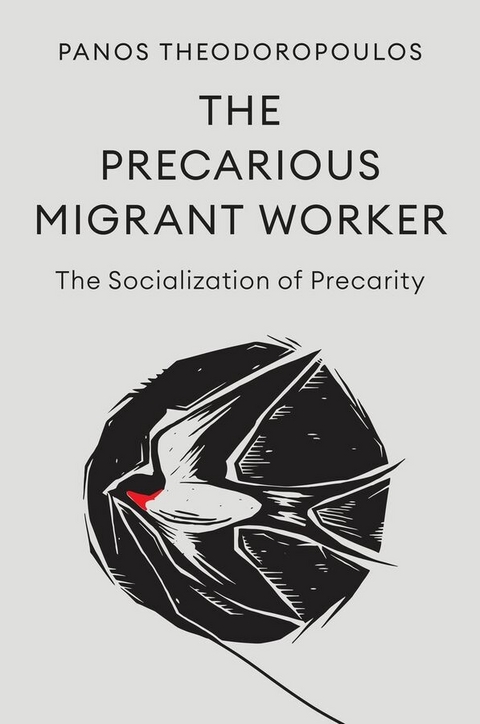
The Precarious Migrant Worker (eBook)
328 Seiten
Polity (Verlag)
978-1-5095-6500-9 (ISBN)
Migrant workers in the West are at the frontline of the precarious condition that is coming to dominate social and economic life in neoliberal societies. Yet despite the highly insecure and exploitative working conditions they routinely face, labour mobilizations by precarious workers are rare.
In this immersive portrait of the daily realities of precarious migrant labour, Panos Theodoropoulos found work in Glasgow's warehouses, factories and kitchens to uncover the ways that precarity is lived and contested. Connecting the realms of structure, subjectivity and culture, his analysis shows that precarity not only dictates workers' labour conditions, but socializes them in an individualist, survival-oriented struggle that erodes solidarities and enforces its own neoliberal logic. Crucially, however, precarity and the wider neoliberal culture are unable to erase workers' material awareness and experience of class injustice. This points to the possibility of forging strong connections and methods of resistance, firmly grounded in the lives and communities of precarious workers.
Blending interviews, ethnographic notes and social theory, The Precarious Migrant Worker offers a unique glimpse into our increasingly precarious social reality and will be a valuable resource for scholars, students and activists interested in issues of migration, precarity and resistance.Panos Theodoropoulos is a sociologist affiliated with the University of Glasgow, and co-founder of the radical theory platform Interregnum.
Migrant workers in the West are at the frontline of the precarious condition that is coming to dominate social and economic life in neoliberal societies. Yet despite the highly insecure and exploitative working conditions they routinely face, labour mobilizations by precarious workers are rare. In this immersive portrait of the daily realities of precarious migrant labour, Panos Theodoropoulos found work in Glasgow s warehouses, factories and kitchens to uncover the ways that precarity is lived and contested. Connecting the realms of structure, subjectivity and culture, his analysis shows that precarity not only dictates workers labour conditions, but socializes them in an individualist, survival-oriented struggle that erodes solidarities and enforces its own neoliberal logic. Crucially, however, precarity and the wider neoliberal culture are unable to erase workers material awareness and experience of class injustice. This points to the possibility of forging strong connections and methods of resistance, firmly grounded in the lives and communities of precarious workers. Blending interviews, ethnographic notes and social theory, The Precarious Migrant Worker offers a unique glimpse into our increasingly precarious social reality and will be a valuable resource for scholars, students and activists interested in issues of migration, precarity and resistance.
Introduction
Alexia works while her son is dreaming. She dreams – can she remember her dreams? – while her son is at school. She wakes up around two hours before he returns; just enough time to cook something and share a few words about their day. She will then take a strong painkiller to ignore the pangs in her back and in the nerves of her arms, get dressed, and slide into Bradford’s neglected landscape for another twelve-hour night shift.
She worked next to me for a few nights. I was struck by her smile: a ray of light amidst decay, the hope that was the last to rise from Pandora’s box. Nobody smiled here. The production line and the earplugs never allowed for much conversation, but the mere existence of a smile in this environment that was built to drown all manifestations of human warmth was soothing. Yet, one night, the smile crumbled. Unnoticed by everyone else – the production line, alongside stifling conversation, is also proficient at stifling humanity – and while maintaining her excellent production rate, Alexia was crying. At around 2 a.m., during our single half-hour break, I approached her and asked what was wrong. Thinking back, there was probably a selfish element to my impulse – I needed that smile to survive the shift – as much as genuine care. Her reply was simple and devastating: ‘I am thinking about my son. And I am thinking that by the time I will be able to really get to know him, and enjoy him, I will have already grown old.’
We are in a large printing press in Bradford. The year is 2014 or 2015. All around us, the howl of machines and the icy glare of fluorescent lights, contrasting sharply with the darkness outside the windows. Throughout the warehouse’s many crevices, precarious migrant workers – mostly from Eastern Europe, their high-vis vests harshly demarcating their status as non-permanent staff – are feverishly working in the different stages of printing, cutting, checking and packaging a beloved product that features in every British household: greeting cards. Their colourful layout and cheery inscriptions are so contradictory to the anxiety, alienation and exploitation that are imbued within them that, when looked upon from the perspective of a worker, it seems as if they are jeering at you: as if they are laughing at your pain. I do not remember the precise words on the greeting cards. However, the feeling of revulsion towards them is unforgettable.
This is one of the first jobs I accessed as a migrant worker in the UK, and one that I would keep on returning to when I couldn’t find anything better. It is a place where the asphyxiating working conditions ensure a constant turnover of staff, and the company is always in need of more fodder for its production lines. This fodder – us – is sourced from two employment agencies, who have stretched their tentacles deep into migrant communities and supply a steady stream of precarious, dependent, disoriented and exploitable migrant workers. Production never stops, which is why this dreary machine needs workers around the clock: there is almost always work, and, in those pre-Brexit years, there are always more migrant workers coming in that need it. As is typical for these types of jobs, we are paid the minimum wage.1
Everyone working alongside me is a migrant. We are all on zero-hours contracts, our lives tethered to the business’s epochal fluctuations. If they receive a big order, we might be required for a few weeks; in the months before Christmas, work is almost guaranteed. We also know that we can be replaced at any moment. As non-permanent staff, we cover most of the posts that are designated as ‘unskilled’ – for me, this mostly means packing the various greeting cards in plastic sleeves, separating the cards from each other after they have been printed, or wrapping thousands of cards on pallets, ready for them to be shipped to stores across the UK. We don’t really speak to the permanently employed, British workers operating the printing machines, and, when we enter the workplace, they rarely acknowledge us. We are but objects that cover a specific need – once it has been addressed, we are thrown back into the labour agency’s pool of available workers, to be shunted to the next workplace. Sometimes the agency will call you without warning and demand that you present yourself for work in a few hours; once that phone rings, you must be ready to upturn your whole life. If you aren’t, they’ll just hire someone who is.
Our presence there is contingent upon our performance. The production line’s pace does not stop, and if you cannot keep up you are replaced. Yet, we have more reasons to overexert ourselves than simply fulfilling this specific order: we know that there is a small, yet important, chance that we might impress one of the British managers and be offered a permanent contract. We also know that we are building a reputation: if the agency considers us to be ‘good workers’, our chances of being offered future jobs before other workers are increased. We are therefore compelled to work as efficiently as possible, with the constant threat of dismissal – and the latent sense of competition amongst ourselves – saturating our every moment.
Precarity breeds insecurity and feeds a constant cycle of anxiety that is intrinsically disempowering. One day, I noticed a problem in my payslip: I had been deducted half an hour’s wage for every shift I had done that week. Upon asking the agency why this deduction had been made, they told me that it was because I received two unpaid, half-hour breaks per shift. Yet, the workplace only allowed us one half-hour break. When I asked my fellow temporary colleagues about this, it emerged that everyone had been subject to the same deduction and had received the same explanation. I was dismayed at their acceptance of the situation: wage theft was perceived as just another lousy aspect of a generally lousy job. The most common response was a shoulder shrug: ‘they do that all the time’. When I suggested bringing a union in to help us reclaim our stolen wages, I was met with anxiety, abjection and apathy: nobody was willing to even consider doing anything that they feared would jeopardize their already precarious job. This is when I began to think about the socialization of precarity: it seemed that precarity does not simply ensure a steady supply of insecure workers – it creates a specific type of worker. Once you realize that everyone else has accepted these conditions – and that you are therefore alone in opposing them – you quickly fall in step.
The cameras above our heads that monitor our performance transmit the image of workers bent over a production line, hastily performing nimble movements and sorting through thousands of cards an hour. What they don’t show are the physical and mental outcomes of this labour: the thumping aches in our calves and the back pains that result from standing and performing very specific, repetitive motions for twelve hours; the blue veins staining the backs of our legs; the bleeding fingers from the paper-cuts, which we must quickly bandage up and keep on working; the piercing fatigue that stems from monotonous night-shifts; the deep, dark circles around our eyes; the papery taste of dust that we inhale; the humiliation of being screamed orders at by the British managers, of not being able to respond in the way that they deserve; the gnawing sense of stress at having to blindly fight for a job that is never guaranteed; the fear of falling sick and missing a shift, which means that you will be replaced; the anxiety every single evening of waiting for the bus, knowing that if it is late, your tardiness will at the very least cost you an hour’s wage, or, at the very worst, your job; and the misery of isolation that comes with working the night-shift. Finally, they don’t show the critical mental recalibrations that operate inside our heads in order to allow us to survive these conditions whilst maintaining our senses of self and dignity.
As I am struggling to ignore my throbbing joints, I wonder if the consumers realize the amount of pain that has gone into these greeting cards. I wonder whether a greeting card tainted with blood from a frantic finger has ever made it through the checks, and whether it has been opened by someone wanting to surprise a person they love. I wonder whether, if people knew about the pain behind the words, they would still buy them. To my dismay, I think I know the answer.
Will Alexia ever give her son a card for his birthday?
This is another book about migration. Migration is as old as humanity itself, inseparable from our collective history, firmly engrained in our myths and our collective narratives. It involves a departure and a becoming, an immersion into the unknown that leads to knowledge and experience, an adventure that also longs for stability. It is personal, and yet reflective of wider, collective forces; simultaneously, it is spurred by those collective forces and is still – always – intimately personal. Its essence contains the material of our greatest stories, and no matter how much we discuss it, analyse it, historicize it, glorify or vilify it, it still stands shoulder to shoulder with war and love in capturing our imaginations in a way few themes can. Our need to wrap our heads around its constantly changing nature leads to the development of archetypes, in a doomed attempt to control the uncontrollable: the Economic Migrant; The...
| Erscheint lt. Verlag | 13.6.2025 |
|---|---|
| Sprache | englisch |
| Themenwelt | Wirtschaft ► Volkswirtschaftslehre |
| Schlagworte | 9781509564989 • 9781509564996 • 9781509565009 • amazon worker exploitation • amazon workers exploited • can immigrants unionize? • can immigrant workers unionize? • can migrants unionize? • can migrant workers unionize? • do migrant workers have rights? • migrant undocumented workers • migrant unionization rates • migrant worker unions • panagiotis Theodoropoulos • panos Theodoropoulos • precarious migrant worker • precarious migrant workers • reliance on illegal migrants • rise of insecure work • rise of precarious work • socialization of precarity • Theodoropoulos • undocumented workers • what jobs have most undocumented workers? • what rights do migrant workers have? |
| ISBN-10 | 1-5095-6500-0 / 1509565000 |
| ISBN-13 | 978-1-5095-6500-9 / 9781509565009 |
| Informationen gemäß Produktsicherheitsverordnung (GPSR) | |
| Haben Sie eine Frage zum Produkt? |
 EPUB (Adobe DRM)
Kopierschutz: Adobe-DRM
Adobe-DRM ist ein Kopierschutz, der das eBook vor Mißbrauch schützen soll. Dabei wird das eBook bereits beim Download auf Ihre persönliche Adobe-ID autorisiert. Lesen können Sie das eBook dann nur auf den Geräten, welche ebenfalls auf Ihre Adobe-ID registriert sind.
Details zum Adobe-DRM
Dateiformat: EPUB (Electronic Publication)
EPUB ist ein offener Standard für eBooks und eignet sich besonders zur Darstellung von Belletristik und Sachbüchern. Der Fließtext wird dynamisch an die Display- und Schriftgröße angepasst. Auch für mobile Lesegeräte ist EPUB daher gut geeignet.
Systemvoraussetzungen:
PC/Mac: Mit einem PC oder Mac können Sie dieses eBook lesen. Sie benötigen eine
eReader: Dieses eBook kann mit (fast) allen eBook-Readern gelesen werden. Mit dem amazon-Kindle ist es aber nicht kompatibel.
Smartphone/Tablet: Egal ob Apple oder Android, dieses eBook können Sie lesen. Sie benötigen eine
Geräteliste und zusätzliche Hinweise
Buying eBooks from abroad
For tax law reasons we can sell eBooks just within Germany and Switzerland. Regrettably we cannot fulfill eBook-orders from other countries.
aus dem Bereich