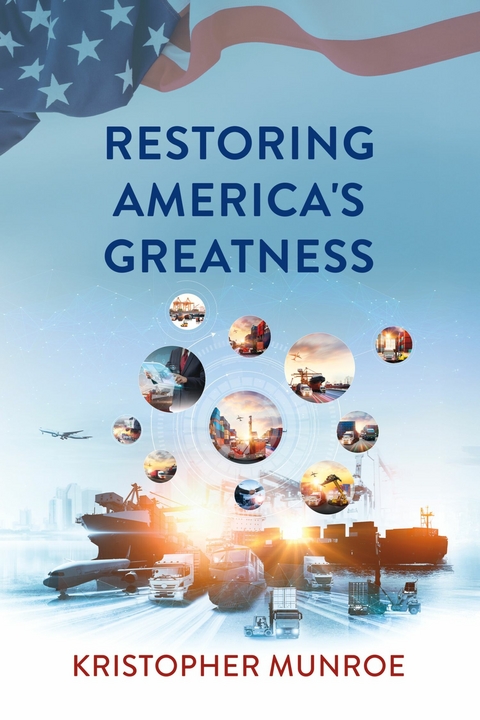
Restoring America's Greatness (eBook)
172 Seiten
Bookbaby (Verlag)
979-8-3178-0147-2 (ISBN)
Kristopher Munroe is from a small town of Dighton, Massachusetts. He lived there all his life until recently, when he moved to Swansea, Massachusetts. Throughout his life, he had a vision of American exceptionalism and was often very proud of his heritage. He loves how his town was honest and hard-working, as it shaped his perception of what America stands for. Growing up, his parents always had his back and taught him the value of hard work, which is why Kristopher strongly admires laborers and feels they are just one of the many reasons America is so great. Currently, Kristopher is working on a 60-credit MBA program at Northeastern University, where he has learned all about logistics and international business. He has worked with many fellow students in learning the complexity of the supply chains and has reviewed many case studies on manufacturing companies' problems with their manufacturing. During his undergraduate program at Johnson & Wales University, he frequently took classes on global and political science to better understand the global market and American interest in the world. Part of his career has been focused on supply chains, particularly clinical supply. In the future, he hopes to help American companies manufacture in the United States and help train a skilled workforce that will make America the dominant country in manufacturing again.
Can America be a rich nation if we don't create our own goods and services? The short answer is no; we may be a wealthy country now, but that won't last long if manufacturing continues to decline. In this book, it will be no secret that reshoring has its problems and is preventing companies from making the switch to manufacturing in America. In "e;Restoring America's Greatness,"e; you will learn the damaging effects politics has had on American manufacturing and how policies such as the North America Free Trade Agreement (NAFTA) were an unfair deal for the American people. You will also discover how environmental policies are a hinderance to our success since they only give the upper hand to the competition. Additionally, the author will also argue the need for major protectionism and how corporations are taking advantage of the American people by offshoring their manufacturing and services. Many believe that the need for free trade outweighs the impact on businesses, which would be hurt by foreign companies importing cheaper goods. But, too many Americans are getting the short end of the stick in the globalized economy. Manufacturing is potentially the most important industry in the United States economy, and it needs to be protected.
Chapter 1
What Is the Argument for Free Trade Absolutism?
Why do many people talk about free trade as an absolutely good thing? They say that free trade is always good for the working people in this country. As we know, we are much richer than we were before, and we have a lot of material wealth in the United States. Our homes are filled with things that previous generations could not imagine. We have many clothes and little plastic widgets we do not need. A lot of people look around and tell you how great this is. It may be very convenient to have a $15 coffee maker that you can replace when it breaks.
Many intellectuals also agree that free trade will undoubtedly benefit both countries and that there will only be winners. “Economists have talked for years about trade, free international trade, being a positive for economies worldwide, both at home and abroad. This is something that economists universally believe.”1 The idea of free trade has been around for a very long time. A prevalent book on free trade is The Wealth of Nations by Adam Smith, initially published in 1776. Free trade has been universally praised and written about. The theories of free trade absolutism sound great but lack impractical implications that hinder their success. Many good ideas look great on paper, but they fail to produce positive effects in practice.
Many people are pushing for free trade or doing so in the goodness of their hearts. However, many of the other actors are acting in their own self-interest in attempting to persuade the law of the American people to pursue ideas that are not in their best interests. It is a popular folktale that tells that as a forest shrinks, the trees kept voting for the axe because its handle was made of wood.
Furthering the topic on The Wealth of Nations by Adam Smith, a point he makes in his book that speaks to many of the current-day problems for many Americans is that inflation and wages have been decreasing. “A man must always live by his work, and his wages must at least be sufficient to maintain him They must, even upon most occasions, be somewhat more; otherwise, it would be impossible for him to bring up a family, and the race of such workmen could not last beyond the first generation” (Wealth of Nations, p. 28). I would take a good look around you. When many people struggle to find good-paying jobs, they will not be able to raise a family and therefore suffer and will be unable to bring forth future generations.
You may often hear the statement that free trade is fair trade as well. These are other ways people express their free trade absolutism. There are a lot of think tanks in the United States that do fascinating work on the powers of free trade. Consider this argument from the Heritage Foundation: “Free trade improves people’s living standards by allowing them to consume higher- quality goods at less expensive prices. In the 19th century, British economist David Ricardo showed that any nation that focuses on producing goods with a comparative advantage will be able to get cheaper and better goods from other countries in return.”2 The basic argument here is that free trade makes goods cheaper, allowing countries to use their unique skills to produce goods at a lower price. As we know, in the United States, many cheap foreign products fill our lives, such as cheap clothes and other electronics and many other things we use daily. Allowing free trade gives people access to these items that cannot be produced in the country at an affordable price. What are the cheap things that improve our standard of living, such as cheap coffee makers and other household items? If you look around at many things in today’s life, you will see that the quality of many items is less efficient than just a few decades ago. We are surrounded by cheap Junk that fills our days.
In the 1950s, we had quality items that would outlive us, from high-quality fabrics to household appliances made of metal and wood that turned into cheap plastics that would break within a few years. On a personal account, I remember my grandfather telling me that it is more expensive to buy cheap because you will have to replace them repeatedly This inferior quality came to my realization of buying cheap dress shoes that would fall apart after one year instead of investing in a quality pair that would last a decade, if not longer. My grandfather left me many tools upon his passing, and many of the things he gifted me were quality products made in the United States. Some of my favorite tools were Craftsman sockets and wrenches that are at least 30 years old and work perfectly. I prefer them to the cheap Harbor Freight tools that are thin and feel much cheaper than the ones my grandfather left me. My grandfather was a wise man who always knew what to do and had a plan. He worked as a truck driver and raised a family in a small town in Massachusetts. My grandfather would also make almost all of the furniture in his house, because he could control the quality and feel of the product when he made it. He may be gone now, but his furniture lives on in the homes of many family members, and many still have some of his creations. He created high-quality furniture the old-fashioned American way. That is why they are still around and will most likely outlive me.
In the case of free trade being suitable for the American people, the Heritage Foundation furthers this argument by saying competition is good for business: “Producers benefit as well. In the absence of trade barriers, producers face greater competition from foreign producers, and this increased competition gives them an incentive to improve the quality of their production while keeping prices low to compete.”1 The argument here is the assumption that the company will become more competitive and have to work harder to compete with the larger foreign companies, but as we can see in our backyard, this is not the case. Look at many Main Streets in towns across America. We can see that Walmart has destroyed many small businesses with predatory practices that lower the prices to force competition out of business, creating an oligopoly where they are and sometimes even a monopoly. Small shops across America have been destroyed by large corporations that import cheap goods, and they will try to say that these goods are equal to those made of better material. Would you only want to live in a world of three stores: Walmart, Amazon, and Target? I certainly would like a variety of places to shop, and many of the owners, and people I know, work hard to bring me the best products at a fair price.
As we can see from the products we buy, quality is merely a perception; there is no universal definition. Look at everything you buy; everything says “premium” or “excellent quality,” even the bargain things. It’s hard for actual quality goods to stand out because consumerism has made many customers focus on the quality of products when they are not experts on discerning real quality against junk.
These loose barriers with tariffs have indeed helped people afford more than they have in the past, but you need quality goods to keep replacing them and have something of value to give to your children or sell in a personal financial crisis. Furthermore, look at stores like Ikea. They are the biggest supplier of cheap Products that people use to furnish their ever-more-expensive house. They spend so much money on their house and apartment to fill it with stylish, cheap garbage. The materials they use to build this furniture will not last and has virtually no resale value. Just because people have more items doesn’t mean their standard of living is increasing. There is a predominant false mentality that the quantity of items means a higher standard of living.
Many people lay out ideas of morality. According to the CATO Institute, free trade has many moral obligations to the people. It supposedly serves their first argument by Daniel Griswold: “A man or woman engaged in honest work has a basic right to enjoy the fruits of his or her labor. It is a violation of my right to property for the government to forbid me to exchange what I produce for something produced by a fellow human being, whether the person I’m trading with lives across town or the ocean. Protectionism is a form of stealing, a violation of the Eighth Commandment and other prohibitions against theft.”3 The Idea that free trade prevents an individual from trading with people overseas is absurd at its face value. Not many Americans are trading directly with people overseas, and trading within the same state is already subject to its own tax, such as sales tax and laws that prevent the sale of certain goods. The labor of the individual is protected to trade freely; you can start a small business or choose to work for whom you like. It’s not that we need more individual trading across the state. The argument that trade is a moral argument is valid. We should have policies that protect our citizens. It is not just a requirement that the government acts in the interest of their own people. They must take an oath to protect and serve their own people. This oath ensures that they will protect the country not only from foreign and domestic threats but also from economic and free trade threats.
Another moral argument by the CATO Institute is that free trade restricts the government’s power: “There is no compelling moral reason why a small group of politicians should decide what goods and services an individual can buy with his earnings based solely on where those products are produced. By diffusing economic decisions as broadly as possible, free trade...
| Erscheint lt. Verlag | 3.6.2025 |
|---|---|
| Sprache | englisch |
| Themenwelt | Wirtschaft |
| ISBN-13 | 979-8-3178-0147-2 / 9798317801472 |
| Informationen gemäß Produktsicherheitsverordnung (GPSR) | |
| Haben Sie eine Frage zum Produkt? |
 EPUB (Ohne DRM)
Größe: 2,8 MB
Digital Rights Management: ohne DRM
Dieses eBook enthält kein DRM oder Kopierschutz. Eine Weitergabe an Dritte ist jedoch rechtlich nicht zulässig, weil Sie beim Kauf nur die Rechte an der persönlichen Nutzung erwerben.
Dateiformat: EPUB (Electronic Publication)
EPUB ist ein offener Standard für eBooks und eignet sich besonders zur Darstellung von Belletristik und Sachbüchern. Der Fließtext wird dynamisch an die Display- und Schriftgröße angepasst. Auch für mobile Lesegeräte ist EPUB daher gut geeignet.
Systemvoraussetzungen:
PC/Mac: Mit einem PC oder Mac können Sie dieses eBook lesen. Sie benötigen dafür die kostenlose Software Adobe Digital Editions.
eReader: Dieses eBook kann mit (fast) allen eBook-Readern gelesen werden. Mit dem amazon-Kindle ist es aber nicht kompatibel.
Smartphone/Tablet: Egal ob Apple oder Android, dieses eBook können Sie lesen. Sie benötigen dafür eine kostenlose App.
Geräteliste und zusätzliche Hinweise
Buying eBooks from abroad
For tax law reasons we can sell eBooks just within Germany and Switzerland. Regrettably we cannot fulfill eBook-orders from other countries.
aus dem Bereich