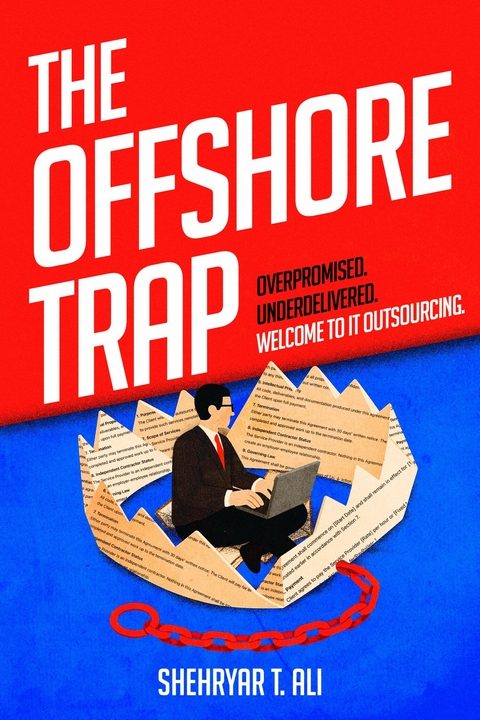
The Offshore Trap (eBook)
264 Seiten
Publishdrive (Verlag)
978-0-00-081009-0 (ISBN)
'The Offshore Trap' is a groundbreaking exposé that rips open the trillion-dollar IT outsourcing industry, revealing a sophisticated system of deception that spans continents and costs businesses billions annually.
Written by industry veteran Shehryar T. Ali, who has uniquely operated on both sides of the outsourcing equation, this manuscript delivers an unfiltered insider's perspective that will transform how readers view technology development.
The narrative unfolds across four parts, beginning with 'The Seduction and Capture,' where Ali reveals how vendors use psychological manipulation, credential fraud, and kickback schemes to land contracts.
Readers follow real-world disasters, like the hospital network that paid $2.7 million for a patient management system so fundamentally broken it mixed up medication records-endangering lives.
In 'Extraction and Concealment,' Ali meticulously documents the machinery of systematic billing fraud, deliberate knowledge withholding, and the 'Agile Theater' that creates the illusion of progress while delivering nothing of value.
He dissects how a $125/hour 'senior architect' often makes only $10-15/hour, with the rest disappearing into elaborate markup schemes.
'Captivity and Control' exposes how vendors engineer technical, contractual, and support traps specifically designed to make escape financially ruinous.
Ali reveals the deliberate creation of security backdoors as 'client retention features,' and the elaborate shell company structures that prevent accountability.
The final section, 'The Reckoning and Collapse,' examines why this exploitative system persists despite decades of spectacular failures-while forecasting how AI will ultimately dismantle the entire outsourcing empire by eliminating the information asymmetry and labor arbitrage that fueled its growth.
Throughout the manuscript, Ali weaves powerful human stories: the healthcare startup founder whose company was systematically bled dry; the CTO whose career was destroyed by a vendor relationship they inherited; and the internal whistleblowers who risked everything to expose the truth.
At approximately 50,000 words, this manuscript delivers a masterclass in industry exposé-combining investigative rigor with narrative drive and first-person authority.
'The Offshore Trap' will appeal to business leaders, technology professionals, and general readers fascinated by how sophisticated deception operates at enterprise scale in plain sight.
CHAPTER 1
THE OUTSOURCING EMPIRE
It was 2 AM when the CEO’s call jolted me awake. “Everything’s gone,” she whispered, voice cracking with panic. “The entire platform is down. We’re losing $10,000 an hour. Users are flooding social media with complaints. And our vendor’s team? They’ve vanished.”
This wasn’t my first middle-of-the-night disaster call. Not even close.
Thirty minutes later, I walked into their downtown office, stepping into what looked like a war zone. The executive team had been there for 36 straight hours—wild-eyed, running on nothing but adrenaline and fear. Empty coffee cups and takeout containers littered the conference room table. The CTO hadn’t slept in days, his normally crisp appearance now a rumpled mess as he stared blankly at dashboards showing a flatlined e-commerce platform.
“We trusted them completely,” he said, not even looking up as I entered. “Paid them $1.3 million for a ‘world-class, enterprise-grade platform.‘ Now look at us.”
Their vendor—one of India’s most prestigious IT services firms, with gleaming offices in Bangalore and slick salespeople in New York—had built their entire e-commerce infrastructure on technical quicksand. The system had collapsed precisely when they needed it most: during their biggest seasonal promotion, with transaction volume at its peak.
The “dedicated senior team” that had impressed them during sales pitches was nowhere to be found. The promised “24/7 emergency support” was responding with canned messages about “investigating the underlying issue” while the company bled money by the minute.
What I uncovered over the next 72 hours was what I always find: an architectural house of cards that was never designed to handle real-world load. Security so fundamentally compromised it would make first-year computer science students cringe. Documentation that was either nonexistent or deliberately obscured. And the code itself—thousands upon thousands of lines, copied wholesale from open-source libraries and stitched together by developers who clearly didn’t understand what they were implementing.
The senior architects who’d dazzled executives during the sales cycle had never written a single line of code for the project. The “rigorous quality assurance process” mentioned in every status report had never actually been performed. The “dedicated team of senior engineers” they’d been introduced to over Zoom existed only as names on an organization chart, while the actual work was done by a rotating cast of junior developers making $8–10 an hour.
I’ll never forget the moment when I showed the CEO the evidence. We were alone in her office, looking at the repository logs that proved beyond doubt that the “20-person team” they’d been paying for was actually 3–5 inexperienced developers, none of whom matched the resumes they’d been shown.
“How is this even legal?” she asked, her voice barely audible.
It’s a question I’ve heard hundreds of times. And the answer is both simple and infuriating: this elaborate con persists because the entire system is built on information asymmetry, geographic barriers, and jurisdictional firewalls specifically designed to make accountability impossible.
The Trillion–Dollar Shell Game
While you were sleeping, IT outsourcing quietly ballooned into a $540 billion global industry. That’s not just big money—that’s nation-state money, economy-warping money. This isn’t some niche business practice. It’s a global empire built on promises that rarely match reality, with tentacles stretching across six continents.
I’ve spent over two decades as the consultant companies call when their outsourced projects implode—when the glossy promises evaporate, when the systems collapse, when millions have been spent with nothing functional to show for it. I’ve sifted through the wreckage of more failed projects than I can count, and the patterns aren’t just similar; they’re identical.
The case that changed everything for me happened back in 2015. A U.S.A based hospital network had spent $2.7 million on a patient management system from one of the “Big Four” Pakistani IT firms. After 18 months of development, what they got was a catastrophe—a system so fundamentally broken that it had to be shut down hours after launch when it began randomly mixing up patient medication records.
As I dug through the technical disaster, what I found wasn’t just incompetence—it was systemic fraud. The vendor had sold them a “custom solution built specifically for your unique healthcare requirements.” What they actually delivered was a barely-modified version of a generic system they’d built for an entirely different industry, with healthcare features bolted on by developers who had no medical domain knowledge whatsoever.
The documentation claimed extensive HIPAA compliance testing. None had been performed. The security audit reports in the project repository were completely fabricated—literally copied from another project with only the client name changed. The “senior healthcare IT architect” who had impressed executives during sales calls had logged a total of six hours on the project, all during the initial kick-off phase.
When I presented my findings to the hospital board, the room fell completely silent. Then the CFO spoke: “So you’re telling me we paid nearly three million dollars for a system that was never going to work? That they knew would not work?”
That’s exactly what had happened. And I’ve seen the same scenario play out countless times since, across every industry, company size, and geographic region. This isn’t occasional bad behavior by a few unethical players. It’s the standard operating procedure for a global industry that’s perfected the art of promising one thing while delivering another.
These systemic failures aren’t limited to my personal experiences. The Hertz lawsuit against Accenture made headlines when they sued for $32 million over a website redevelopment that failed spectacularly. The suit alleged Accenture didn’t even create a responsive design that worked across devices—in 2019! That’s like hiring a professional chef who forgets to turn on the oven. When a global corporation with sophisticated procurement processes and deep pockets gets taken for a ride this egregious, imagine what happens to organizations with fewer resources and less leverage.
What makes this machine so effective is how it systematically exploits information gaps. Most clients can’t effectively evaluate what they’re buying. They can’t distinguish between genuine technical complexity and manufactured obfuscation. They have no way to verify that the impressive “senior architects” they meet during sales pitches will ever touch their project. And by the time they discover the truth, they’ve invested so much that starting over seems impossible.
The sales pitch has evolved brilliantly over time. Fifteen years ago, it was nakedly about cost: “Our developers are 70% cheaper!” Now that same pitch comes wrapped in consultant-speak: “strategic partnership,” “digital transformation enablement,” “global talent access strategy.” Same cheap labor, fancier wrapping paper.
And governments don’t just allow this system—they actively subsidize it. India’s SEZ (Special Economic Zone) tax breaks. The Philippines’ PEZA incentives. Poland’s technology investment credits. These countries aren’t accidentally becoming outsourcing hubs. They’re funding an industry that promises their citizens a path to the middle class, even if that means systematically misleading Western clients about capability and quality.
I’ve witnessed this firsthand in government meetings where officials explicitly discuss how to position their country’s “cost advantage” to attract foreign clients, while showing zero concern about whether those clients actually receive the value they’re paying for.
COVID was the outsourcing industry’s golden opportunity. When remote work became normalized overnight, the geographic barriers that had previously given clients pause suddenly vanished. If your developer can work from home in Denver, why not Delhi? The floodgates opened, and the industry expanded into markets that had previously been resistant.
This isn’t just a shell game operating at global scale—it’s one moving billions of dollars through a system that consistently promises one thing while delivering another, all while making accountability virtually impossible.
Different Accents, Same Scam
Each geography has perfected its own unique marketing wrapper while delivering the identical dysfunctional model.
Latin America has mastered the “we’re practically in your office” narrative. Their sales pitch oozes with promises of timezone alignment, cultural compatibility, and “true Agile collaboration.” The Dominican Republic, Mexico, and Colombia firms will spend hours explaining how their 9-to-5 overlaps perfectly with yours – as if sharing working hours somehow prevents their developers from copying open-source code and billing you for “custom development.” That status call might be more convenient, but...
| Erscheint lt. Verlag | 22.5.2025 |
|---|---|
| Sprache | englisch |
| Themenwelt | Wirtschaft ► Betriebswirtschaft / Management ► Unternehmensführung / Management |
| ISBN-10 | 0-00-081009-6 / 0000810096 |
| ISBN-13 | 978-0-00-081009-0 / 9780000810090 |
| Informationen gemäß Produktsicherheitsverordnung (GPSR) | |
| Haben Sie eine Frage zum Produkt? |
 EPUB (Adobe DRM)
Größe: 6,9 MB
Kopierschutz: Adobe-DRM
Adobe-DRM ist ein Kopierschutz, der das eBook vor Mißbrauch schützen soll. Dabei wird das eBook bereits beim Download auf Ihre persönliche Adobe-ID autorisiert. Lesen können Sie das eBook dann nur auf den Geräten, welche ebenfalls auf Ihre Adobe-ID registriert sind.
Details zum Adobe-DRM
Dateiformat: EPUB (Electronic Publication)
EPUB ist ein offener Standard für eBooks und eignet sich besonders zur Darstellung von Belletristik und Sachbüchern. Der Fließtext wird dynamisch an die Display- und Schriftgröße angepasst. Auch für mobile Lesegeräte ist EPUB daher gut geeignet.
Systemvoraussetzungen:
PC/Mac: Mit einem PC oder Mac können Sie dieses eBook lesen. Sie benötigen eine
eReader: Dieses eBook kann mit (fast) allen eBook-Readern gelesen werden. Mit dem amazon-Kindle ist es aber nicht kompatibel.
Smartphone/Tablet: Egal ob Apple oder Android, dieses eBook können Sie lesen. Sie benötigen eine
Geräteliste und zusätzliche Hinweise
Buying eBooks from abroad
For tax law reasons we can sell eBooks just within Germany and Switzerland. Regrettably we cannot fulfill eBook-orders from other countries.
aus dem Bereich