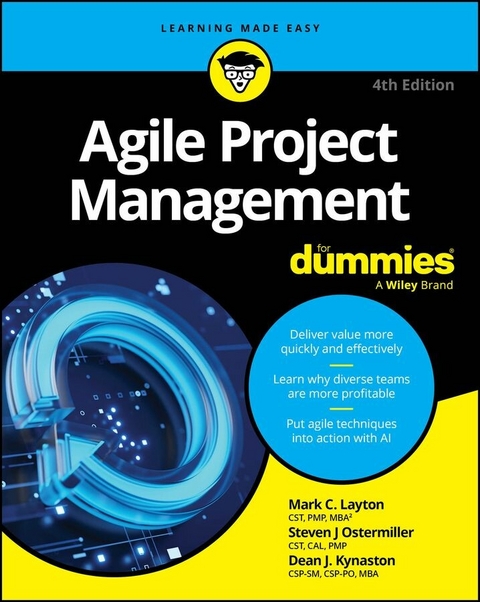
Agile Project Management For Dummies (eBook)
670 Seiten
For Dummies (Verlag)
978-1-394-33210-6 (ISBN)
Put agile techniques into practice to boost your efficiency and effectiveness
Agile Project Management For Dummies introduces you to the planning and execution approaches that can help you complete projects more quickly, with higher quality and using fewer resources. For companies in any industry-not just software development-agile project management reduces waste and increases transparency, while addressing customers' ever-changing requirements. This book lays out the principles and practices of agile techniques in jargon-free language that anyone can understand. You'll learn all the important terms, tools, and concepts, so you can infuse agility into your projects right away. Create a product roadmap and prepare for product launches with ease, thanks to this Dummies guide.
- Discover why agile techniques are so popular with many of the world's most successful businesses
- Use agile principles to manage the scope, time, cost, team dynamics, quality, and risk of any project
- Learn how Inclusion makes organizations more agile, and create an agile-friendly culture of flexibility and productivity within your team and organization
- Explore how the agile world is changing with new developments like artificial intelligence
Agile Project Management For Dummies is great for project and product managers, as well as anyone in any industry who wants get up to speed on how to be more agile.
Mark C. Layton is an organizational strategist and past PMI chapter president with more than 20 years' experience in the agile transformation field.
Steven J Ostermiller is a business agility guide and community leader helping organizations maximize value delivery.
Dean J. Kynaston is a coach, Certified Scrum Professional, and organizational agile transformation leader.
Put agile techniques into practice to boost your efficiency and effectiveness Agile Project Management For Dummies introduces you to the planning and execution approaches that can help you complete projects more quickly, with higher quality and using fewer resources. For companies in any industry not just software development agile project management reduces waste and increases transparency, while addressing customers' ever-changing requirements. This book lays out the principles and practices of agile techniques in jargon-free language that anyone can understand. You'll learn all the important terms, tools, and concepts, so you can infuse agility into your projects right away. Create a product roadmap and prepare for product launches with ease, thanks to this Dummies guide. Discover why agile techniques are so popular with many of the world's most successful businesses Use agile principles to manage the scope, time, cost, team dynamics, quality, and risk of any project Learn how Inclusion makes organizations more agile, and create an agile-friendly culture of flexibility and productivity within your team and organization Explore how the agile world is changing with new developments like artificial intelligence Agile Project Management For Dummies is great for project and product managers, as well as anyone in any industry who wants get up to speed on how to be more agile.
Chapter 1
Modernizing Project Management
IN THIS CHAPTER
Understanding why project management needs to change
Seeing how agile project management is becoming agile product management
Finding out about agile product development
Agile is a descriptor — an adjective synonymous with adaptive, nimble, flexible, responsive, and lightweight. When we speak of becoming more agile as an organization or taking an agile approach, we are referring to all these terms.
Agile describes an organization’s capability to sense and respond or the approach a project team takes to adapt a plan to a customer’s needs or to evolve with changing technologies. Agility in project management focuses on early delivery of customer value as well as continuous improvement of the product being created and the processes used to create the product. At its essence, an agile mindset seeks customer-centric scope flexibility, team input, and the delivery of well-tested, valuable products that reflect customer needs.
In this chapter, you find out why agile approaches to software development project management emerged in the mid-1990s and why these ways of working and thinking have caught the attention of project managers, customers, and executives. While business agility is popular in software product development, agile values, principles, and techniques (which you learn about in the following chapters) apply in a multitude of industries and applications — not just software. This chapter also explains the advantages of agile approaches over historical project management methodologies.
Project Management Needed a Makeover
A project is a planned program of work that requires a definitive amount of time, effort, and planning to complete. Projects have goals and objectives and often must be completed in some fixed period of time and within a certain budget.
Because you're reading this book, you're likely a project manager or someone who initiates projects, works on projects, or is affected by projects in some way. Agile approaches are a response to the need to modernize project management. To understand how agile approaches are revolutionizing product development, it helps to know a little about the history and purpose of project management and the issues that projects face today.
The origins of modern project management
Projects have been around since ancient times, from the Great Wall of China to the invention of the internet. As a formal discipline, project management as we know it has been around only since the middle of the twentieth century. Around the time of World War II, researchers around the world were making major advances in building and programming computers, mostly for the United States military. To complete those projects, they started creating formal project management processes. The first processes were based on step-by-step manufacturing models the United States military used during World War II.
People in the computing field adopted these step-based manufacturing processes because early computer-related projects relied heavily on hardware, with computers that filled entire rooms. Software, by contrast, was a smaller part of computer projects. In the 1940s and 1950s, computers could have thousands of physical vacuum tubes but fewer than 30 lines of programming code. The 1940s manufacturing process used on these initial computers is the foundation of what has become known as waterfall in project management.
In 1970, a computer scientist named Winston Royce wrote “Managing the Development of Large Software Systems,” an article for IEEE (Institute of Electrical and Electronics Engineers) that described the phases of a waterfall in project management. The term waterfall was coined later, but the phases, even if they are sometimes titled differently, are essentially the same as defined by Royce:
-
1. Requirements
2. Design
3. Development
4. Integration
5. Testing
6. Deployment
On waterfall projects, you move to the next phase only when the prior one is complete — hence the name waterfall.
Pure waterfall project management — completing each step in full before moving to the next step — is actually a misinterpretation of Royce's suggestions. Royce identified that this approach was inherently risky and recommended developing and testing within iterations to create products — suggestions that were overlooked by many organizations that adopted waterfall.
Variations of waterfall were the most common project management approaches in software development until it was surpassed by improved approaches based on agile values and principles around 2008.
The problem with the status quo
Computer technology has, of course, changed a great deal since the last century. Many people have a computer on their wrist with more power, memory, and capabilities than the largest, most expensive machine that existed when people first started using waterfall methodologies.
At the same time, the people using computers have changed as well. Instead of creating behemoth machines with minimal programs for a few researchers and the military, people create hardware and software for the general public. In most countries, almost everyone uses a tablet or smartphone, directly or indirectly, every day. Software runs our cars, our appliances, our homes; it provides our daily information and daily entertainment. Even young children use computers — generative artificial intelligence is helping them develop mobile apps and professional-looking graphics and videos. The demand for newer, better products is constant and rapidly evolving.
Somehow, during all this growth of technology, processes stagnated. Software developers are still using project management methodologies from the 1950s, and all these approaches were derived from manufacturing processes meant for the hardware-heavy computers of the mid-twentieth century.
Today, traditional projects that do succeed often suffer from one problem: scope bloat, the introduction of unnecessary product features. Think about the software products you use every day. For example, the word-processing program we're typing on right now has many features and tools. Even though we write with this program every day, we use only some of the features all the time. We use other elements less frequently. And we have never used quite a few features — and come to think of it, we don't know anyone else who has used them, either. The features that few people use are the result of scope bloat.
Scope bloat appears in all kinds of software, from complex enterprise applications to websites that everyone uses. Figure 1-1 shows data from a Standish Group study that illustrates just how common scope bloat is. In the figure, you can see that 80 percent of requested features are infrequently or never used.
© Copyright 2017 Standish Group
FIGURE 1-1: Actual use of requested software features.
Figure 1-1 illustrates the waste resulting from traditional project management processes. Traditional project managers and stakeholders believe that change is not welcome mid-project, so their best chance of getting a potentially desirable feature is at the start of a project. Therefore, they ask for
- Everything they need
- Everything they think they may need
- Everything they want
- Everything they think they may want
The result is the bloat in features that results in the statistics in Figure 1-1.
The problems associated with using outdated management and development approaches are not trivial. These problems waste billions of dollars a year. It’s no wonder billions of dollars are lost in waterfall project failures (see the sidebar, “Software project success and failure”), especially if success means every feature delivered on time, on budget, and with perfect quality.
Over the past three decades, people working on projects have recognized the growing problems with traditional project management and have been working to create a better model.
Modern impacts of artificial intelligence
Emerging technologies affect project management and product development, and artificial intelligence has had one of the most significant effects we’ve seen to date. Artificial intelligence, or AI, is the theory and development of computer systems able to perform tasks that normally require human intelligence, such as visual perception, speech recognition, decision-making, and translation between languages. AI is transforming project management by reducing the administrative work required by teams, enabling them to redirect their effort, time, and thinking to be more creative, lateral, and inclusive.
While AI creates many benefits, there are also precautionary implications. AI isn’t here to replace everything people can do. For instance, AI can handle scheduling, task tracking, and data analysis, but human intuition from experience is vital in high-stakes decisions. The benefits and precautions will be discussed throughout this book.
Modern impacts of diversity and inclusion
Rapidly advancing technologies such as AI as well as increased mobility and access to information have not only opened us up...
| Erscheint lt. Verlag | 23.5.2025 |
|---|---|
| Sprache | englisch |
| Themenwelt | Sachbuch/Ratgeber ► Beruf / Finanzen / Recht / Wirtschaft ► Wirtschaft |
| Wirtschaft ► Betriebswirtschaft / Management ► Projektmanagement | |
| Schlagworte | Agile • agile business • agile development • agile handbook • Agile methodology • Agile projects • agile scrum • Agile Tools • DevOps • Project Management • Project management guide • project manager book • scrum dummies • Scrum Guide • Scrum Master |
| ISBN-10 | 1-394-33210-6 / 1394332106 |
| ISBN-13 | 978-1-394-33210-6 / 9781394332106 |
| Informationen gemäß Produktsicherheitsverordnung (GPSR) | |
| Haben Sie eine Frage zum Produkt? |
 EPUB (Adobe DRM)
Kopierschutz: Adobe-DRM
Adobe-DRM ist ein Kopierschutz, der das eBook vor Mißbrauch schützen soll. Dabei wird das eBook bereits beim Download auf Ihre persönliche Adobe-ID autorisiert. Lesen können Sie das eBook dann nur auf den Geräten, welche ebenfalls auf Ihre Adobe-ID registriert sind.
Details zum Adobe-DRM
Dateiformat: EPUB (Electronic Publication)
EPUB ist ein offener Standard für eBooks und eignet sich besonders zur Darstellung von Belletristik und Sachbüchern. Der Fließtext wird dynamisch an die Display- und Schriftgröße angepasst. Auch für mobile Lesegeräte ist EPUB daher gut geeignet.
Systemvoraussetzungen:
PC/Mac: Mit einem PC oder Mac können Sie dieses eBook lesen. Sie benötigen eine
eReader: Dieses eBook kann mit (fast) allen eBook-Readern gelesen werden. Mit dem amazon-Kindle ist es aber nicht kompatibel.
Smartphone/Tablet: Egal ob Apple oder Android, dieses eBook können Sie lesen. Sie benötigen eine
Geräteliste und zusätzliche Hinweise
Buying eBooks from abroad
For tax law reasons we can sell eBooks just within Germany and Switzerland. Regrettably we cannot fulfill eBook-orders from other countries.
aus dem Bereich