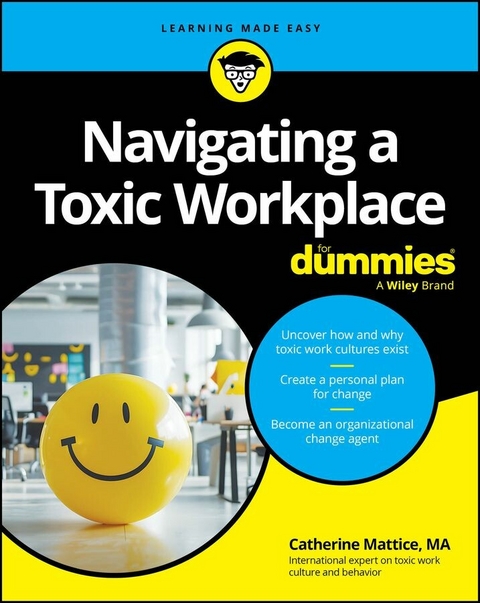
Navigating a Toxic Workplace For Dummies (eBook)
487 Seiten
For Dummies (Verlag)
978-1-394-32614-3 (ISBN)
This friendly, compassionate guide is the antidote to workplace toxicity
Toxic workplaces can be bad for your mental and physical health, and they're one of the leading causes of employee turnover. Navigating a Toxic Workplace For Dummies explores what causes work environments to turn sour, and what you-as an employee, manager or leader-can do about it. You'll learn why people engage in toxic behavior like bullying, harassment, exclusion, and disrespect at work. More importantly, you'll gain the tools and skills to counter that behavior with positivity. Every individual, at every level of an organization, can make a difference in detoxifying the workplace. Don't let the stress of your job environment weigh you down. Let this Dummies guide teach you to support yourself and the people around you.
- Discover the signs and symptoms of a toxic workplace
- Learn why people do toxic things, and how to protect yourself
- Get advice on reporting harassment and other behaviors to HR
- Understand how to make organizational change as a manager, HR or leader
- Lead your organization in a detoxification campaign
Navigating a Toxic Workplace For Dummies is a must for anyone who has dealt with or is currently dealing with a toxic situation at work, as well as managers and leaders committed to resolving toxic situations.
Catherine Mattice is the founder and CEO of Civility Partners, a consulting firm that has helped over 250 companies detoxify and create respectful and productive workplace cultures. Her 60+ online courses have reached over three million global learners, and she's a widely regarded keynote speaker on building civil company culture.
Chapter 1
Recognizing a Toxic Workplace and Its Consequences
IN THIS CHAPTER
Understanding the prevalence of toxic workplaces
Discerning between toxic and tough people and behavior
Outlining the damage and consequences of toxic behavior
Welcome to the first step in navigating yourself, your team, or your organization through a toxic work environment. You may be reading this book because you personally feel like you’re working on a toxic team or for a toxic boss or because you have a friend or family member who does. You may be here because you’re a manager or human resources (HR) professional in a toxic work environment and you seek to drive positive change where you can. Or, you may be here because you’re a top leader in an organization with a toxic work culture, and you want to understand what needs to happen to turn it around.
No matter who you are and where you fall in your organization, this book is for you. It can help you understand how and why company culture evolves into a toxic situation, why people engage in toxic behavior, and most importantly, what to do about it. The journey begins in this chapter as you jump right into understanding the prevalence of toxic workplaces and the damage they cause.
Defining the Prevalence of Toxicity in the Workplace
Toxic behavior is a pattern of behavior and communication that hurts other people. It disrupts relationships and organizational functioning. Chapter 2 breaks down a long list of behaviors that people may consider toxic, including incivility or annoying behavior that drains energy, all the way up to harassment and violence. Some could argue that the word toxic is a little strong for uncivil behavior, and if they’re referring to a one-time offense, then they may be right. But ongoing patterns of incivility from one person on a team seep into other people’s patterns of behavior as they subconsciously learn it’s acceptable to be uncivil. Incivility begets more incivility, and over time, that behavior evolves and escalates into something worse.
You may be working in or managing a toxic workplace culture if
- There’s high turnover all around you.
- You can’t sleep at night because you dread going to work.
- You or others don’t feel safe to share your thoughts and ideas because you worry about being persecuted, made to feel stupid, or that someone will steal credit.
- Internal communication is not working, so you don’t always get the right information on time to do your job, you feel confused about goals or who’s supposed to be doing what, you don’t receive feedback often enough or rarely receive positive feedback, or when you share ideas with leaders to make improvements in the work or culture, you have no idea what happens to them.
- You observe cliques, favoritism, or exclusion so that there’s a group of “cool kids” versus not, or a group of individuals who seem to work at ostracizing others through gossip, hazing, or avoiding.
- You’re burned out by long hours, unrealistic expectations, glorification of the people who run themselves ragged with no concern for their well-being, and just generally dealing with a negative vibe all day, every day.
- You feel micromanaged, bullied, and blamed for problems that aren’t your fault or where you haven’t been given the chance to suggest or implement solutions.
In short, if it feels like you’re in a toxic work culture, you probably are.
Discerning toxic from challenging behavior
When I started my consulting business over 15 years ago, I was shocked at how many people told me there wasn’t a market for consulting in the realm of workplace bullying and creating positive, thriving workplaces. Back then, harassment had started to gain some traction, but it seemed people believed that was where toxic behavior ended.
As I explored the content and information about workplace bullying available online, I came across some forums and articles in which HR professionals were seriously pushing back that bullying even existed. They said things like, “This is a fad that will fade away, just like diversity and inclusion,” and, “Just because someone’s boss yells at them, it doesn’t make the boss a bully. It’s usually an underperforming employee filing the complaint anyway.”
Thankfully, these days, identifying toxic behavior is not such an uphill battle — but we still have a long way to go. Diversity, equity, and inclusion, or DEI, has taken a beating over the last few years as many organizations report it hasn’t made much difference in their business or bottom line. Women still make less than men, and people of color are hard to find among the top ranks of businesses. People who have a disability, are gay or transgender, are immigrants, or are over 50 all struggle to find themselves in a welcoming environment where they’re accepted and valued.
The comments from those HR professionals do highlight something important, however. Everyone has various tolerance levels for toxic behavior, and you can work with a challenging boss who drives you nuts, but that doesn’t necessarily mean your boss is toxic. Review Table 1-1 to get some clarity on the differences between tough and toxic boss behavior.
TABLE 1-1 Tough Versus Toxic Behaviors
| Tough Boss | Toxic Boss |
|---|
| Has high expectations but provides coaching using goals and rewards Gives credit when it’s due May motivate with “tough love” but doesn’t cross the line into abuse When work or tasks change, explains why the change is occurring Offers constructive feedback | Has high expectations and “freaks out” when people don’t meet them with yelling or shaming Takes credit for others’ ideas and work product “Motivates” with arbitrary and punitive punishment, abuse, and fear Assigns work or task changes without explanation, causing confusion and fear Offers criticism, insults, and humiliation |
Of course, toxic bosses aren’t the only reason people may feel like they’re in a toxic work culture. It’s safe to say that most people have either worked in, currently work in, or will work in a toxic environment at some point in their lives.
For example, the Society for Human Resources Management (SHRM) has been monitoring civility for a few years and states that 58 percent of U.S. workers believe society is uncivil and that workers collectively experience 223 million acts of incivility each day. (See www.shrm.org/topics-tools/topics/civility for more information.) The American Psychological Association’s (APA) 2023 Work in America survey found that 22 percent of employees experienced harassment in the 12 months prior to the survey, and 19 percent described their workplace as toxic. And 38 percent of women reported sexual harassment and 38 percent of LGBTQ+ members faced physical, verbal, or sexual harassment. (See www.apa.org/pubs/reports/work-in-america/2023-workplace-health-well-being for more information). In fact, research from all around the world over the last 40 years on topics like workplace bullying, abusive conduct, sexual harassment, and more all point to one thing — toxicity is a real problem.
Toxic behavior can range from ongoing incivility to workplace violence and everything in between.
Understanding how to positively influence your workplace
A company’s top leadership team is responsible for creating a positive work environment in which people can thrive. Unfortunately, CEOs and their executive teams often ignore the problem, believe it’s not that bad without any data to back up that belief, or even in spite of survey data that says otherwise, don’t want to confront a valued employee who engages in bullying because they’re conflict avoidant, or get distracted by other priorities like earning revenue or building the customer base. Indeed, many studies can be found online that show employers are out of touch with the workplace culture. The 2023 APA survey found, for example, that 77 percent of respondents in a toxic workplace agreed that their employer believed the workplace was healthier than it actually was.
Thankfully, the ol’ cliché that culture comes from the top is only partly true. You have the ability to influence the world around you. You don’t have to wait for leadership to declare they’ll make change before you do anything about it. You can influence your team, and you get to control your narrative. You get to decide how to react and respond to the toxicity around you.
The most important step you can take in that endeavor is to start working on your self-talk and resilience. You get to decide how you want to react to the situation you’re in, as no one is responsible for your happiness but you. Once you decide to take control, you can prioritize your self-care, mental health, and well-being and develop a plan to overcome the challenge your toxic workplace presents. Review Chapter 8 for more ideas on developing resilience.
The second important step to take is to embrace your power and opportunity to influence your situation. You have to start by...
| Erscheint lt. Verlag | 22.5.2025 |
|---|---|
| Sprache | englisch |
| Themenwelt | Sachbuch/Ratgeber ► Beruf / Finanzen / Recht / Wirtschaft ► Wirtschaft |
| Wirtschaft | |
| Schlagworte | Conflict Resolution • Crisis Management • executive assistant books • HR books • Human resources books • Leadership • Leadership Book • Mentoring • toxic leadership • toxic work environment • toxic workplace • Workplace Harassment • Workplace inclusion |
| ISBN-10 | 1-394-32614-9 / 1394326149 |
| ISBN-13 | 978-1-394-32614-3 / 9781394326143 |
| Informationen gemäß Produktsicherheitsverordnung (GPSR) | |
| Haben Sie eine Frage zum Produkt? |
 EPUB (Adobe DRM)
Kopierschutz: Adobe-DRM
Adobe-DRM ist ein Kopierschutz, der das eBook vor Mißbrauch schützen soll. Dabei wird das eBook bereits beim Download auf Ihre persönliche Adobe-ID autorisiert. Lesen können Sie das eBook dann nur auf den Geräten, welche ebenfalls auf Ihre Adobe-ID registriert sind.
Details zum Adobe-DRM
Dateiformat: EPUB (Electronic Publication)
EPUB ist ein offener Standard für eBooks und eignet sich besonders zur Darstellung von Belletristik und Sachbüchern. Der Fließtext wird dynamisch an die Display- und Schriftgröße angepasst. Auch für mobile Lesegeräte ist EPUB daher gut geeignet.
Systemvoraussetzungen:
PC/Mac: Mit einem PC oder Mac können Sie dieses eBook lesen. Sie benötigen eine
eReader: Dieses eBook kann mit (fast) allen eBook-Readern gelesen werden. Mit dem amazon-Kindle ist es aber nicht kompatibel.
Smartphone/Tablet: Egal ob Apple oder Android, dieses eBook können Sie lesen. Sie benötigen eine
Geräteliste und zusätzliche Hinweise
Buying eBooks from abroad
For tax law reasons we can sell eBooks just within Germany and Switzerland. Regrettably we cannot fulfill eBook-orders from other countries.
aus dem Bereich