


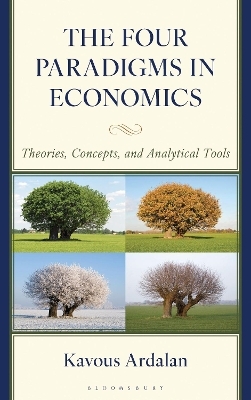
The Four Paradigms in Economics
Theories, Concepts, and Analytical Tools
Seiten
2025
Rowman & Littlefield (Verlag)
978-1-6669-7784-4 (ISBN)
Rowman & Littlefield (Verlag)
978-1-6669-7784-4 (ISBN)
In this book, the author discusses four paradigms and shows how they view and explain any economics phenomenon differently, and therefore, together they provide a broader and deeper understanding of the economic phenomenon under consideration.
In The Four Paradigms in Economics: Theories, Concepts, and Analytical Tools, Kavous Ardalan demonstrates how these four paradigms explain any economics phenomenon differently, and therefore, together they provide a broader and deeper understanding of the economic phenomenon under consideration. The main theme of The Four Paradigms of Economics is that social theory can usefully be conceived in terms of these four key paradigms: functionalist, interpretive, radical humanist, and radical structuralist. The four paradigms are founded upon different assumptions about the nature of social science and society, and therefore, provide different explanations of any phenomenon. The book also looks at the major prevailing schools of thought in economics (Neo-Classical Economics, New Institutional Economics, Behavioral Economics, Austrian Economics, Post-Keynesian Economics, Institutional Economics, Social Economics, Radical Economics, and Marxist Economics) from the point of view of the four paradigms and locates them within the four-paradigm framework.
In The Four Paradigms in Economics: Theories, Concepts, and Analytical Tools, Kavous Ardalan demonstrates how these four paradigms explain any economics phenomenon differently, and therefore, together they provide a broader and deeper understanding of the economic phenomenon under consideration. The main theme of The Four Paradigms of Economics is that social theory can usefully be conceived in terms of these four key paradigms: functionalist, interpretive, radical humanist, and radical structuralist. The four paradigms are founded upon different assumptions about the nature of social science and society, and therefore, provide different explanations of any phenomenon. The book also looks at the major prevailing schools of thought in economics (Neo-Classical Economics, New Institutional Economics, Behavioral Economics, Austrian Economics, Post-Keynesian Economics, Institutional Economics, Social Economics, Radical Economics, and Marxist Economics) from the point of view of the four paradigms and locates them within the four-paradigm framework.
Kavous Ardalan is professor of finance at Marist University, Poughkeepsie, New York, U.S.A.
Table of Contents
Introduction
Chapter 1. Four Paradigms
Chapter 2. Structure of a Paradigm
Chapter 3. Human Nature: A Multi-Paradigmatic View
Chapter 4. Rationality: A Multi-Paradigmatic View
Chapter 5. Ethics: A Multi-Paradigmatic View
Chapter 6. Environmental Governance: A Multi-Paradigmatic View
Chapter 7. Schools of Thought in Economics: A Multi-Paradigmatic View
Conclusion
About the Author
Index
| Erscheinungsdatum | 24.07.2025 |
|---|---|
| Zusatzinfo | 3 b/w Figures |
| Sprache | englisch |
| Maße | 152 x 230 mm |
| Gewicht | 820 g |
| Themenwelt | Wirtschaft ► Allgemeines / Lexika |
| Wirtschaft ► Volkswirtschaftslehre ► Makroökonomie | |
| ISBN-10 | 1-6669-7784-5 / 1666977845 |
| ISBN-13 | 978-1-6669-7784-4 / 9781666977844 |
| Zustand | Neuware |
| Informationen gemäß Produktsicherheitsverordnung (GPSR) | |
| Haben Sie eine Frage zum Produkt? |
Mehr entdecken
aus dem Bereich



aus dem Bereich
Buch | Softcover (2024)
Schäffer-Poeschel (Verlag)
CHF 48,95
Makroökonomie, Wirtschaftspolitik und nachhaltige Entwicklung
Buch | Hardcover (2022)
Vahlen (Verlag)
CHF 69,70
Kontroversen, Daten und Fakten zur Nachhaltigkeit
Buch | Softcover (2025)
Kohlhammer (Verlag)
CHF 54,60


