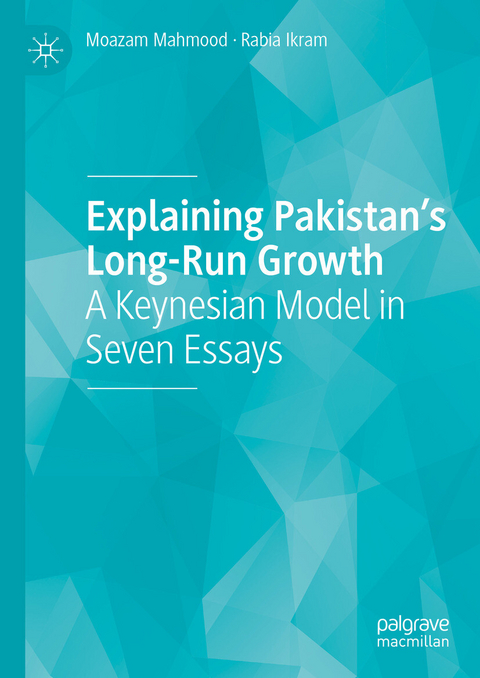
Explaining Pakistan’s Long-Run Growth (eBook)
230 Seiten
Springer Nature Switzerland (Verlag)
978-3-031-86677-7 (ISBN)
This book explains the behaviour of output and its growth over time. It does so by deliberating over a choice among three fundamental models—the Samuelson-Swan-Solow neoclassical model, the Harrod-Domar model and the Keynesian model—to choose one fit for purpose. The criteria for goodness of fit are some mathematical properties of growth models. The model chosen for meeting these properties is the Keynesian model, which is a bit better on all these counts.
The chosen Keynesian model of aggregate demand has been used to explain the observed behaviour of Pakistan’s long-run growth of gross domestic product (GDP). Pakistan’s GDP growth over the long run between 1973 and 2019 is marked by a statistically significant hiatus at approximately 1992. Pre-1992, GDP growth on trend approximated 6 percent per annum. Post-1992, it drops on trend to approximately 4 percent per annum. Applied to the hiatus in Pakistan’s GDP growth after 1992, this model shows that pre-1992, high GDP growth is explained by high investment growth, paired with a low marginal propensity to consume (MPC), while post-1992, lowered GDP growth is explained by lower investment growth paired with a higher MPC. Thus, Pakistan’s higher GDP growth pre-1992 was investment-led while its lower GDP growth post-1992 has been consumption-led.
The book then traces the causality of these trends in investment and consumption to a falling trend in public investment. This is linked to an increasingly austere regulatory policy environment, while private investment fails to step in and maintain aggregate investment.
| Erscheint lt. Verlag | 14.5.2025 |
|---|---|
| Zusatzinfo | XV, 230 p. 47 illus., 37 illus. in color. |
| Sprache | englisch |
| Themenwelt | Wirtschaft ► Betriebswirtschaft / Management ► Unternehmensführung / Management |
| Wirtschaft ► Volkswirtschaftslehre | |
| Schlagworte | Development Economics • Economic consumption • economic growth theory • External economic vulnerability • Fiscal Deficits • government expenditure • Keynesian demand led model • Public investment growth |
| ISBN-10 | 3-031-86677-0 / 3031866770 |
| ISBN-13 | 978-3-031-86677-7 / 9783031866777 |
| Informationen gemäß Produktsicherheitsverordnung (GPSR) | |
| Haben Sie eine Frage zum Produkt? |
 PDF (Wasserzeichen)
DRM: Digitales Wasserzeichen
Dieses eBook enthält ein digitales Wasserzeichen und ist damit für Sie personalisiert. Bei einer missbräuchlichen Weitergabe des eBooks an Dritte ist eine Rückverfolgung an die Quelle möglich.
Dateiformat: PDF (Portable Document Format)
Mit einem festen Seitenlayout eignet sich die PDF besonders für Fachbücher mit Spalten, Tabellen und Abbildungen. Eine PDF kann auf fast allen Geräten angezeigt werden, ist aber für kleine Displays (Smartphone, eReader) nur eingeschränkt geeignet.
Systemvoraussetzungen:
PC/Mac: Mit einem PC oder Mac können Sie dieses eBook lesen. Sie benötigen dafür einen PDF-Viewer - z.B. den Adobe Reader oder Adobe Digital Editions.
eReader: Dieses eBook kann mit (fast) allen eBook-Readern gelesen werden. Mit dem amazon-Kindle ist es aber nicht kompatibel.
Smartphone/Tablet: Egal ob Apple oder Android, dieses eBook können Sie lesen. Sie benötigen dafür einen PDF-Viewer - z.B. die kostenlose Adobe Digital Editions-App.
Buying eBooks from abroad
For tax law reasons we can sell eBooks just within Germany and Switzerland. Regrettably we cannot fulfill eBook-orders from other countries.
aus dem Bereich