How the murder of George Floyd transformed the attitude towards and implementation of DEI across the world
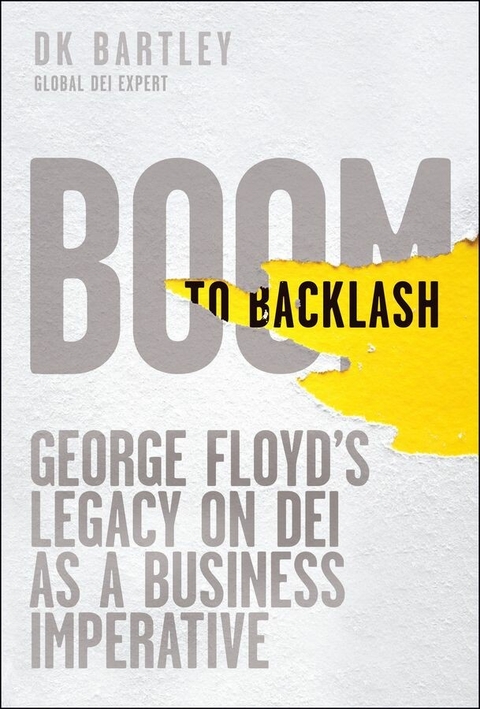
Boom to Backlash: George Floyd's Legacy on DEI as a Business Imperative examines the seismic shift in DEI initiatives following George Floyd's completely preventable death, exploring the initial surge of corporate commitments to DEI, the tangible progress and advancements made, and the subsequent backlash. Through data and case studies, as well as the unparalleled personal experiences of Black executive, global DEI expert, and author DK Bartley, this book illustrates how DEI has evolved from a fringe concept to a crucial element of business strategy, corporate success, and social progress. Some of the topics explored in this book include:
- The mischaracterization of DEI as 'new' or 'woke' by various platforms
- The real impact of DEI on a business's bottom line
- The future of DEI with respect to the current political climate and technology's role in implementation strategies
- Why George Floyd's murder was a catalyst for change
By addressing these critical aspects of DEI within the context of recent historical events, Boom to Backlash engages with a growing audience of business and political leaders, social media influencers, HR professionals, and individuals who want to understand and implement effective DEI strategies in a post-2020 world.
DK BARTLEY is a subject matter expert for DEI and talent acquisition. As an executive, public speaker, and influencer, Bartley inspires people and corporations around the world to expand and innovate their business practices. He is currently Chief Talent Officer for Diversity Talent International and former Chief DEI Officer for Moody's Corporation.
How the murder of George Floyd transformed the attitude towards and implementation of DEI across the world Boom to Backlash: George Floyd's Legacy on DEI as a Business Imperative examines the seismic shift in DEI initiatives following George Floyd's completely preventable death, exploring the initial surge of corporate commitments to DEI, the tangible progress and advancements made, and the subsequent backlash. Through data and case studies, as well as the unparalleled personal experiences of Black executive, global DEI expert, and author DK Bartley, this book illustrates how DEI has evolved from a fringe concept to a crucial element of business strategy, corporate success, and social progress. Some of the topics explored in this book include: The mischaracterization of DEI as new or woke by various platforms The real impact of DEI on a business's bottom line The future of DEI with respect to the current political climate and technology's role in implementation strategies Why George Floyd's murder was a catalyst for change By addressing these critical aspects of DEI within the context of recent historical events, Boom to Backlash engages with a growing audience of business and political leaders, social media influencers, HR professionals, and individuals who want to understand and implement effective DEI strategies in a post-2020 world.
1
Breaking the Silence
On May 25, 2020, George Floyd woke up to a typical Minneapolis spring morning.1 A thin layer of clouds hung in the sky and the air was hot and heavy with moisture.2 Floyd pulled himself out of bed. At 46 years old, he was working to rebuild his life after moving from his hometown of Houston, Texas, to Minnesota for a fresh start.3 Known as “Big Floyd” to his friends and family, he cut an imposing figure at 6′4″ but was thought of by those who knew him as a “gentle giant.” In fact, his high school football coach later recalled, “If you said something to him, his head would drop … he just wasn't going to ball up and act like he wanted to fight you.”4
That morning, Floyd likely thought about his daughters back in Houston.5 He may have said a prayer. Floyd was known in his community as a man of faith who had worked extensively with a Christian ministry called Resurrection Houston to mentor young men. “The things that he would say to young men always referenced that God trumps street culture,” recalled Ronnie Lillard, who performed with Floyd under the name Reconcile. “I think he wanted to see young men put guns down and have Jesus instead of the streets.”6 Perhaps he spent some time worrying that morning about making ends meet. The COVID‐19 pandemic had thrown millions out of work, including Floyd, after the restaurant where he worked as a bouncer was forced to close.7
George Perry Floyd Jr. was born in Fayetteville, North Carolina, and raised in Houston's Third Ward, where his mother moved the family seeking better opportunities.8 Growing up in the Cuney Homes housing project, known locally as “The Bricks,” Floyd found refuge in sports and music. His childhood friend Herbert Mouton remembered him as someone who could always lighten the mood after a tough loss: “He never wanted us to feel bad for too long,” Mouton recalled. The housing project's challenges were real. Residents created a self‐deprecating song: “I don't want to grow up, I'm a Cuney Homes kid. They got so many rats and roaches I can play with.”9
He was the first of his siblings to go to college, attending South Florida State College on a basketball scholarship before transferring to Texas A&M University–Kingsville.10 His college basketball coach, George Walker, remembered specifically seeking Floyd out: “I was looking for a power forward, and he fit the bill. He was athletic, and I liked the way he handled the ball.”11 Though he didn't graduate, his family remembered how proud he was to be the first to make it to college. As a young boy in second grade, he had written an essay expressing his dream of becoming a Supreme Court Justice. “When I grow up, I want to be a Supreme Court judge,” young Floyd wrote. “When people say, ‘Your Honor, he did rob the bank,’ I will say, ‘Be seated.’ And if he doesn't, I will tell the guard to take him out.”12
Life hadn't been easy for Floyd. He struggled with addiction at times and had run‐ins with the law, including a 2007 armed robbery conviction that resulted in a five‐year prison sentence.13 But after his release, he was committed to turning his life around. He participated in Christian outreach programs in Houston's Third Ward, using his experience to mentor younger men and steer them away from violence. In one video message, he pleaded: “Our young generation is clearly lost, man … Come on home, man. One day, it's gonna be you and God. You're goin' up or you're goin' down, you know what I'm sayin'? That's gonna be it.”14
In Minneapolis, Floyd worked as a security guard at the Salvation Army's Harbor Light Center homeless shelter and later at Conga Latin Bistro, where he was known as a friendly face who would walk coworkers to their cars after late shifts.15 His employer at Conga Latin Bistro, Jovanni Thunstrom, remembered Floyd's warm personality: “Always cheerful … He would dance badly to make people laugh. I tried to teach him how to dance because he loved Latin music, but I couldn't because he was too tall for me. He always called me ‘Bossman.’ I said, ‘Floyd, don't call me Bossman. I'm your friend.’”16 When COVID‐19 hit and restaurants closed, Floyd, like millions of Americans, found himself out of work.17
On that fateful Memorial Day evening, Floyd walked into Cup Foods, a corner store he'd visited many times before. Like everyone else during those strange pandemic days, he wore a face mask.18 The store's owner, Mike Abumayyaleh, would later tell NBC News that Floyd was a regular customer with whom they had “never had an issue.” The teenage clerk who served Floyd that day was new to the job. When Floyd used what appeared to be a counterfeit $20 bill, the clerk initially intercepted it and returned it to Floyd, who then left the store. When Floyd returned about 10 minutes later and used another $20 bill, the clerk suspected both bills were counterfeit. Following store protocol, he informed his supervisor and called the police.19
At 8:08 PM, Officers Thomas Lane and J. Alexander Kueng arrived at Cup Foods.20 Lane, who had been on the force for only four days, drew his gun and ordered Floyd to show his hands.21 Floyd was cooperative but visibly distressed. “I'm sorry, I'm sorry,” Floyd said. “I didn't do nothing … What did I do though? What did we do, Mr. Officer?” He begged the officers not to shoot him, telling them he had been shot before. When officers tried to put him in the squad car, he told them he was claustrophobic and had recently recovered from COVID‐19.22
Officers Derek Chauvin and Tou Thao arrived later. What happened next would be captured on multiple cameras and viewed by millions around the world. Darnella Frazier, a 17‐year‐old bystander who had been walking with her 9‐year‐old cousin to the store, recorded the incident on her phone. “Although this wasn't the first time I've seen a Black man get killed at the hands of police,” she would later write, “this is the first time I witnessed it happen in front of me. Right in front of my eyes, a few feet away.”23 For 9 minutes and 29 seconds, Chauvin kept his knee on Floyd's neck.24 Even after Floyd became unresponsive, even after bystanders begged the officers to check his pulse, Chauvin didn't move. A Cup Foods employee called the owner crying, telling him, “‘Mike, Mike. What should I do? The guy can't breathe. They're killing him.’ ‘Call the police on the police,’” Abumayyaleh recalled telling the employee. “And make sure it's recorded.”25 When the ambulance finally arrived, Floyd had no pulse. He was pronounced dead at 9:25 PM at the Hennepin County Medical Center.26
George Floyd couldn't have known that his death would become a turning point in American history.27 He couldn't have known that his last words, “I can't breathe,” would echo in protests from Seoul to Sydney, and London to Lagos.28 He couldn't have known that his name would become a rallying cry for racial justice that would transform institutions around the globe.
Ripples in the Corporate World
The first call came minutes after George Floyd was pronounced dead. I let it go to voicemail, hoping to take a moment to process what I'd just witnessed on my screen. Then another call came. And another. The sound pierced through the quiet of my kitchen, where I sat with my takeout growing cold. The shrill beeping shook me out of my numbness.
I knew what these calls meant. As a DEI expert practitioner, I'd received similar calls before. Every time we received a tragic reminder of America's unresolved racial trauma my phone would ring. But something felt different this time. The calls weren't just from my usual network of DEI colleagues. They came from CEOs, board members, and HR directors I hadn't heard from in years.
One company offered me a million‐dollar base salary (plus very competitive long‐term incentives) on the spot to become their Chief Diversity Officer. I turned it down. It was obvious they didn't want real change; they wanted a poster child, someone they could point to and say, “look, we're doing something. See? We hired a top expert. We care!” But as my phone continued to light up with calls from corporate leaders across the country, I realized we were witnessing something unprecedented.
The response began locally. On May 26, hundreds gathered in Minneapolis at the site of Floyd's death. By May 27, protesters took to the city streets in growing numbers. Within a week, demonstrations had spread to almost every major US city, and most minor ones too, marking one of the largest protest movements in American history.29 The unprecedented scale of documentation made this movement different from any before. Live streams of more than 400 protests were viewed over 1.4 billion times, creating what analysts called a “perfect storm” of visibility: there was simply no way to look away or deny what was happening.30
As people...
| Erscheint lt. Verlag | 13.5.2025 |
|---|---|
| Sprache | englisch |
| Themenwelt | Wirtschaft ► Betriebswirtschaft / Management |
| Schlagworte | AI • Business Leadership • dei ai • dei backlash • dei business • dei commitment • dei corporate • DEI implementation • dei politics • dei progress • dei social media • dei technology • George Floyd • george floyd history • global dei • social justice business |
| ISBN-13 | 9781394351466 / 9781394351466 |
| Informationen gemäß Produktsicherheitsverordnung (GPSR) | |
| Haben Sie eine Frage zum Produkt? |
 EPUB (Adobe DRM)
Kopierschutz: Adobe-DRM
Adobe-DRM ist ein Kopierschutz, der das eBook vor Mißbrauch schützen soll. Dabei wird das eBook bereits beim Download auf Ihre persönliche Adobe-ID autorisiert. Lesen können Sie das eBook dann nur auf den Geräten, welche ebenfalls auf Ihre Adobe-ID registriert sind.
Details zum Adobe-DRM
Dateiformat: EPUB (Electronic Publication)
EPUB ist ein offener Standard für eBooks und eignet sich besonders zur Darstellung von Belletristik und Sachbüchern. Der Fließtext wird dynamisch an die Display- und Schriftgröße angepasst. Auch für mobile Lesegeräte ist EPUB daher gut geeignet.
Systemvoraussetzungen:
PC/Mac: Mit einem PC oder Mac können Sie dieses eBook lesen. Sie benötigen eine
eReader: Dieses eBook kann mit (fast) allen eBook-Readern gelesen werden. Mit dem amazon-Kindle ist es aber nicht kompatibel.
Smartphone/Tablet: Egal ob Apple oder Android, dieses eBook können Sie lesen. Sie benötigen eine
Geräteliste und zusätzliche Hinweise
Buying eBooks from abroad
For tax law reasons we can sell eBooks just within Germany and Switzerland. Regrettably we cannot fulfill eBook-orders from other countries.
aus dem Bereich