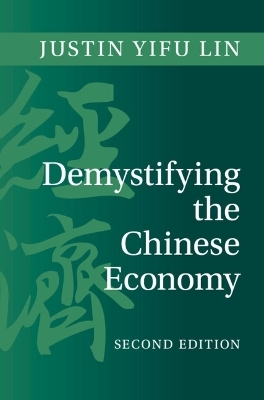
Demystifying the Chinese Economy
Cambridge University Press (Verlag)
978-1-009-20930-4 (ISBN)
By the late 19th century, China had degenerated into one of the world's poorest economies. Despite generations of effort for national rejuvenation, China did not reverse its fate until the market-oriented reform. Since then, China has become the most dynamic economy in the world and is likely to regain its position as the world's largest economy before 2030. Demystifying the Chinese Economy, provides insightful answers to why China was so advanced in premodern times and what caused it to become so poor for almost two centuries. It explains how China maintained stability and grew rapidly in its transition to an open, market economy. Featuring three new chapters (and five new appendices) on challenges facing China's economic development and structural reform, this new edition covers topical issues such as the origins of US-Sino trade frictions, the impact of Donald Trump's presidency, and the development of the 'Belt and Road' initiative.
Justin Yifu Lin is the Dean of Institute of New Structural Economics and Institute of South-South Cooperation and Development and Honorary Dean, School of National Development at Peking University. He was formerly the Senior Vice President and Chief Economist of the World Bank in 2008–2012. Prior to joining the Bank, he served for 15 years as Founding Director and Professor of the China Centre for Economic Research (CCER) at Peking University. He is a Corresponding Fellow of the British Academy and a Fellow of the Academy of Sciences for Developing World. He was awarded the 1993 and 2001 Sun Yefang Prize (the highest honour for economists in China).
Preface to the second edition; Preface to the first edition; 1. Opportunities and challenges in China's economic development; 2. Why the scientific and industrial revolutions bypassed China; 3. The great humiliation and the socialist revolution; 4. The comparative advantage–defying, catching-up strategy and China's traditional economic system; 5. Enterprise viability and factor endowments; 6. The comparative advantage–following development strategy; 7. Rural reform and the three rural issues; 8. Urban reform and the remaining issues; 9. Reforming the state-owned enterprises; 10. The financial reforms; 11. Deflationary expansion and building a new socialist countryside; 12. Improving the market system and promoting fairness and efficiency for harmonious development; 13. Supply-side structural reform and economic transformation and upgrading under the new normal; 14. China's economic development and cultural rejuvenation; 15. Reflections on neoclassical theories; Appendix 1. Economic growth and institutional changes; Appendix 2. The puzzles of long-term unchanged per capita income and a large population in pre-modern China; Appendix 3. Global imbalances, reserve currency, and global economic governance; Appendix 4. The debates with Xiaokai Yang and Weiying Zhang on the role of the state and the sequence of reform; Appendix 5. The belt and road initiative and the free trade zone: China's new measures for opening.
| Erscheinungsdatum | 23.12.2025 |
|---|---|
| Übersetzer | Wang Qiong |
| Zusatzinfo | Worked examples or Exercises |
| Verlagsort | Cambridge |
| Sprache | englisch |
| Gewicht | 806 g |
| Themenwelt | Wirtschaft ► Volkswirtschaftslehre ► Makroökonomie |
| Wirtschaft ► Volkswirtschaftslehre ► Wirtschaftspolitik | |
| ISBN-10 | 1-009-20930-2 / 1009209302 |
| ISBN-13 | 978-1-009-20930-4 / 9781009209304 |
| Zustand | Neuware |
| Informationen gemäß Produktsicherheitsverordnung (GPSR) | |
| Haben Sie eine Frage zum Produkt? |
aus dem Bereich