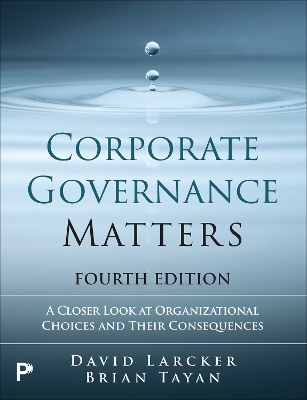
Corporate Governance Matters
Addison Wesley (Verlag)
978-0-13-546310-9 (ISBN)
Fully updated to reflect the latest research, trends, and regulations, Corporate Governance Matters, Fourth Edition, is the definitive resource for anyone seeking to improve corporate governance practices--from directors and institutional investors to policymakers and researchers. This edition offers comprehensive, objective insights grounded in rigorous analysis and real-world examples, covering new discussions on ESG ratings, stakeholder interests, CEO behavior, and artificial intelligence.
David Larcker and Brian Tayan examine today's most pressing governance challenges, including board effectiveness, shareholder activism, organizational risk, and systemic breakdowns. Their empirical, non-ideological approach helps readers understand the impact of governance structures and processes on organizational performance, equipping them to make informed decisions in an increasingly complex environment.
Extensively revised coverage of:
International corporate governance
Compensation, equity ownership, incentives, and the labor market for CEOs
Optimal board structure, tradeoffs, and consequences
Governance, organizational strategy, business models, and risk management
Succession planning
Alternative corporate governance structures, including family controlled businesses, nonprofits, private equity, and venture capital
Financial reporting and external audit
The market for corporate control
Roles of institutional and activist shareholders
Governance ratings, and more
Features:
Objectively and fully addresses every component of governance, with no axe to grind: explains what's known and what isn't, helping leaders make better choices in the face of uncertainty
Brings together new academic research, updated examples and statistics, and a complete decision-making framework
Includes expanded discussions of environmental and social issues in governance, board effectiveness, CEO succession and compensation, cyber risk, and shareholder activism
Register your product at informit.com/register for convenient access to downloads, updates, and/or corrections as they become available.
David Larcker is James Irvin Miller Professor of Accounting at Stanford Graduate School of Business; Director of the Corporate Governance Research Initiative; and Senior Faculty, Arthur and Toni Rembe Rock Center for Corporate Governance. David’s research focuses on executive compensation, corporate governance, and managerial accounting. He has published many research papers and is frequently quoted in both the popular and business press. He received his BS and MS in engineering from the University of Missouri–Rolla and his PhD in business from the University of Kansas. He previously was on the faculty of the Kellogg Graduate School of Management at Northwestern University and The Wharton School at the University of Pennsylvania. Professor Larcker presently serves on the Board of Trustees for the Wells Fargo Advantage Funds. Brian Tayan is a member of the Corporate Governance Research Program at the Stanford Graduate School of Business. He has written broadly on the subject of corporate governance, including boards of directors, succession planning, executive compensation, financial accounting, and shareholder relations. Previously, he worked as a financial analyst at Stanford University's Office of the CEO and as an investment associate at UBS Private Wealth Management. He has actively managed a private investment partnership since 2006, specializing in long-term, conservative growth through equity investments. Tayan received his MBA from the Stanford Graduate School of Business and his BA from Princeton University.
Acknowledgments xv
About the Authors xvii
Preface xviii
Chapter 1. Introduction to Corporate Governance 1
Self-Interested Executives 4
Defining Corporate Governance 8
Corporate Governance Standards 9
Best Practice or Best Practices? Does “One Size Fit All”? 12
Relationship between Corporate Governance and Firm Performance 13
Endnotes 16
Chapter 2. International Corporate Governance 21
Capital Market Efficiency 21
Legal Tradition 24
Accounting Standards 25
Enforcement of Regulations 27
Societal and Cultural Values 28
Individual National Governance Structures 30
Endnotes 46
Interlude 52
Chapter 3. Board of Directors: Duties and Liability 53
Board Responsibilities 53
Board Independence 54
The Operations of the Board 55
Duration of Director Terms 63
Director Elections 63
Removal of Directors 66
Legal Obligations of Directors 66
Endnotes 78
Chapter 4. Board of Directors: Selection, Compensation, and Removal 83
Market for Directors 83
Director Recruitment Process 91
Director Compensation 93
Removal of Directors 100
Endnotes 104
Chapter 5. Board of Directors: Structure and Consequences 111
Board Structure 112
Summary 143
Endnotes 144
Interlude 153
Chapter 6. Strategy, Performance Measurement, and Risk Management 155
Organizational Strategy 156
Strategy Implementation Process 158
Business Model Development and Testing 160
Key Performance Measures 163
How Well Are Boards Doing with Performance Measures and Business Models? 166
Risk and Risk Management 168
Risk and Risk Tolerance 169
Risk to the Business Model 170
Risk Management 173
Oversight of Risk Management 176
Assessing Board Performance on Risk Management 178
Cybersecurity 180
Endnotes 182
Chapter 7. CEO Selection, Turnover, and Succession Planning 187
Labor Market for Chief Executive Officers 187
Labor Pool of CEO Talent 190
CEO Turnover 193
Newly Appointed CEOs 196
Models of CEO Succession 198
The Succession Process 201
How Well Are Boards Doing with Succession Planning? 205
Executive Search Firms 207
Endnotes 209
Chapter 8. Executive Compensation and Incentives 217
The Controversy over Executive Compensation 218
Competing Theories of CEO Pay 219
Components of Compensation 220
Determining Compensation 225
Compensation Consultants 227
Compensation Levels 228
Ratio of CEO Pay to Other Top Executive Pay 233
Ratio of CEO Pay to Average Employee Pay 235
Compensation Mix 236
Short-Term Incentives 239
Long-Term Incentives 241
Benefits and Perquisites 244
Compensation Disclosure 245
Say-on-Pay 247
Competing Theories of CEO Pay 249
Endnotes 250
Chapter 9. Executive Equity Ownership 259
Equity Ownership and Firm Performance 259
Equity Ownership and Risk 262
Equity Ownership and Agency Costs 268
Accounting Manipulation 268
Manipulation of Equity Grants 269
Equity Sales and Insider Trading 272
Rule 10b5-1 275
Hedging 278
Pledging 282
Repricing and Exchange Offers 284
Endnotes 286
Chapter 10. Financial Reporting and External Audit 295
The Audit Committee 296
Accounting Quality, Transparency, and Controls 296
Financial Reporting Quality 298
Financial Restatements 302
Models to Detect Accounting Manipulations 307
The External Audit 309
Audit Quality 312
Structure of Audit Industry 313
Impact of the Sarbanes–Oxley Act 315
External Auditor as CFO 317
Auditor Rotation 318
Endnotes 320
Chapter 11. The Market for Corporate Control 329
The Market for Corporate Control 330
Stock Market Assessment of Acquiring and Target Firms 334
Antitakeover Protections 340
Antitakeover Actions 341
Warding Off Unwanted Acquirers 351
Endnotes 354
Chapter 12. Shareholders and Shareholder Activism 361
The Role of Shareholders 361
Blockholders and Institutional Investors 364
Institutional Investors and Proxy Voting 367
Activist Investors 369
The Rise of Index Investing 379
Shareholder Democracy and Corporate Engagement 380
Proxy Advisory Firms 384
Endnotes 389
Chapter 13. Stakeholders and Stakeholder Activism 399
Pressure to Incorporate Stakeholder Interests 400
Legal and Economic Implications 404
Director and CEO Views on Stakeholders 408
ESG Metrics and Disclosure 409
External Assessment of ESG 413
Endnotes 421
Chapter 14. Corporate Governance and ESG Ratings 429
Third-Party Ratings 429
Credit Ratings 430
Commercial Corporate Governance Ratings 432
Governance Rating Systems by Academic Researchers 437
The Viability of Governance Ratings 442
ESG Ratings 443
Endnotes 448
Chapter 15. Alternative Models of Governance 451
Family-Controlled Corporations 451
Venture-Backed Companies 454
Special Purpose Acquisition Companies 461
Private Equity–Owned Companies 462
Nonprofit Organizations 465
Endnotes 469
Chapter 16. Summary and Conclusions 475
Testing Remains Insufficient 476
The Current Focus Is Misdirected 476
Important Variables Are Clearly Missing 478
Context Is Important 479
Rights of Shareholders and Stakeholders 479
Endnotes 480
Index 481
| Erscheinungsdatum | 17.10.2025 |
|---|---|
| Verlagsort | Boston |
| Sprache | englisch |
| Maße | 180 x 232 mm |
| Gewicht | 670 g |
| Themenwelt | Wirtschaft ► Betriebswirtschaft / Management ► Unternehmensführung / Management |
| Wirtschaft ► Volkswirtschaftslehre | |
| ISBN-10 | 0-13-546310-6 / 0135463106 |
| ISBN-13 | 978-0-13-546310-9 / 9780135463109 |
| Zustand | Neuware |
| Informationen gemäß Produktsicherheitsverordnung (GPSR) | |
| Haben Sie eine Frage zum Produkt? |
aus dem Bereich