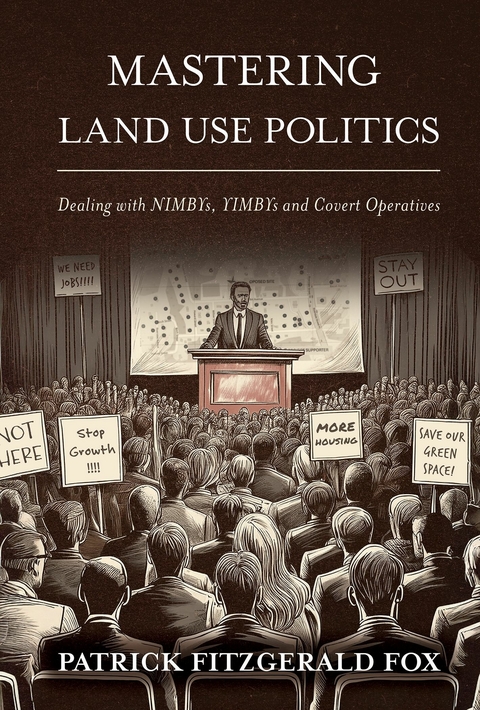
Mastering Land Use Politics (eBook)
248 Seiten
Bookbaby (Verlag)
979-8-3178-0044-4 (ISBN)
Patrick F. Fox is a nationally recognized expert in land use politics with over 35 years of experience managing high-stakes development campaigns across the United States and internationally. As founder and CEO of Consensus Strategies, he has advised thousands of projects across America and five different countries. He helped clients navigate the complex political, legal, and public relations challenges that can make or break real estate development. Patrick has pioneered work in both offensive and defensive land use strategies that have made him the go-to advisor for developers who are facing fierce opposition or for corporations looking to protect market shares. He uses a unique blend of political instinct, campaign expertise, and a deep understanding of community dynamics that help him shape the way modern development is approved-or stopped. Additionally, Patrick is the former President of The Saint Consulting Group and co-author of 'NIMBY Wars: The Politics of Land Use.' His commentary and other works have been featured in The New York Times, The Wall Street Journal, Politico, and The Washington Post.
"e;Mastering Land Use Politics"e; is a practical guide for navigating the political, legal, and public relations challenges that shape real estate development. Patrick F. Fox, a veteran strategist, shares decades of hard-won insights and experience from the frontlines of development battles. Patrick has over 35 years of experience managing more than a thousand land use campaigns across the United States and five international countries. Offering his advice, Patrick gives a comprehensive, practical, and often entertaining guide to the forces that determine which projects move forward and which ones die in public hearings, courtrooms, or the comment sections of local Facebook groups. Within this book are essential resources for developers, land use attorneys, political consultants, public officials, planners, and anyone who is involved in the approval and permitting process. Learn how successful projects are won, not just with good plans and community benefits, but by mastering the political and public perception that increasingly defines the development process. Inside you will learn how to: Build grassroots coalitions and mobilize real public support Counter misinformation, emotional opposition, and online outrage Recognize and neutralize covert opposition campaigns funded by competitors Navigate regulatory agencies, public hearings, and community meetings Use digital tools and data-driven strategies to control the narrative Conduct political due diligence and avoid preventable project failuresWith real-world examples, campaign-tested tactics, and candid stories, "e;Mastering Land Use Politics"e; will offer a realistic, behind-the-scenes look at what it takes to succeed in today's contentious development environment. Whether you're trying to get a project approved, protect your market from competitors, or understand why a seemingly rational process gets detailed so often this book provides the roadmap. It doesn't just explain the rules; it teaches you how to win the game.
Chapter 2:
The Origins of Land Use Regulation
The difference between experts and dabblers in land use politics comes down to understanding the rules. Successful developers and strategists know how to maneuver within legal frameworks, anticipate opposition, and call out competitors who overreach. They don’t just know the laws—they know how to work them to their advantage.
The Early Days: Informal Land Use Practices
Before the advent of formal land use regulations, communities relied on informal agreements to dictate how land could be used. These practices were rooted in cultural traditions and local customs, often prioritizing harmony within tight-knit communities. Disputes were resolved through consensus or by community leaders.
But as cities grew during the Industrial Revolution, the lack of formal regulations led to chaotic urban environments. Factories operated alongside residential areas, creating health and safety hazards. This period highlighted the need for structured land use policies to address the demands of growing urban populations.
Land use regulation has evolved over centuries, shaping the physical and social fabric of communities. What began as informal agreements and unwritten customs has become a complex web of zoning laws, environmental regulations, and bureaucratic oversight. Understanding how we got here isn’t just a history lesson—it’s a roadmap for navigating today’s land use battles.
A Century of Change in Land Use Battles
Land use has always been about power—who controls the land, who benefits, and who gets left behind. A century ago, these decisions were mostly personal. If a factory opened next to your home, you sued. If your neighbor’s livestock trampled your garden, you took them to court. Governments rarely got involved unless a dispute escalated into a public nuisance.
But as cities grew, the old system fell apart. Industrialization brought dense, chaotic urban centers filled with tenements, rail yards, and factories belching smoke. Without rules, the results were disastrous: slums, pollution, unchecked sprawl. The solution? Regulation.
The first major attempt to control urban growth came in 1916, when New York City introduced the nation’s first comprehensive zoning ordinance. This wasn’t about aesthetics or property values—it was about survival. Skyscrapers were casting massive shadows over neighborhoods, factories were encroaching on residential blocks, and health concerns were mounting. The new rules set height limits, separated land uses, and laid the groundwork for modern zoning laws.
New York’s experiment triggered a national movement. By 1926, the U.S. Supreme Court had upheld zoning in Euclid v. Ambler Realty, giving local governments the power to dictate what could be built and where. With that decision, land use was no longer just a financial or property rights issue—it became political.
Mayors and city councils were no longer just approving projects; they now had the power to shape the future of their communities. And with that power came the first organized fights over development.
From “Build Anything”
to “Not in My Backyard”
For decades, zoning was seen as a tool for progress. After World War II, federal policies encouraged suburban expansion, fueling a boom in new housing, highways, and shopping centers. Eager to grow their tax bases and create jobs, local governments rolled out the red carpet for developers. Economic development wasn’t just encouraged—it was celebrated.
But prosperity has a way of creating its own problems. The very communities that had been symbols of progress—suburban neighborhoods, carefully planned shopping districts—became hotbeds of opposition. Homeowners who had moved in expecting stability began to resist further change.
By the 1960s and 1970s, opposition to development wasn’t just a local skirmish—it was a movement. Homeowners’ associations evolved into political entities wielding real power over local governments. Environmental activism surged, leading to landmark legislation like the National Environmental Policy Act (NEPA) and the Clean Water Act.
Suddenly, opponents had new weapons: lawsuits, environmental impact reviews, and regulatory challenges. If they couldn’t stop a project outright, they could slow it down—sometimes indefinitely.
Then came Kelo v. City of New London in 2005. When the Supreme Court ruled that local governments could seize private property for economic development, the backlash was immediate. The decision turned land use into a political flashpoint. No longer was opposition just about traffic or aesthetics—it was about government overreach, corporate influence, and community control.
The Playbook of Modern Opposition
Today’s land use battles are a direct result of this history. Over the past century, opposition strategies have become more sophisticated, leveraging legal, political, and digital tools to block or delay projects.
Technology has changed the game. In the past, opponents had to organize door to door or hold public meetings. Now, a single Facebook post can spark a movement. Online petitions generate thousands of signatures overnight. Community groups coordinate protests through X (formerly Twitter) and WhatsApp, while Nextdoor becomes a battleground for neighborhood disputes.
Legal opposition has become standard. Zoning appeals, environmental impact lawsuits, and historic preservation claims are now routine. If a group can’t stop a project outright, they can tie it up in litigation until it becomes financially unfeasible.
Covert opposition is on the rise. It’s no longer just residents fighting projects—competitors are now funding opposition groups to block rival developments. A proposed shopping center might face “grassroots” resistance from a concerned citizens’ group that, upon closer inspection, is backed by a competing retailer.
Political realities have shifted. Unlike the past, when politicians saw development as a win, today’s elected officials are cautious. They know that approving a controversial project can cost them votes. They know that social media can turn a zoning board decision into a viral scandal. And they know that it’s often easier to side with vocal opponents than to fight for a project, no matter how beneficial it might be.
Global Perspectives on Planning Systems
Strategic advocacy is effective in any country where residents can influence government decision-making. While I have worked on projects in five countries, I’ve been asked to go to others where public involvement and influence is neither welcomed nor effective.
When asked to work in China at one point, I told the developer I was surprised he thought I could operate effectively there and impact planning decisions.
He said, “The government doesn’t want to build things people don’t want.”
I presented this scenario: A developer wants to build a retail shopping center, and I organize 15 Chinese residents to protest outside city hall. Is that okay?
“Oh no!” he said. “You’ll be arrested.”
There are still other countries where the zoning and planning process can be circumvented by a bag of cash (India and Mexico, among many others). While many cynics believe this is prevalent in the United States, Canada, and the United Kingdom, it is not. It’s rare in these countries, and highly dangerous for those who engage in it.
When working on my first project in the United Kingdom, I met with a team from a British law firm to walk through some typical strategies we might engage in on behalf of our clients there. After laying out some basic tactics we use in the United States and Canada, the solicitors told us we were on solid ground and could safely use those tactics in the United Kingdom.
As my plane landed back in Boston, my phone was blowing up with messages from them warning me that I would be looking at a £50,000 fine and five years in prison for tactics securely protected as free speech in the United States.
It’s important to understand the rules before you play the game. Every country has its own regulatory framework, but the core challenges—balancing growth, environmental concerns, and political pressures—are universal.
In the United Kingdom, planning decisions are centralized. The national government has direct control over projects of strategic importance, leading to a more unified approach. This contrasts with the United States, where over 19,000 municipalities each set their own zoning policies. The result? A fragmented system where projects that might sail through in one city face impossible hurdles in another.
A striking example of these contrasting systems can be seen in how the two countries addressed the rise of big-box stores. In the 1990s, Walmart’s expansion across the United States led to...
| Erscheint lt. Verlag | 25.6.2025 |
|---|---|
| Sprache | englisch |
| Themenwelt | Betriebswirtschaft / Management ► Spezielle Betriebswirtschaftslehre ► Immobilienwirtschaft |
| ISBN-13 | 979-8-3178-0044-4 / 9798317800444 |
| Informationen gemäß Produktsicherheitsverordnung (GPSR) | |
| Haben Sie eine Frage zum Produkt? |
 EPUB (Ohne DRM)
Größe: 11,8 MB
Digital Rights Management: ohne DRM
Dieses eBook enthält kein DRM oder Kopierschutz. Eine Weitergabe an Dritte ist jedoch rechtlich nicht zulässig, weil Sie beim Kauf nur die Rechte an der persönlichen Nutzung erwerben.
Dateiformat: EPUB (Electronic Publication)
EPUB ist ein offener Standard für eBooks und eignet sich besonders zur Darstellung von Belletristik und Sachbüchern. Der Fließtext wird dynamisch an die Display- und Schriftgröße angepasst. Auch für mobile Lesegeräte ist EPUB daher gut geeignet.
Systemvoraussetzungen:
PC/Mac: Mit einem PC oder Mac können Sie dieses eBook lesen. Sie benötigen dafür die kostenlose Software Adobe Digital Editions.
eReader: Dieses eBook kann mit (fast) allen eBook-Readern gelesen werden. Mit dem amazon-Kindle ist es aber nicht kompatibel.
Smartphone/Tablet: Egal ob Apple oder Android, dieses eBook können Sie lesen. Sie benötigen dafür eine kostenlose App.
Geräteliste und zusätzliche Hinweise
Buying eBooks from abroad
For tax law reasons we can sell eBooks just within Germany and Switzerland. Regrettably we cannot fulfill eBook-orders from other countries.
aus dem Bereich