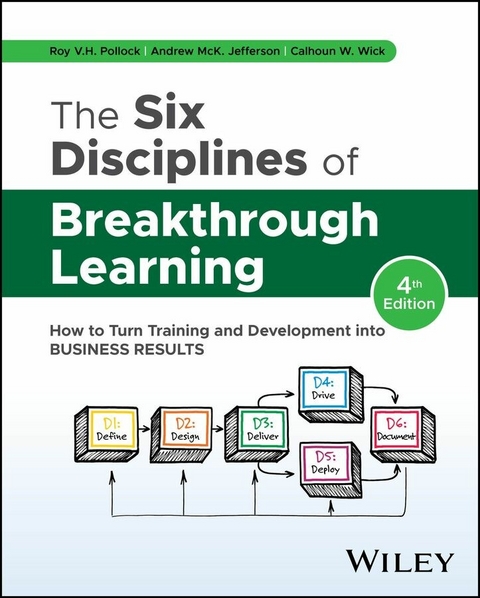
The Six Disciplines of Breakthrough Learning (eBook)
600 Seiten
Wiley (Verlag)
978-1-394-28540-2 (ISBN)
All-in-one resource to increase effectiveness and ROI of enterprise training and development programs
In The Six Disciplines of Breakthrough Learning: How to Turn Training and Development into Business Results, renowned instructors and consultants Dr. Roy Pollock ,Andrew Jefferson, and Calhoun Wick deliver a complete blueprint to maximize the effectiveness and ROI of training and development programs within any organization. In this newly revised and extensively updated Fourth Edition, readers will find tools, guides, and checklists to implement meaningful strategies immediately, supported by the latest research and new case studies from global companies across industries.
Along with key insight into the craft of instruction, this book details how to talk to the business leaders in a way that gets their attention and earns respect. Some of the topics covered in this book include:
- Defining the business outcomes L&D is expected to deliver and effective management of the learning portfolio
- Delivering for application by utilizing performance appropriate instructional methods, adult learning principles, and logic maps
- Maximizing business impact by driving learning transfer and providing performance support
- 'Selling the sizzle' when reporting results and common training evaluation pitfalls to avoid
The Six Disciplines of Breakthrough Learning: How to Turn Training and Development into Business Results is an essential read for learning professionals, including instructors, instructional designers, trainers, training managers, and Chief Learning Officers, as well as business leaders seeking an all-in-one resource to deliver greater value from training and development programs in an increasingly competitive business environment.
ROY V.H. POLLOCK, DVM, PhD, is the Chief Learning Officer and Co-founder of the 6Ds Company. He is a sought-after instructor and consultant to leading companies around the world.
ANDREW McK. JEFFERSON, JD, is the Chief Executive Officer and Co-founder of the 6Ds Company. He is a popular international speaker and consultant with deep experience in both business management and learning and development.
CALHOUN W. WICK is the Founder and Chairman of Fort Hill Company and advisor to the 6Ds Company. He is a nationally recognized consultant, educator, and researcher who was named 'Thought Leader of the Year' by ISA, the Association of Learning Providers.
All-in-one resource to increase effectiveness and ROI of enterprise training and development programs In The Six Disciplines of Breakthrough Learning: How to Turn Training and Development into Business Results, renowned instructors and consultants Dr. Roy Pollock ,Andrew Jefferson, and Calhoun Wick deliver a complete blueprint to maximize the effectiveness and ROI of training and development programs within any organization. In this newly revised and extensively updated Fourth Edition, readers will find tools, guides, and checklists to implement meaningful strategies immediately, supported by the latest research and new case studies from global companies across industries. Along with key insight into the craft of instruction, this book details how to talk to the business leaders in a way that gets their attention and earns respect. Some of the topics covered in this book include: Defining the business outcomes L&D is expected to deliver and effective management of the learning portfolio Delivering for application by utilizing performance appropriate instructional methods, adult learning principles, and logic maps Maximizing business impact by driving learning transfer and providing performance support Selling the sizzle when reporting results and common training evaluation pitfalls to avoid The Six Disciplines of Breakthrough Learning: How to Turn Training and Development into Business Results is an essential read for learning professionals, including instructors, instructional designers, trainers, training managers, and Chief Learning Officers, as well as business leaders seeking an all-in-one resource to deliver greater value from training and development programs in an increasingly competitive business environment.
Core Concepts
Business education is a means to an end, not an end in itself.
—van Adelsberg and Trolley4
Four themes recur throughout this book. They are:
- Organizations invest in learning and development to improve performance.
- Many factors affect performance.
- Learning adds value only when it is applied on the job.
- Learning is a process that can be improved.
These four themes support the fundamental premise of The Six Disciplines: Company‐sponsored learning and development initiatives add value today. But these initiatives can—and should—generate even greater value.
In this chapter, we introduce each of these four themes as a foundation. In subsequent chapters, we show how they support the practice of the Six Disciplines and how those disciplines work together to optimize the value of learning initiatives.
It Is All About Performance
Whether organizations succeed or fail, whether they persist or perish, depends on their performance relative to alternatives. Those alternatives might be another product or provider, or they might be simply to do or buy nothing. Even governments and government agencies are not guaranteed immortality. Any organization that fails to meet the needs of its constituents will eventually be replaced. Individuals and organizations who perform well prosper and grow; those who perform less well wither and die.
Continuing to thrive in a changing environment requires adaptation. Learning is key. Satya Nadella, CEO of Microsoft, put it this way: “Always keep learning. You stop doing useful things if you don't learn.” Jack Welch put it more bluntly: “When the pace of change on the outside exceeds the pace of change on the inside, the end is near.”
Organizations provide learning and development (L&D) opportunities for their employees to ensure that they have the skills and knowledge necessary to keep up with the pace of change and achieve the organization's mission and vision. Business leaders don't really want training per se. What they want are the benefits that effective training provides: greater productivity and enhanced competitiveness. When they invest in learning and development, they expect performance to improve (Figure CC.1). In an enterprise, learning matters only if it meaningfully contributes to the organization's sustainability, mission, and goals.
Figure CC.1 Organizations invest in learning and development with the expectation that performance will improve.
While many factors contribute to an organization's success, its performance is increasingly a reflection of the strength of its human capital. At the turn of the millennium, Fitz‐Enz5 presciently wrote: “People, not cash, buildings, or equipment, are the critical differentiators of a business” (p. 1). Proof of his observation is that the world's most highly valued companies today—for example, Nvidia, Alphabet (Google), Meta, and Microsoft—are prized more for their intellectual property, know‐how, and human capital than for their fixed assets (bricks and mortar).
Moreover, in developed countries—as well as in many developing countries—the service sector is now larger than manufacturing, mining, or agriculture.6,7 In the United States, for example, the service economy—including professional and business services, real estate, finance, and healthcare—amounts to nearly 80% of the gross national product.7
Service operations are driven primarily by intellectual capital.
That trend has implications for L&D. In service industries, the quality of the customer's experience depends more on the performance of the individual service provider than on the company's reputation, average performance, or know‐how.8 If the particular employee with whom a customer interacts is rude, wastes time, or cannot answer questions, then the customer is likely to take their business elsewhere, even if the company's overall reputation for service is good.
Thus, to succeed in a service business, a company must reduce the variability between its best‐ and its worst‐performing employees (so‐called Human Sigma8) as well as to improve its average performance. Training and development plays an important role in this regard. That is because “in manufacturing businesses, a significant investment in equipment may be required to improve labor productivity. In contrast, service operations are primarily driven by intellectual capital.”9
The point is that corporate‐sponsored learning is a business activity. It is an investment that an organization makes in its human capital to improve current performance as well as ensure future competitiveness. Therefore, as workplace learning professionals, “we are not in the business of providing classes, learning tools, or even learning itself. We are in the business of facilitating improved business results.”10 Like any other investment, the investment in learning is expected to pay a return (Figure CC.2).
Figure CC.2 An investment in learning is expected to be more than repaid through improved performance.
Thomas Gilbert,11 a leading thinker in human performance management, introduced the concept of “worthy performance” in his book Human Competence. Gilbert defined worthy performance as performance for which the value of the accomplishments exceeds the cost of the behaviors required to achieve them. He specifically distinguished performance from mere activity (behaviors). Performance includes the outcomes and their worth to the organization. In business, then, worthy performances are actions that produce high‐value business‐relevant outcomes at relatively low cost. Superior performance means producing valuable outcomes faster, more consistently, and at lower cost than your competitors. To deliver superior performance, workers must have the right knowledge and skills, and those must be kept up to date, which is the rationale for having an L&D function.
Many Factors Affect Performance
Any effort to improve performance through learning must recognize that there are many potential impediments to worthy performance. For example, employees might know how to perform a task and be willing to do so but lack the information or the tools they need. Or they might not be clear about what is expected of them or might lack incentives or meaningful feedback (Figure CC.3).
Unfortunately, when confronted with a gap between the current level of performance (“is now”) and the desired performance (“should be”), many managers assume that the problem is with the employees and that training is the solution. But training is effective at closing performance gaps only when the root cause is a lack of skill or knowledge. If there are other root causes or contributing factors, then training will fail to close the gap.
To avoid wasting time and effort on a training initiative that is doomed to fail, learning professionals must work with business managers to identify and address the real impediments to performance—a process known as performance consulting.
Figure CC.3 There are many potential barriers to worthy performance.
A useful model for thinking about the factors that affect performance is the 4W model developed by the International Society for Performance Improvement.12 The model posits that performance is influenced by four factors that, in English, all begin with the letter “w”: the world, the workplace, the work, and the worker (Figure CC.4).
- World refers to factors in the business environment that are largely outside a company's control, such as government regulations or actions by competitors.
- Workplace refers to the internal company environment and includes such things as resource allocation, how departments interact, employment and compensation policies, cultural norms, and management practices.
- Work refers to how the work itself is structured and the processes, tools, systems, and information available to facilitate the work.
- Worker refers to the characteristics of the employees: their knowledge, skills, attitudes, and engagement.
Figure CC.4 An organization's performance is influenced by factors in the world, workplace, work, and worker.
Pit a good employee against a bad system, and the system will win every time.
The important insight that the model provides is that it is the combination of these four factors that determines performance. Therefore, efforts to improve competitiveness need to consider and address all the potential impediments to worthy performance. For example, if employees lack the tools they need, or the time, or the information, they won't be able to perform to their full capability, even if they have the requisite skills. If the work process is fundamentally flawed, or if the computer system is outdated or hard to use, performance will suffer. As Geary Rummler13 famously remarked: “If you pit a good performer against a bad system, the system will win almost every time” (p. 11).
Need...
| Erscheint lt. Verlag | 29.4.2025 |
|---|---|
| Sprache | englisch |
| Themenwelt | Wirtschaft ► Betriebswirtschaft / Management ► Personalwesen |
| Schlagworte | Adult learner • association for training and development • business instruction • business training programs • enterprise development • enterprise training • job aids • L and D • leadership development • learning portfolio • learning transfer • performance consulting • Performance Support • ROI • Safety Training • Sales training • technical training • training evaluation • trusted learning advisor |
| ISBN-10 | 1-394-28540-X / 139428540X |
| ISBN-13 | 978-1-394-28540-2 / 9781394285402 |
| Informationen gemäß Produktsicherheitsverordnung (GPSR) | |
| Haben Sie eine Frage zum Produkt? |
 EPUB (Adobe DRM)
Kopierschutz: Adobe-DRM
Adobe-DRM ist ein Kopierschutz, der das eBook vor Mißbrauch schützen soll. Dabei wird das eBook bereits beim Download auf Ihre persönliche Adobe-ID autorisiert. Lesen können Sie das eBook dann nur auf den Geräten, welche ebenfalls auf Ihre Adobe-ID registriert sind.
Details zum Adobe-DRM
Dateiformat: EPUB (Electronic Publication)
EPUB ist ein offener Standard für eBooks und eignet sich besonders zur Darstellung von Belletristik und Sachbüchern. Der Fließtext wird dynamisch an die Display- und Schriftgröße angepasst. Auch für mobile Lesegeräte ist EPUB daher gut geeignet.
Systemvoraussetzungen:
PC/Mac: Mit einem PC oder Mac können Sie dieses eBook lesen. Sie benötigen eine
eReader: Dieses eBook kann mit (fast) allen eBook-Readern gelesen werden. Mit dem amazon-Kindle ist es aber nicht kompatibel.
Smartphone/Tablet: Egal ob Apple oder Android, dieses eBook können Sie lesen. Sie benötigen eine
Geräteliste und zusätzliche Hinweise
Buying eBooks from abroad
For tax law reasons we can sell eBooks just within Germany and Switzerland. Regrettably we cannot fulfill eBook-orders from other countries.
aus dem Bereich