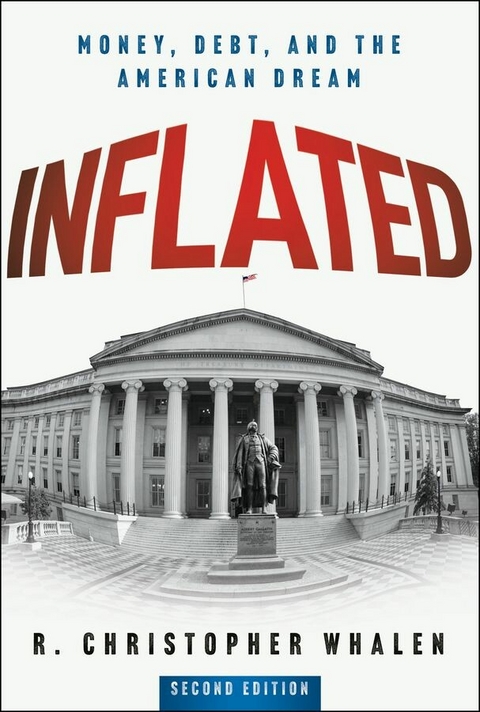
Inflated (eBook)
556 Seiten
Wiley (Verlag)
978-1-394-28572-3 (ISBN)
Discover where America's monetary system is heading-and how it will impact you-in the years to come
In the newly revised second edition of Inflated: How Money & Debt Built the American Dream, veteran investment banker, author, and Chairman of Whalen Global Advisors LLC delivers the latest installment of his concise history of the United States' monetary system, putting contemporary financial phenomena like inflation and high housing costs into context. You'll learn to understand how issues like the public debt and the rise of cryptocurrencies can be understood through the lens of how the United States government exploits debt and the monetary system to fund its operations.
The author explains:
- How contemporary concepts like Modern Monetary Theory fit into and influence the American economy
- How and why the United States' debt has tripled in the last fifteen years and the necessary consequences of that increase
- The likelihood and potential impacts of another economic correction during the 2020s
An engrossing and essential read for anyone interested in the economic and monetary realities driving our markets, politics, and societies, the second edition of Inflated is an eye-opening discussion of the drastic changes unfolding in the American economy and the even more dramatic transformations that lie just beyond the horizon.
R. CHRISTOPHER WHALEN is an investment banker and author in New York City. He is Chairman of Whalen Global Advisors LLC, which focuses on the financial services, mortgage finance, and technology sectors. He has three decades' experience as a writer and financial professional in Washington, New York, and London.
Discover where America's monetary system is heading and how it will impact you in the years to come In the newly revised second edition of Inflated: How Money & Debt Built the American Dream, veteran investment banker, author, and Chairman of Whalen Global Advisors LLC delivers the latest installment of his concise history of the United States' monetary system, putting contemporary financial phenomena like inflation and high housing costs into context. You'll learn to understand how issues like the public debt and the rise of cryptocurrencies can be understood through the lens of how the United States government exploits debt and the monetary system to fund its operations. The author explains: How contemporary concepts like Modern Monetary Theory fit into and influence the American economy How and why the United States' debt has tripled in the last fifteen years and the necessary consequences of that increase The likelihood and potential impacts of another economic correction during the 2020s An engrossing and essential read for anyone interested in the economic and monetary realities driving our markets, politics, and societies, the second edition of Inflated is an eye-opening discussion of the drastic changes unfolding in the American economy and the even more dramatic transformations that lie just beyond the horizon.
Chapter 1
Free Banking and Private Money
In his December 1776 pamphlet The Crisis, Thomas Paine famously said, “These are the times that try men's souls.” He then proceeded to lay out a detailed assessment of America's military challenges in fighting the British. But after the fighting was over, America faced the task of creating a new, independent state separate from British trade and especially independent from the banks of the City of London. The story of creating new money and debt in early America is the chronicle of how a fragment of the British empire broke off in the late 1700s and supplanted and surpassed Great Britain in economic terms by the end of World War II. Britain for centuries was the dominant economic system in the world, yet in just 250 years America grew to lead the global economy.
The English pound was not the first great global currency, nor will the dollar likely be the last. Mankind has been through cycles of inflation and deflation more than once, going back to before Greek and Roman times. The story of money in each society is a description of the ebb and flow of these states in economic as well as political terms. The latest version of this repeating narrative features a still very young country called America, which used money and the promise of it to build a global economic empire based upon the dollar.
When the 13 colonies reluctantly declared independence from Great Britain in 1776, the young nation had no independent banking system and no common currency, although most colonists knew the political and financial traditions of Europe. The Articles of Confederation adopted in 1777 did not even give the central government the ability to levy taxes to retire war debt. European banks and governments met America's capital needs via loans and gold coins. Pawnbrokers were the predominant source of credit for individuals, and businesses obtained commercial credit from banks, mostly foreign. Foreign coins and some colonial paper money were in circulation, yet barter was the most common means of payment used by Americans from the start of the nation's existence through the Civil War.1
Sidney Homer and Richard Sylla wrote in the classic work A History of Interest Rates:
The American colonies were outposts of an old civilization. Their physical environment was primitive, but their political and financial traditions were not. Therefore, the history of colonial credit and interest rates is not a history of innovation but rather a history of adaptation.2
One early adaptation of the states was to issue paper debt to pay bills. Going back to the revolution and the inception of the republic, America's leaders have always been reluctant to raise taxes. After the adoption of the Articles of Confederation, tax collection was loosely enforced and the increase in paper currency drove inflation higher in the last decades of the 1700s. Issuing IOUs was easier than collecting taxes, although the tax was paid via currency inflation.
Upon winning independence, the colonies formed states and issued colonial currency. Bonds were issued, when possible, with individuals and even the government of France subscribing in the earliest days of the young nation. The Bank of North America was established in Philadelphia by the Continental Congress in 1782 and became the first chartered bank in the United States. Creating a new bank under the control of the American government was an effort to gain some independence from private banks and also foreign nations.
David McCullough's Pulitzer Prize–winning biography John Adams presents several scenes where the ambassador of the new American government goes literally hat in hand to the capitals of Europe seeking foreign currency loans. The tireless Adams was able to secure huge sums that sustained the colonial war effort. But as Adams knew too well, his family and other Americans suffered horribly due to inflation and privation in those early years.
“Rampant inflation, shortages of nearly every necessity made the day-to-day struggle at home increasingly difficult,” McCullough relates. “‘A dollar was not worth what a quarter had been,’ Abigail [Adams] reported. ‘Our money will soon be as useless as blank paper.’”3 This need was acute since the U.S. government lacked the power to tax or the means to collect it. Nor would the American people tolerate higher taxes, because of the unhappy experience with Britain. The leaders of the American revolution led a political revolt against unfair taxation; thus they were not in a position to then raise taxes.
Adams was no apologist for debt, but he believed that having a national debt was a good thing because it created relationships with other nations that helped the nation survive and grow. In his correspondence with Thomas Jefferson, Adams showed the sharp contrast between on the one hand wanting to create a constituency among financial powers for America's national debt while on the other hand expressing his opposition to having private bankers and banks.
The Mississippi Bubble, a financial scheme in eighteenth-century France that led to a speculative frenzy and market collapse, lent a new meaning to the term “bubble.” The term denoted deception. Speculators were known as “bubblers” and to be cheated was to get bubbled, Harold James reveals in Seven Crashes: The Economic Crises That Shaped Globalization.4
Owing somewhat to the shortcomings of banks and bankers, Adams advocated creating a single, publicly owned national bank to serve the needs of the country, with branches in the individual states. He wanted to prohibit the states from chartering banks and to have one single, national institution. Ron Chernow wrote in his 2004 biography Alexander Hamilton that Adams viewed banking “as a confidence trick by which the rich exploited the poor.” He quoted Adams similarly saying that “every bank in America is an enormous tax upon the people for the profit of individuals.”
Adams wanted one state bank with branches around the nation, but no private banks at all.5 He differed significantly from Alexander Hamilton on these issues, even though like Hamilton, Adams was interested in strengthening the country's finances. Hamilton, a New York lawyer who became the first Treasury secretary and a future leader of the United States, was a great advocate of private banks and debt. He believed that finance was the key both to political power and economic growth. Author Joe Costello summed up Hamilton's significance:
Hamilton understood the control of money as a fundamental component of the rule of the modern state. At the time or now for that matter, he was one of a very few to understand the role debt played as the foundation of modern money. As the first Secretary of the Treasury, in a report to President Washington, Hamilton astutely noted “government debt had a ‘capacity for prompt convertibility' to currency, potentially rendering transfers ‘equivalent to a payment in coin.'” In part, the constitution was established to make good the debt incurred during the revolution. Just as importantly, Hamilton understood the new federal government incurring greater debt would help unite and develop the infant nation.6
The charter of the Bank of North America lapsed in 1790 and two years later, the State of New York chartered The Bank of New York, which is the corporate predecessor of the company now known as Bank of New York/Mellon. Supported by New York's powerful merchants, the bank was first organized in 1784 and was led by Hamilton.
So important was the Bank of New York to the local economy that much of the region's commercial activity was financed by this single institution for decades even as other institutions were chartered. The formation of the bank was not just a financial event, but a very significant political milestone as well that greatly elevated the power of New York.7, There was no real money nor any payment system in existence for the country. Commerce had been financed by English and other foreign banks up until the Revolutionary War. Now the United States had to create a new financial system to replace these trade relationships, a process that would take more than a century.
The demise of the Bank of North America at the end of the 1700s came as a political battle raged over whether the federal government should assume the debts incurred by the states and cities during the war against Britain. The final agreement from southerners to support the assumption of state debts was tied to the compromise over moving the location of the capital city from New York to Philadelphia temporarily and eventually to an entirely new capital on the Potomac River to be called Washington. But this Compromise of 1790 engineered by Jefferson and Hamilton did not deal with the issue of a national bank.
The Bank of the United States
President George Washington chartered the First Bank of the United States in 1791. This was the government's attempt at creating a permanent central bank of issue for the infant nation. Madison and Jefferson opposed the bank, but Adams ironically led a sizable majority in the Congress that favored the measure.
The First Bank of the United States had just a 20-year charter. While it was a bold and novel innovation, the bank only provided credit to established merchants. During the presidency of Thomas Jefferson, the agrarian and other interests not served by the Bank...
| Erscheint lt. Verlag | 29.4.2025 |
|---|---|
| Sprache | englisch |
| Themenwelt | Wirtschaft ► Betriebswirtschaft / Management |
| Schlagworte | American consumer debt • american debt • American monetary policy • American public debt • consumer inflation • Consumer Price Index • inflation in America • monetary policy • us consumer debt • US debt • us inflation • US monetary policy • us public debt |
| ISBN-10 | 1-394-28572-8 / 1394285728 |
| ISBN-13 | 978-1-394-28572-3 / 9781394285723 |
| Informationen gemäß Produktsicherheitsverordnung (GPSR) | |
| Haben Sie eine Frage zum Produkt? |
 EPUB (Adobe DRM)
Kopierschutz: Adobe-DRM
Adobe-DRM ist ein Kopierschutz, der das eBook vor Mißbrauch schützen soll. Dabei wird das eBook bereits beim Download auf Ihre persönliche Adobe-ID autorisiert. Lesen können Sie das eBook dann nur auf den Geräten, welche ebenfalls auf Ihre Adobe-ID registriert sind.
Details zum Adobe-DRM
Dateiformat: EPUB (Electronic Publication)
EPUB ist ein offener Standard für eBooks und eignet sich besonders zur Darstellung von Belletristik und Sachbüchern. Der Fließtext wird dynamisch an die Display- und Schriftgröße angepasst. Auch für mobile Lesegeräte ist EPUB daher gut geeignet.
Systemvoraussetzungen:
PC/Mac: Mit einem PC oder Mac können Sie dieses eBook lesen. Sie benötigen eine
eReader: Dieses eBook kann mit (fast) allen eBook-Readern gelesen werden. Mit dem amazon-Kindle ist es aber nicht kompatibel.
Smartphone/Tablet: Egal ob Apple oder Android, dieses eBook können Sie lesen. Sie benötigen eine
Geräteliste und zusätzliche Hinweise
Buying eBooks from abroad
For tax law reasons we can sell eBooks just within Germany and Switzerland. Regrettably we cannot fulfill eBook-orders from other countries.
aus dem Bereich