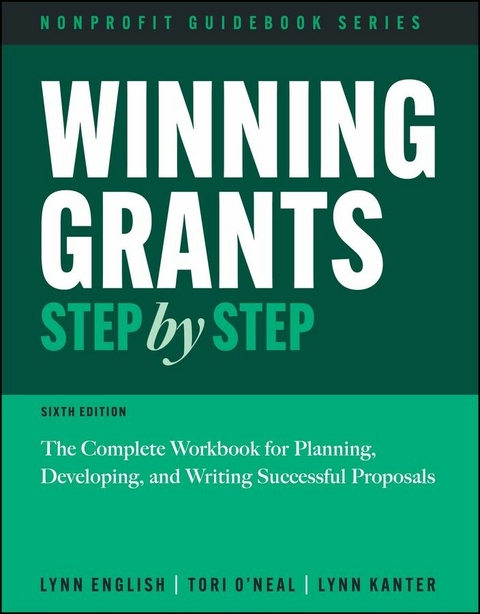
Winning Grants Step by Step (eBook)
230 Seiten
Jossey-Bass (Verlag)
978-1-394-32162-9 (ISBN)
The gold standard 'how-to' manual for writing a winning grant application or proposal, thoroughly updated and revised
In the newly revised sixth edition of Winning Grants Step by Step: The Complete Workbook for Planning, Developing and Writing Successful Proposals, a team of veteran nonprofit leaders delivers the most up-to-date and straightforward version of this book yet. This easy-to-read manual enables individuals and organizations alike to combine concepts and research into a strong, effective proposal.
The latest edition explores some of the most relevant developments that have occurred over the last five years, including:
- New information and strategies for prospect research, including state-of-the art databases and AI-enabled research and prospecting
- How to use AI for research and writing in a ways that are ethical, transparent, strategic, and efficient
- Updated resources and information for electronically submitted grants
- Updated guidelines and tips for federal, state, and local government grants in the US
- New information about the increasing popularity of Donor Advised Funds (DAFs)
- Updated discussions about mega-donors (like Mackenzie Scott and Melinda Gates) and how they give
Perfect for nonprofit executives, professionals, fundraisers, grant and proposal writers, and other stakeholders, Winning Grants Step-by-Step is the most clear-cut and simplified 'how-to' guide to writing a winning proposal that incorporates the latest changes in the philanthropic sector and nonprofit community.
The gold standard how-to manual for writing a winning grant application or proposal, thoroughly updated and revised In the newly revised sixth edition of Winning Grants Step by Step: The Complete Workbook for Planning, Developing and Writing Successful Proposals, a team of veteran nonprofit leaders delivers the most up-to-date and straightforward version of this book yet. This easy-to-read manual enables individuals and organizations alike to combine concepts and research into a strong, effective proposal. The latest edition explores some of the most relevant developments that have occurred over the last five years, including: New information and strategies for prospect research, including state-of-the art databases and AI-enabled research and prospecting How to use AI for research and writing in a ways that are ethical, transparent, strategic, and efficient Updated resources and information for electronically submitted grants Updated guidelines and tips for federal, state, and local government grants in the US New information about the increasing popularity of Donor Advised Funds (DAFs) Updated discussions about mega-donors (like Mackenzie Scott and Melinda Gates) and how they give Perfect for nonprofit executives, professionals, fundraisers, grant and proposal writers, and other stakeholders, Winning Grants Step-by-Step is the most clear-cut and simplified how-to guide to writing a winning proposal that incorporates the latest changes in the philanthropic sector and nonprofit community.
Step 1
Develop a Proposal Idea That Serves Your Mission
IT IS TIME TO TAKE THE first step. This chapter explores some questions to help develop the proposal idea.
A good approach is to begin with the end in mind. The goal is to secure funding that will enable your organization to pursue its mission. The proposal can seek support for the entirety of your organization's work (a general support proposal) or for a segment of the work (for example, a program or project proposal). This workbook focuses on a general operating support request as the model for developing a proposal.
It is critical for grantseekers to research prospective funders so that you understand each funder's programmatic priorities, geographic focus, and issue areas. Some funders prefer to invest in new and expanding programs rather than general operating support or program continuation. Others might have an interest in a special project, a capacity‐building idea, a set of technology improvements, or in building up particular capacities within organizations. Your aim is to find a good match between the funder's interests and your organization's existing goals, commitments, and plans.
When preparing a proposal, most grantwriters start with the planning sections (statement of need; goals, objectives, and strategies; evaluation; organizational capacity; sustainability; and budget) because these sections form the core of the proposal. Most finish by writing the executive summary because it needs to incorporate the most important points from the previous sections. This workbook follows that format, keeping in mind that most foundation proposals are now submitted via online portals and with limited space. The limited space requires being even more succinct with grant proposal copy. Every word, space, and punctuation mark counts. (Please refer to the “Helpful Hint” section.)
The planning sections of the proposal deserve careful attention; without a clearly articulated plan, it is nearly impossible to get funding. Writing a crisp, goal‐oriented proposal is crucial. If a grantseeker can't succinctly explain who they serve, what they plan to do, why they're doing it, and how they're going to do it (and measure their success in doing so), foundation staff will not have what they need to understand the request and why it is worthwhile, or to advocate on the organization's behalf.
The importance of having the right people at the table when the proposal plan is developed cannot be overstated. Nonprofit organizations sometimes make the serious mistake of securing funding for a program that they do not have the ability to implement or – worse yet – a program that does not meet the needs of their constituency or service area because it was developed without the appropriate staff people involved. Who are the appropriate people? Please refer to the Introduction, “An Overview of the Grantseeking Process.”
A general guideline is that nonprofits should expect to focus approximately 70 percent of their time on program planning; the other 30 percent can be dedicated to crafting the proposal summary and conducting the proposal submission process. Remember, submitting via an online portal is going to take some time, as will gathering the required attachments, so these steps need to be factored into the overall timeline.
The tighter an organization's plan (annual operating or programmatic), the easier the proposal will be to write. Enter this process knowing that even with a program plan in hand, you will need to fine‐tune the plan as the proposal is being developed. This should also be built into the timeline.
Consider the proposal included in this workbook as an example. Open Options in the (fictional) city of Naylor is an organization that has identified and is successfully meeting an unmet need in a well‐defined community. As an existing organization, rather than a start‐up nonprofit, Open Options is clear on its issue focus, the community it serves, its goals and objectives, and its strategies for success. In the case of Open Options, the executive director will drive the development of the organization's annual operating plan and will involve other staff, program participants, and volunteers as appropriate. The annual operating plan for the organization will serve as the basis of the proposal.
Helpful Hint
HOW TO STAY WITHIN THE LENGTH LIMITS FOR PORTAL SUBMISSIONS
Most grant proposals are submitted through a foundation's online portal, which generally limits text to a certain length. While some portals allow you to save text as you type, it is generally easier and safer (from tech glitches) to draft the proposal using your usual word processing program rather than in the foundation's portal. When you're satisfied with what you've written and the appropriate people in your organization have approved it, then you can cut and paste the text into the portal.
For instance, let's say a foundation limits the evaluation section of a proposal to 3,000 characters, including spaces. Once you've written the evaluation section, use the word‐count feature that most word processing programs have to find out how many characters the section contains. (Note that some programs, such as Word, give character counts both with and without spaces; make sure you're looking at the figure with spaces, since most foundation portals include spaces in the character count.)
If the section has been written as concisely as possible but is still too long, you can shorten it by whittling down the words. (See the example in “Step 8, Write the Proposal Summary.”) This is an effective but time‐consuming way to trim text, a few characters at a time. Here are some tips, most of which are helpful to strengthen writing in general:
- Excise double descriptions. Look for places where two descriptors were used but one will do, such as, “The work is both challenging and demanding.” Choose one and delete the other.
- Delete flabby words. In good writing, every word must carry its weight; if a word doesn't provide important meaning to the reader, you don't need it. Certain words are generally suspect. For instance, the words “key” and “specific” should be used sparingly. These are good words to delete if they are not absolutely necessary to the reader's understanding. So is “absolutely” for that matter! Same with “successfully”: If a program successfully increased participation by 50 percent, a grantwriter can communicate that just as well without using “successfully” – and save 12 characters.
- Replace words or phrases with shorter ones. “Approximately 3,000” can become “about 3,000” and shave off eight characters.
- Consider cutting words that end in “ly.” Many words that end in ly are adverbs: words that further describe other words. Most sentences are just as good without them. Strongly, honestly, swiftly – delete them. It's also good to cut (or avoid in the first place) words that intensify other words, such as “very” and “extremely.”
- Bend some rules. It's fair to take some shortcuts to save space, even if they would not necessarily be appropriate in a full‐length text. Use a numeral instead of spelling out a number; replace “percent” with “%.” Use a well‐known acronym instead of writing out a full name.
Reality Check
Pay attention to the fit. When doing prospect research, grantseekers will come across various funding opportunities, including special initiatives and grants for programs within defined areas of interest. These opportunities might be tempting, but organizations should take care to evaluate these opportunities against their organization's mission, goals, and objectives. Is there really a fit? Or is the organization “growing another foot” to “fit the shoe” the funder is presenting? Grantseekers should keep the mission, goals, and objectives of their organization at the forefront of every funding opportunity. It is better not to pursue a particular grant than to win a grant that commits your organization to doing work that pleases a funder but does not serve your community or your mission.
To begin to develop the proposal idea, complete Worksheet 1.1. The more thorough the answers, the more helpful the worksheet will be. After completing the worksheet, use those answers to identify one idea to focus on as you develop a grant proposal using the exercises in this workbook. To check the merit of the idea you identified, answer the Proposal Development Review Questions at the end of this chapter, and then follow Steps 2 through 9 to create a well‐planned, winning grant proposal. Throughout the steps, this workbook will refer grantseekers to the accompanying website for worksheet examples and templates.
WORKSHEET 1.1: Proposal Idea Questionnaire
- What programs or projects are you planning for the next two to three years?
Program/Project A:
Program/Project B:
Program/Project C:
Program/Project D:
- In what ways are these programs or projects compatible with your organization's current mission and...
| Erscheint lt. Verlag | 24.4.2025 |
|---|---|
| Reihe/Serie | The Jossey-Bass Nonprofit Guidebook Series |
| Sprache | englisch |
| Themenwelt | Wirtschaft ► Betriebswirtschaft / Management |
| Schlagworte | grant writing • how to apply for a grant • how to write a grant • How to Write a Grant Application • how to write a grant proposal • how to write a proposal • nonprofit fundraising • nonprofit fundraising with ai • proposal writing |
| ISBN-10 | 1-394-32162-7 / 1394321627 |
| ISBN-13 | 978-1-394-32162-9 / 9781394321629 |
| Informationen gemäß Produktsicherheitsverordnung (GPSR) | |
| Haben Sie eine Frage zum Produkt? |
 EPUB (Adobe DRM)
Kopierschutz: Adobe-DRM
Adobe-DRM ist ein Kopierschutz, der das eBook vor Mißbrauch schützen soll. Dabei wird das eBook bereits beim Download auf Ihre persönliche Adobe-ID autorisiert. Lesen können Sie das eBook dann nur auf den Geräten, welche ebenfalls auf Ihre Adobe-ID registriert sind.
Details zum Adobe-DRM
Dateiformat: EPUB (Electronic Publication)
EPUB ist ein offener Standard für eBooks und eignet sich besonders zur Darstellung von Belletristik und Sachbüchern. Der Fließtext wird dynamisch an die Display- und Schriftgröße angepasst. Auch für mobile Lesegeräte ist EPUB daher gut geeignet.
Systemvoraussetzungen:
PC/Mac: Mit einem PC oder Mac können Sie dieses eBook lesen. Sie benötigen eine
eReader: Dieses eBook kann mit (fast) allen eBook-Readern gelesen werden. Mit dem amazon-Kindle ist es aber nicht kompatibel.
Smartphone/Tablet: Egal ob Apple oder Android, dieses eBook können Sie lesen. Sie benötigen eine
Geräteliste und zusätzliche Hinweise
Buying eBooks from abroad
For tax law reasons we can sell eBooks just within Germany and Switzerland. Regrettably we cannot fulfill eBook-orders from other countries.
aus dem Bereich