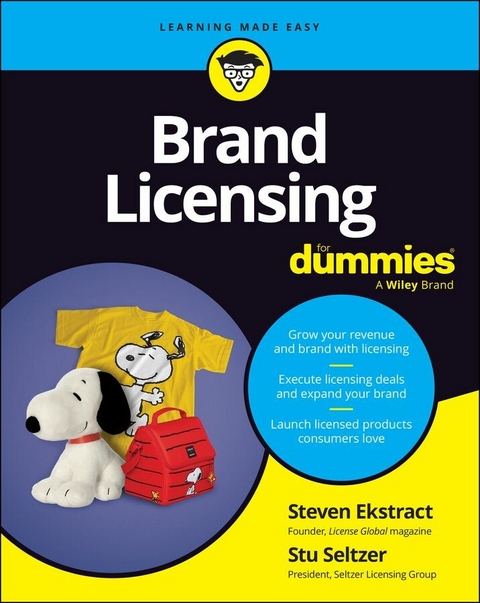
Brand Licensing For Dummies (eBook)
333 Seiten
For Dummies (Verlag)
978-1-394-29018-5 (ISBN)
Your guide to profiting from the world of licensing
The brand licensing business is everywhere, turning intellectual property in sectors like entertainment, sports, and fashion into consumer products. Brand Licensing For Dummies offers advice from a pair of the leading experts on licensing to anyone entering the business of connecting content owners with product creators. In this clear guide, you'll learn about the inner workings of licensing and how both licensor and licensee benefit. Discover how to identify opportunities, negotiate deals, market licensed products, and navigate the legalities of licensing. Licensing gurus Steven Ekstract and Stu Seltzer bring decades of experience to this guide, demystifying the world of licensing and teaching you all about the win-win partnerships that allow licensors and licensees to do the things they do best.
- Discover why licensing is valuable to licensors and licensees alike
- Explore licensing agreements and different types of deals
- Learn how to spot a valuable licensing opportunity
- Negotiate solid licensing deals using the latest strategies
This book is a must for brand managers, licensing executives, intellectual property attorneys, product developers, marketing managers, and business owners. Whatever your role, Licensing For Dummies will give you practical guidance, legal insights, and strategic approaches to the dynamic landscape of licensing agreements and intellectual property management.
Steven Ekstract co-founded License!, a leading business publication and news source for the global consumer products licensing industry. He is also Founder and Organizer of NYC Summit: The Business of Brand Licensing-an annual conference for global licensing industry executives. Ekstract also writes a regular column for License Global.
Stu Seltzer is the president of Seltzer Licensing Group, a leading global agency (SeltzerLicensing.com). He is a member of the Licensing International Hall of Fame (Class of 2024) and has taught Brand Licensing at New York University for over 20 years.
Your guide to profiting from the world of licensing The brand licensing business is everywhere, turning intellectual property in sectors like entertainment, sports, and fashion into consumer products. Brand Licensing For Dummies offers advice from a pair of the leading experts on licensing to anyone entering the business of connecting content owners with product creators. In this clear guide, you'll learn about the inner workings of licensing and how both licensor and licensee benefit. Discover how to identify opportunities, negotiate deals, market licensed products, and navigate the legalities of licensing. Licensing gurus Steven Ekstract and Stu Seltzer bring decades of experience to this guide, demystifying the world of licensing and teaching you all about the win-win partnerships that allow licensors and licensees to do the things they do best. Discover why licensing is valuable to licensors and licensees alike Explore licensing agreements and different types of deals Learn how to spot a valuable licensing opportunity Negotiate solid licensing deals using the latest strategies This book is a must for brand managers, licensing executives, intellectual property attorneys, product developers, marketing managers, and business owners. Whatever your role, Licensing For Dummies will give you practical guidance, legal insights, and strategic approaches to the dynamic landscape of licensing agreements and intellectual property management.
Chapter 1
How Brand Licensing Works
IN THIS CHAPTER
Introducing brand licensing
Showcasing why businesses love brand licensing (and you should too!)
Looking at the strategy of brand licensing
Breaking down the major licensing categories
Collaborating with other brands
Welcome to the world of brand licensing, and specifically to Brand Licensing For Dummies. In the next 16 chapters, we provide you with an easy-to-understand overview of the brand licensing business.
To kick things off, this chapter gives you the big-picture view of why brand licensing can be a game-changer for a product you make (or plan to make). But what exactly is brand licensing, what business practices does it involve, and why do companies do it? We break it all down here; and don’t worry, we’ve got plenty more details throughout the book.
Getting a Bird’s-Eye View of Brand Licensing
Here’s how brand licensing works: A company owns intellectual property (IP) — also called the brand — that builds a strong positive emotional connection with consumers. Over time, people develop an affinity for the brand. That connection makes licensing a powerful goal for expanding a brand’s reach and impact.
Brands license for several key reasons:
- Boosting consumer engagement by partnering with businesses that can reach a wider audience
- Tapping into new markets by licensing products that appeal to different demographics and are sold through different marketing channels
- Driving sales and brand visibility by creating new products or experiences that keep the brand fresh and top of mind
To make brand licensing work, IP owners team up with key players to get their products into the hands of consumers. Each member of the licensing squad has a specific role:
- The licensor: The brand owner who holds the intellectual property and grants the licensee the right to use it.
- The licensee: The manufacturer or service provider who licenses the brand to use on its products or services. In return, it pays the licensor a royalty (a percentage of sales).
- The sellers: Retailers, wholesalers, and distributors who help get the licensed products or services into stores, online marketplaces, and ultimately, into customers’ hands.
When these three work together, brand licensing becomes a powerful business tool that benefits everyone involved!
Seeing Why So Many Top Companies Love Brand Licensing
The reason so many companies use brand licensing is pretty simple: It’s an incredibly powerful marketing tool. When done right, licensing boosts a brand’s visibility, strengthens its reputation, and — unlike traditional marketing — actually generates revenue (through royalties paid by licensees) instead of just costing money.
Licensing as a marketing powerhouse
To put licensing’s marketing potential in perspective, here’s how other common marketing tactics work:
- Advertising: This marketing aspect can include anything from print ads in newspapers and magazines to billboards, TV or radio ads, or even ads online. Companies can spend millions here, but after the money’s spent, it’s gone.
- Social media posts and campaigns: Platforms such as Instagram, Facebook, and YouTube connect brands with customers, but effectively managing campaigns requires a dedicated social media team to handle the posts.
- Email marketing: Sending emails with special offers and sales to customers to keep the brand fresh in their minds is a great way to encourage repeat buyers. However, developing and maintaining an email database and constantly updating it requires significant time and investment.
- Marketing analytics: Tracking customer behavior helps refine marketing strategies, but it requires specialized software and trained experts to interpret the data.
- Search engine optimization (SEO): Ensuring a brand ranks high in search results helps drive traffic; however, optimizing websites and content requires ongoing work by SEO specialists.
- Public relations (PR): Gaining media attention through press releases and earned media helps maintain visibility, but PR efforts require an in-house team or external agency.
Unlike these other strategies, licensing allows a brand to expand into new products, reach fresh audiences, and generate revenue at the same time — all while strengthening customer loyalty.
Brand Licensing 101: How Coca-Cola capitalizes on its brand
Ever wonder why you see so many Coca-Cola hoodies, T-shirts, and caps? It’s not just fashion; it’s smart business! Coca-Cola is a master at brand licensing; the following sections break down how.
Step 1: Spend big to make big
Coca-Cola knows that advertising equals sales. In 2023, the company spent a whopping $5 billion on ads — TV, social media, billboards, you name it. That was 20 percent more than in 2022. But it worked. Its net operating revenue (a fancy term for total sales) hit $46 billion that year.
Step 2: Turn fans into free ads
Coca-Cola goes beyond selling drinks by licensing its brand for all kinds of products. Its favorite? Fashion and apparel. Sixty percent of Coca-Cola’s licensing business comes from clothing.
Think about it: When someone wears a Coca-Cola hoodie, they’re a walking billboard for the brand. But here’s the genius part: Instead of paying for the ad, Coca-Cola gets paid!
Step 3: Be selective
Even though Coca-Cola makes billions from licensed products, it doesn’t just slap its logo on anything. It carefully chooses licensing partners to protect its brand.
Too much licensing can flood the market and weaken a brand’s image. That’s why Coca-Cola sees licensing as a marketing tool first and a money-maker second.
COCA-COLA CHEWING GUM: THE BIRTH OF BRAND LICENSING
Did you know that Coca-Cola was one of the first brands to do licensing? Way back in 1903, Coca-Cola licensed its name to a separate company to produce Coca-Cola–branded chewing gum. This early move set the stage for modern brand licensing.
Fast forward 120-plus years, and Coca-Cola is still one of the most recognizable brands in the world. Licensing has been a key part of its marketing strategy from the very beginning, helping expand its brand far beyond soft drinks. (Flip to the nearby section “Brand Licensing 101: How Coca-Cola capitalizes on its brand” for details.)
Want to dive deeper into Coca-Cola’s rich licensing history? Check out The Martin Guide to Coca-Cola Memorabilia’s article at www.earlycoke.com/coca-cola-chewing-gum.
Coca-Cola’s licensing journey proves that a strong brand can go way beyond its original product and sometimes even create a whole new industry.
Exploring the licensing of other brands
Brand licensing is everywhere. From fashion and publishing to automotive, music, film, and even heavy construction, companies across industries have successfully leveraged licensing to expand their brand reach.
What do all these brands have in common? Brand equity, the loyalty and recognition that consumers have for a brand that makes it valuable beyond its core products. Strong brand equity allows companies to license their names into new and exciting product categories, from merchandise and retail experiences to theme parks and even digital content. Licensing is about creating deeper consumer connections and ensuring that a brand stays relevant and visible across different industries.
Table 1-1 provides a look at some of the most famous brands that have thrived through licensing (aside from Coca-Cola, which we cover in the earlier section “Brand Licensing 101: How Coca-Cola capitalizes on its brand”). These brands have successfully turned their names into powerful revenue streams and marketing tools, proving that a well-managed licensing strategy can be a game-changer.
TABLE 1-1 Famous Successful Brands
| The Brand | How It Started | What It Licenses |
|---|
| Star Wars | Premiered as a film in 1977 and became an instant hit that turned into a franchise. | Toys, collectibles, apparel, home décor, kitchenware, LEGO sets, board games, books, comics, trading cards, video games, and many others |
| Caterpillar | A manufacturer of construction and mining equipment (becoming the world’s leader in the industry); synonymous with rugged durability and quality. | Footwear (work boots), work wear, storage products, tools, and even toys |
| Grateful Dead | Formed in 1965; became one of the most legendary rock bands, with a devoted fan base known as Deadheads. | Apparel, posters, home décor, collectibles, accessories, lifestyle products, and even ice cream. Ben & Jerry’s Cherry Garcia flavor is one of the most famous licensed products. |
| Chevy... |
| Erscheint lt. Verlag | 23.4.2025 |
|---|---|
| Sprache | englisch |
| Themenwelt | Sachbuch/Ratgeber ► Beruf / Finanzen / Recht / Wirtschaft ► Wirtschaft |
| Wirtschaft ► Betriebswirtschaft / Management | |
| Schlagworte | business contracts • copyright book • Copyrights • Intellectual Property • intellectual property book • ip dummies • IP rights • Licensing • licensing book • licensing contracts • Public Domain • Trademark • trademark book • trademark law book • Trademark Usage |
| ISBN-10 | 1-394-29018-7 / 1394290187 |
| ISBN-13 | 978-1-394-29018-5 / 9781394290185 |
| Informationen gemäß Produktsicherheitsverordnung (GPSR) | |
| Haben Sie eine Frage zum Produkt? |
 EPUB (Adobe DRM)
Kopierschutz: Adobe-DRM
Adobe-DRM ist ein Kopierschutz, der das eBook vor Mißbrauch schützen soll. Dabei wird das eBook bereits beim Download auf Ihre persönliche Adobe-ID autorisiert. Lesen können Sie das eBook dann nur auf den Geräten, welche ebenfalls auf Ihre Adobe-ID registriert sind.
Details zum Adobe-DRM
Dateiformat: EPUB (Electronic Publication)
EPUB ist ein offener Standard für eBooks und eignet sich besonders zur Darstellung von Belletristik und Sachbüchern. Der Fließtext wird dynamisch an die Display- und Schriftgröße angepasst. Auch für mobile Lesegeräte ist EPUB daher gut geeignet.
Systemvoraussetzungen:
PC/Mac: Mit einem PC oder Mac können Sie dieses eBook lesen. Sie benötigen eine
eReader: Dieses eBook kann mit (fast) allen eBook-Readern gelesen werden. Mit dem amazon-Kindle ist es aber nicht kompatibel.
Smartphone/Tablet: Egal ob Apple oder Android, dieses eBook können Sie lesen. Sie benötigen eine
Geräteliste und zusätzliche Hinweise
Buying eBooks from abroad
For tax law reasons we can sell eBooks just within Germany and Switzerland. Regrettably we cannot fulfill eBook-orders from other countries.
aus dem Bereich