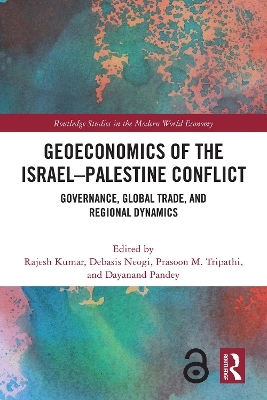
Geoeconomics of the Israel–Palestine Conflict
Routledge (Verlag)
978-1-032-84371-1 (ISBN)
The book offers a thorough analysis of the various economic effects of the conflict between Israel and Palestine. With the help of insights from a variety of fields, such as economics, political science, international relations, and humanitarian studies, it provides a comprehensive explanation of how this geopolitical battle affects the world economy. It goes beyond theory to include real-world case studies that show the conflict's true economic repercussions. The book is current and discusses the state of the Israel-Palestine conflict, which is relevant given how geopolitical conflicts are constantly changing. It examines the financial ramifications in light of current affairs, making it an important and topical reference for everyone trying to figure out how this protracted battle affects the world economy.
Scholars and researchers in fields such as international relations, economics, political science, global studies, and conflict resolution will find the book valuable for its in-depth analysis and research on the Israel-Palestine conflict's geopolitical and economic dimensions. Policymakers and international organisations looking for workable solutions to deal with the economic difficulties brought on by geopolitical tensions will learn from the insights presented in the book.
The Open Access version of this book, available at www.taylorfrancis.com, has been made available under a Creative Commons Attribution-Non Commercial-No Derivatives (CC-BY-NC-ND) 4.0 International license.
Rajesh Kumar is Assistant Professor and Research Scholar at the Department of Economics, Institute of Management Studies Ghaziabad, National Institute of Technology, Agartala, India. Debasis Neogi is Professor and Dean at the Department of Management, Humanities and Social Sciences, National Institute of Technology (NIT) Agartala, India. Prasoon M. Tripathi is Director at IMS Ghaziabad, Uttar Pradesh, India. Dayanand Pandey is Professor and Dean at Jindal School of Banking & Finance, Sonipat, India.
Introduction 1: Economics Amidst the Israeli-Palestinian Conflict: The Case of Syria 2. The Israel-Palestine Conflict: A Century of Tensions and Transformations 3. Governance Challenges and State Fragility in Conflict-Affected Regions 4. Resource Conflict in the Global South: Lessons from Israel-Palestine 5. The Israel-Palestine Conflict's Global Reach: The Impact on Developed Economies 6. Multilateral Diplomacy and International Mediation: A Way Forward 7. The Economic Impact of the Israel-Palestine Conflict and Policy Pathways for Stability and Growth: Breaking Through International Barriers 8. Charting a Path Forward: Synthesizing Key Findings of Economic and Diplomatic Solutions 9. The Israel-Palestine War and its Ripple Effects on the Indian Stock Market: An Event Study of Key Sectors 10. Scholarly Sentiments and Research Focus in the Context of the Geopolitics of the Israel-Palestine Conflict 11. Conclusion
| Erscheinungsdatum | 15.08.2025 |
|---|---|
| Reihe/Serie | Routledge Studies in the Modern World Economy |
| Zusatzinfo | 12 Tables, black and white; 9 Line drawings, black and white; 9 Illustrations, black and white |
| Verlagsort | London |
| Sprache | englisch |
| Maße | 156 x 234 mm |
| Gewicht | 520 g |
| Themenwelt | Wirtschaft ► Allgemeines / Lexika |
| Wirtschaft ► Volkswirtschaftslehre ► Makroökonomie | |
| Wirtschaft ► Volkswirtschaftslehre ► Wirtschaftspolitik | |
| ISBN-10 | 1-032-84371-3 / 1032843713 |
| ISBN-13 | 978-1-032-84371-1 / 9781032843711 |
| Zustand | Neuware |
| Informationen gemäß Produktsicherheitsverordnung (GPSR) | |
| Haben Sie eine Frage zum Produkt? |
aus dem Bereich