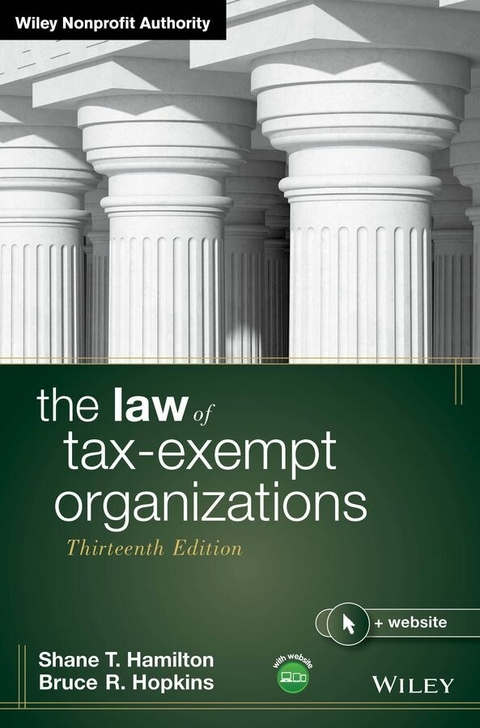
The Law of Tax-Exempt Organizations (eBook)
2004 Seiten
Wiley (Verlag)
978-1-394-25843-7 (ISBN)
Ensure compliance with the latest tax-exempt legal developments
The 13th edition of The Law of Tax-Exempt Organizations compiles all of the latest pertinent statutes, regulations, rulings, and court opinions into a single authoritative resource. Written by renowned authors and legal experts Bruce R. Hopkins and Shane Hamilton, this book uses accessible language and extensive tabular information to allow for easy navigation and quick reference.
A companion website provides seven additional online resources, including Cumulative Tables of IRS Private Letter Rulings, Technical Advice Memoranda, and Counsel Memoranda. Sample topics featured in this book include:
- Nonprofit governance, including board duties and responsibilities in duty of care, loyalty, and obedience
- Charitable organizations focusing on relief of distressed, provision of housing, and promotion of health and social welfare
- General constitutional law principles and internal revenue code provisions for religious organizations
- Public charities, private foundations, and other types of charitable organizations, such as amateur sports leagues, business leagues, and social clubs
Tax laws are continuously evolving and the statutes and regulations for tax-exempt organizations change more quickly than most. The thirteenth edition of The Law of Tax-Exempt Organizations is an essential reference for all non-profit organizations to ensure compliance in all directives and activities.
Ensure compliance with the latest tax-exempt legal developments The 13th edition of The Law of Tax-Exempt Organizations compiles all of the latest pertinent statutes, regulations, rulings, and court opinions into a single authoritative resource. Written by renowned authors and legal experts Bruce R. Hopkins and Shane Hamilton, this book uses accessible language and extensive tabular information to allow for easy navigation and quick reference. A companion website provides seven additional online resources, including Cumulative Tables of IRS Private Letter Rulings, Technical Advice Memoranda, and Counsel Memoranda. Sample topics featured in this book include: Nonprofit governance, including board duties and responsibilities in duty of care, loyalty, and obedience Charitable organizations focusing on relief of distressed, provision of housing, and promotion of health and social welfare General constitutional law principles and internal revenue code provisions for religious organizations Public charities, private foundations, and other types of charitable organizations, such as amateur sports leagues, business leagues, and social clubs Tax laws are continuously evolving and the statutes and regulations for tax-exempt organizations change more quickly than most. The thirteenth edition of The Law of Tax-Exempt Organizations is an essential reference for all non-profit organizations to ensure compliance in all directives and activities.
CHAPTER ONE
Definition of and Rationales for Tax‐Exempt Organizations
- § 1.1 Definition of Nonprofit Organization
- § 1.2 Definition of Tax‐Exempt Organization
- § 1.3 Tax‐Exempt Organizations Law Philosophy
- § 1.4 Political Philosophy Rationale
- § 1.5 Inherent Tax Rationale
- § 1.6 Other Rationales and Reasons for Exempt Organizations
- § 1.7 Freedom of Association Doctrine
Nearly all federal and state law pertains, directly or indirectly, to tax‐exempt organizations; there are few areas of law that have no bearing whatsoever on these entities. The fields of federal law that directly apply to exempt organizations include tax exemption and charitable giving requirements, and the laws concerning antitrust, contracts, education, employee benefits, the environment, estate planning, health care, housing, labor, political campaigns, the postal system, securities, and fundraising for charitable and political purposes. The aspects of state law concerning exempt organizations are much the same as the federal ones, along with laws pertaining to the formation and operation of corporations and trusts, insurance, real estate, and charitable solicitation acts. Both levels of government have much constitutional and administrative law directly applicable to exempt organizations. A vast array of other civil and criminal laws likewise applies. The principal focus of this book is the federal tax law as it applies to nonprofit organizations.
§ 1.1 DEFINITION OF NONPROFIT ORGANIZATION
A tax‐exempt organization is a unique entity; among its features is the fact that it is (with few exceptions) a nonprofit organization. Most of the laws that pertain to the concept and creation of a nonprofit organization originate at the state level, while most laws concerning tax exemption are generated at the federal level. Although almost every nonprofit entity is incorporated or otherwise formed under state law, a few nonprofit organizations are chartered by federal statute. The nonprofit organizations that are the chief focus from a federal tax law standpoint are corporations, trusts, and unincorporated associations. There may also, however, be the use of limited liability companies in this regard.
A nonprofit organization is not necessarily a tax‐exempt organization. To be exempt, a nonprofit organization must meet certain criteria. As noted, most of these criteria are established under federal law. State law, however, may embody additional criteria; those rules can differ in relation to the tax from which exemption is sought (such as taxes on income, sales of goods or services, use of property, tangible personal property, intangible personal property, or real property).1 Thus, nonprofit organizations can be taxable entities, under both federal and state law.2
(a) Nonprofit Organization Defined
The term nonprofit organization does not refer to an organization that is prohibited by law from earning a profit (that is, an excess of earnings over expenses). In fact, it is quite common for nonprofit organizations to generate profits. Rather, the definition of nonprofit organization essentially relates to requirements as to what must be done with the profits earned or otherwise received.
The legal concept of a nonprofit organization is best understood through a comparison with a for‐profit organization. The essential difference between nonprofit and for‐profit organizations is reflected in the private inurement doctrine.3 Nonetheless, the characteristics of the two categories of organizations are often identical, in that both mandate a legal form,4 one or more directors or trustees, and usually officers; both of these types of entities can have employees (and thus pay compensation), face essentially the same expenses, make investments, enter into contracts, sue and be sued, produce goods and/or services, and, as noted, generate profits.5
A fundamental distinction between the two entities is that the for‐profit organization has owners who hold the equity in the enterprise, such as stockholders of a corporation. The for‐profit organization is operated for the benefit of its owners; the profits of the business undertaking are passed through to them, such as by the payment of dividends on shares of stock. That is what is meant by the term for‐profit organization: It is one that is designed to generate a profit for its owners. The transfer of the profits from the organization to its owners is the inurement of net earnings to them in their private capacity.
By contrast, a nonprofit organization generally is not permitted to distribute its profits (net earnings) to those who control it (such as directors and officers).6 (A nonprofit organization rarely has owners.)7 Simply stated, a nonprofit organization is an entity that cannot lawfully engage in private inurement. Consequently, the private inurement doctrine is the substantive defining characteristic that distinguishes nonprofit organizations from for‐profit organizations for purposes of the federal tax law.
In addition to the prohibition on private inurement, several state nonprofit corporation acts require the nonprofit entity to devote its profits to ends that are beneficial to society or the public, such as purposes that are classified as agricultural, arts promotion, athletic, beneficial, benevolent, cemetery, charitable, civic, cultural, debt management, educational, eleemosynary, fire control, fraternal, health promotion, horticultural, literary, musical, mutual improvement, natural resources protection, patriotic, political, professional, religious, research, scientific, and/or social.8
(b) Nonprofit Sector
Essential to an understanding of the nonprofit organization is appreciation of the concept of the nonprofit sector of society. This sector of society has been termed, among other titles, the independent sector, the third sector, the voluntary sector, and the philanthropic sector.
A tenet of political philosophy is that a democratic state—or, as it is sometimes termed, civil society—has three sectors. These sectors contain institutions and organizations that are governmental, for‐profit, and nonprofit in nature. Thus, in the United States, the governmental sector includes the branches, departments, agencies, and bureaus of the federal, state, and local governments; the class of for‐profit entities comprises the business, trade, professional, and commercial segment of society; and nonprofit entities constitute the balance of this society. The nonprofit sector is seen as being essential to the maintenance of freedom for individuals and a bulwark against the excesses of the other two sectors, particularly the governmental sector.
There are subsets within the nonprofit sector. Tax‐exempt organizations represent a subset of nonprofit organizations. Organizations that are eligible to attract deductible charitable gifts, charitable organizations (using the broad definition),9 and other types of exempt organizations are subsets of exempt organizations. Charitable organizations (in the narrow, technical sense of that term) are subsets of charitable organizations (as defined in the broader sense).10
§ 1.2 DEFINITION OF TAX‐EXEMPT ORGANIZATION
The term tax‐exempt organization is somewhat of a fabrication, in that nonprofit organizations are rarely excused from being subject to all taxes, including the federal income tax. There are, of course, other applicable federal taxes, such as excise and employment taxes; there are categories of exemptions from them. At the state level, there are exemptions associated with income, sales, use, excise, and property taxes.
The income tax that is potentially applicable to nearly all tax‐exempt organizations is the tax on income derived from an unrelated trade or business.11 Exempt entities can be taxed for engaging in political activities;12 public charities are subject to tax in the case of substantial efforts to influence legislation13 or participation in political campaign activities;14 business leagues may elect to pay a proxy tax;15 donor‐advised funds are subject to taxes;16 and some exempt organizations, such as social clubs and political organizations, are taxable on their investment income.17 Private foundations are caught up in a variety of excise taxes.18
This anomaly of a tax‐exempt organization being an entity that is subject to various taxes is addressed in the Internal Revenue Code. There it is written that an organization that is exempt from tax19 shall nonetheless be subject to certain taxes but, notwithstanding that tax exposure, “shall be considered an organization exempt from income taxes for the purpose of any law which refers to organizations exempt from income taxes.”20 The Internal Revenue Service (IRS) advanced the argument that an organization, having paid tax on unrelated business income for some of its years, should not be considered a tax‐exempt organization for a federal tax law purpose,21 but that...
| Erscheint lt. Verlag | 14.4.2025 |
|---|---|
| Reihe/Serie | Wiley Nonprofit Authority |
| Sprache | englisch |
| Themenwelt | Wirtschaft ► Betriebswirtschaft / Management |
| Schlagworte | business nonprofit • charity governance • charity law • charity legal • charity regulations • nonprofit court opinions • Nonprofit Governance • Nonprofit Law • nonprofit regulations • nonprofit rulings • nonprofit statutes • Religious Charity |
| ISBN-10 | 1-394-25843-7 / 1394258437 |
| ISBN-13 | 978-1-394-25843-7 / 9781394258437 |
| Informationen gemäß Produktsicherheitsverordnung (GPSR) | |
| Haben Sie eine Frage zum Produkt? |
 EPUB (Adobe DRM)
Kopierschutz: Adobe-DRM
Adobe-DRM ist ein Kopierschutz, der das eBook vor Mißbrauch schützen soll. Dabei wird das eBook bereits beim Download auf Ihre persönliche Adobe-ID autorisiert. Lesen können Sie das eBook dann nur auf den Geräten, welche ebenfalls auf Ihre Adobe-ID registriert sind.
Details zum Adobe-DRM
Dateiformat: EPUB (Electronic Publication)
EPUB ist ein offener Standard für eBooks und eignet sich besonders zur Darstellung von Belletristik und Sachbüchern. Der Fließtext wird dynamisch an die Display- und Schriftgröße angepasst. Auch für mobile Lesegeräte ist EPUB daher gut geeignet.
Systemvoraussetzungen:
PC/Mac: Mit einem PC oder Mac können Sie dieses eBook lesen. Sie benötigen eine
eReader: Dieses eBook kann mit (fast) allen eBook-Readern gelesen werden. Mit dem amazon-Kindle ist es aber nicht kompatibel.
Smartphone/Tablet: Egal ob Apple oder Android, dieses eBook können Sie lesen. Sie benötigen eine
Geräteliste und zusätzliche Hinweise
Buying eBooks from abroad
For tax law reasons we can sell eBooks just within Germany and Switzerland. Regrettably we cannot fulfill eBook-orders from other countries.
aus dem Bereich