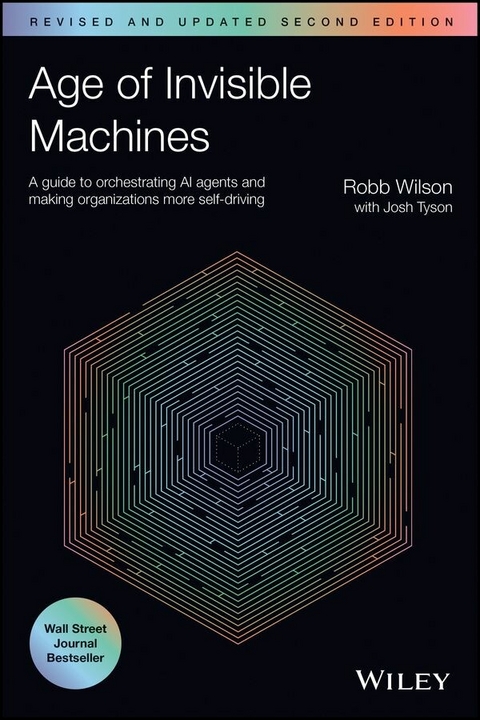
Age of Invisible Machines (eBook)
450 Seiten
Wiley (Verlag)
978-1-394-32156-8 (ISBN)

Cut through the noise and unlock the transformational power of conversational AI
In the newly revised second edition of Age of Invisible Machines, renowned tech leader Robb Wilson delivers a startlingly insightful and eye-opening blueprint for using conversational AI to make your company self-driving-with a digital ecosystem of interconnected automations powering all aspects of your business.
Conversational AI is transforming every job at every company (starting yesterday) and this book is perfect for anyone affected by these technologies. You'll learn how to develop a hyperautomation strategy by identifying outdated processes and systems holding your company back.
This latest edition offers brand new chapters dedicated to fast-growing automation tools, including Large Language Models, generative AI, and much more. You'll discover ways to implement new technologies that are force-multipliers for rapid growth. A must-read for every business leader, Wilson's book debunks common myths about conversational AI while simplifying the inevitable complexity of restructuring your business to unlock the substantial opportunities this new era offers.
You'll also find:
- Incisive discussions of the ethical dilemmas that lie before us as mass adoption of conversational AI takes effect
- Fascinating examinations of what a self-driving business looks like and how you can use conversational AI to generate an enduring competitive advantage
- Strategies for creating a hyperautomated ecosystem that any company can begin using immediately
- QR links to interactive and ongoing discussions of the subjects covered in each chapter
A practical and essential exploration of the future of conversational AI and hyperautomation, Age of Invisible Machines belongs in the hands of entrepreneurs, founders, business leaders, tech enthusiasts, designers and anyone else with a stake in the future of business.
ROBB WILSON is the CEO and co-founder of OneReach.ai, the only AI agent orchestration platform recognized as a 'leader' by all top analyst firms including Gartner, Forrester, and IDC. With over two decades in AI research and user-centered design, Robb helped unlock the agentic approach to automation that's being feverishly pursued by enterprises all over the world. The GSX platform he developed traces its origins back to a DARPA initiative and is used by leaders including PepsiCo, Deloitte, and the city of Washington D.C. A former tech and design executive at publicly traded companies, Robb has mentored AI, UX and technology leaders at Amazon, Google, Salesforce, Frog, Box, and other top firms.
JOSH TYSON is an author and producer who has held leadership roles for a variety of organizations, including TEDxMileHigh and UX Magazine. He is the co-host of the Invisible Machines podcast, and his writing has appeared in numerous publications over the years, including Chicago Reader, Fast Company, FLAUNT, Harvard Business Review, The New York Times, Observer, Stop Smiling, and Thrasher. His forthcoming novel, Alamosa, is a deconstructed coming-of-age story set in the multiverse.
USA Today BestsellerThe Book That Saw 2027 In 2022. Now Sharpened for the Road Ahead. Age of Invisible Machines quickly earned a reputation as a prophetic guide for technology and business leaders, offering a clear vision of what was coming just before it arrived. When the first edition launched in late 2022, few had seen the tidal wave of generative AI coming. But Robb Wilson and Josh Tyson had. Their predictions including the pivotal role of large language models and conversational interfaces soon became reality, helping thousands of readers understand, prepare for, and act on the AI shift already reshaping the world. Now, the newly revised second edition pushes that vision forward offering a 2027-level roadmap for software architects, enterprise architects, developers, product owners, and future-focused executives who are ready to build what's next. This expanded edition introduces timely, practical guidance on: Harnessing generative AI in the software development lifecycle Building composable, agentic systems that scale Orchestrating intelligent agents across knowledge, process, and interface layers Designed for architects of all kinds enterprise, system, solution, and experience this book distills decades of R&D, implementation, and design into a playbook for AI-native transformation. You ll also find insights drawn from exclusive conversations on the Invisible Machines podcast with pioneers including: Cassie Kozyrkov (Google s first Chief Decision Scientist) Jaron Lanier (Microsoft OCTOPUS) Tom Gruber & Adam Cheyer (Siri co-creators) Cathy Pearl (UX Lead, Google Gemini) Jonathan Frankle (Chief AI Scientist, Databricks/Mosaic ML), Kara Swisher, Jim Webber (Chief Scientist, Neo4j), and more With AI accelerating faster than most enterprises can adapt, this book provides both the urgency and the operational clarity leaders need to move from exploration to execution. It s an indispensable resource for those shaping the future of platforms, systems, teams, and entire organizations. If the first edition helped readers see the future of AI in 2023 this one will help you navigate 2027 and beyond.
CHAPTER 1
Organizational Artificial General Intelligence Is Already Upon Us
We don't want to scare you, but the revised edition of this book comes with the same ominous warning as the first edition: the status quo is a death sentence. Most modern organizations are still run using systems and strategies that will likely seem comically outdated a few short years from now. That's because the strategic orchestration of technologies described in this book, like AI agents, generative AI, deep learning, blockchain, and code‐free development tools, will do a lot more than disrupt the ways we're accustomed to dealing with technology. The strategic orchestration of these technologies will obliterate existing models.
Back in 2010, former Google CEO Eric Schmidt claimed that humans were creating as much data every two days as we had in our entire history up until 2003, pointing to “user‐generated content” as the main source.1 This was more than a decade before users started turning generative models loose, creating exponentially more content. While Schmidt's stat was contentious, there's no doubt that we're creating and capturing more data than ever.2 In many ways, however, this wealth of information represents a failure. To say it's being poorly leveraged is a bit of an understatement, but all of this is changing.
The technologies surrounding conversational artificial intelligence are heading toward a point of convergence that is already fundamentally altering our relationship with machines. We all experienced the early stages of these changes with the arrival of OpenAI's ChatGPT in the public sphere. The experiences customers and employees have with businesses are being reshaped by the hallmarks of this convergence—putting those massive stores of data into action in ways that have upended entire industries. In the first edition of this book, we said that this might sound hyperbolic given the substandard chatbot experiences endemic to much of the automation happening in the world. We now live in a world where most of the people you walk past on the street have engaged in conversations with machines, either by prompting any of the widely available large language models (LLMs) like ChatGPT or through interactions with companies leveraging LLMs in automated experiences.
These technologies are becoming more and more sophisticated, but that hasn't changed the fact that people don't like task‐switching between a whole host of different software solutions.
For example, let's say you log on to your home security system website to cancel service. Asking their chatbot a question drops you down a funnel of FAQ menus where you learn, five minutes in, that cancellations can't be handled online. When you call the accounts department, you're confronted by a series of voice automations that feels like another funnel drop, so you start stamping “0” hoping for a shortcut to a live agent. Crap experiences like this can feel less productive than just waiting on hold and hoping you can remember the security PIN you created five years ago.
The “I don't have time—I'll do it the long way” mindset is symptomatic of the lackluster conversational experiences users are accustomed to having with machines. But that's starting to change. One of the key elements of this convergence of technologies surrounding agentic AI involves intelligent and evolving ecosystems designed for accelerated automation powered by one of humankind's oldest adaptations: conversation. Make no mistake, agentic AI isn’t going anywhere. In fact, it’s going everywhere.
Groundbreaking as they've been, innovations such as Alexa and Google Home hardly qualify as conversational AI, or AI agents. Asking smart speakers to issue weather reports, set a timer, or play a song are very limited and immature applications of agentic AI, though they hint at its nascent power. Smart speakers have completely upended the speaker industry, to the point where it might become difficult to find a new speaker for sale that doesn't have built‐in conversational capabilities. But how powerful does a smart speaker become when it's not limited to the things that Siri or Alexa can do? What happens when you can ask your speaker to play “Mr. Roboto” by Styx and then follow up with another request: “I want to buy a copy of the book that Marc Maron mentioned during the intro to his podcast today. I don't remember the title but see if there's a copy available from Powell's before looking on Amazon.”
What will happen is, a few minutes later, a text message could appear on your phone with a link showing a hardcover copy of Camera Man by Dana Stevens available on Powells.com. By replying, “Yes. Please buy” via text, you'd be communicating with the same AI agent that you initially spoke to—an umbrella conversational interface that has become your primary interaction point with most of the technology in your life.
Apple is making moves to improve Siri, and Amazon has coupled Alexa with generative AI, allowing users to request chat sessions. This is a step closer to the scenario described above, but chatting with an LLM is a different experience than talking to a system that can automate any number of tasks. Once scenarios like this are possible, you won't think of technology in terms of different apps, because you'll rarely need to open and interact with an app. Domo arigato, Mr. Roboto.
Take this a step further and imagine how different the experience of work would be if employees could ask a smart speaker for help and instantly engage with a conversational operating system for their company that connected them to all the relevant departments and data needed to make their work less tedious and more impactful. This is the essence of organizational artificial general intelligence, or OAGI (it's kind of fun to pronounce it, oh‐ah‐gee).
We've spent a lot of time talking about this concept on the Invisible Machines podcast (with guests Ben Goertzel and Aaron De Smet of McKinsey) and believe it's a central concept for forward‐thinking businesses to understand. Give an organization a shared conversational interface that can communicate across channels and leverage data in various forms and organizational self‐awareness is likely to emerge. Really, the “organization” part is the context that a generally intelligent machine needs to do things the way a team or company wants them done. With OAGI, a technology ecosystem is in place that can perform all sorts of tasks without needing to involve humans unless necessary.
OAGI represents a systemic understanding of the inner workings of a brand. This awareness allows technology to operate as an extension of the brand for those inside the company as well as customers. Such a technology ecosystem would also be able to identify patterns within an organization and make predictions about all aspects of operations. Obviously, this kind of functionality goes far beyond what LLMs alone are capable of, and we will discuss numerous aspects of LLMs that bear sober consideration.
Human conversation is broader than the spoken word, as we have many ways of communicating our thoughts and needs. Humans frequently incorporate gestures, facial expressions, visual aids, and sounds in conversation. As such, conversational AI encompasses a full breadth of what we call “multi‐turn” or “multimodal” interactions. Because they are part of an interconnected ecosystem, these multimodal interactions can leverage those massive stores of data we're continually creating—unearthing massive opportunities for personalization and precision.
Having a text conversation with an invisible machine might include that machine showing you part of a video to illustrate a point. If you're asking it to analyze a spreadsheet or data, it can draw you a graph on the fly to help visualize data points. If the interaction is ongoing and you're about to start driving, the interface can move to voice command. Multimodal experiences mirror normal parts of conversations between people, and that sophistication enables humans to wield technological functions and capabilities using our most natural interface. These bite‐sized user interfaces, or micro UIs as we call them, are dialogue‐driven and, just like human conversations, they can include all kinds of audio and visual aids and even haptic cues.
You could never have an experience this seamless and efficient while digging through nested tabs or apps—and many of the world's leading companies are coming around to this fact. Salesforce didn't just acquire Slack back in 2021. Their CEO openly admitted that they were rebuilding their entire organization around Slack, and that work continues as of this writing.3 They're betting that an integrated communication platform and a unifying conversational interface—one machine that connects to everything—will benefit customers, employees, and organizations in big ways. Slack has added generative AI to the mix, leaning on LLMs to summarize activity on users' channels. Microsoft's Copilot offers similar capabilities, but again, as of this writing, these amount to bolt‐on applications that fall short of the advanced orchestration of technologies detailed in these pages.
It's critical to establish an understanding of the difference between bolt‐on...
| Erscheint lt. Verlag | 14.4.2025 |
|---|---|
| Sprache | englisch |
| Themenwelt | Wirtschaft ► Betriebswirtschaft / Management ► Unternehmensführung / Management |
| Schlagworte | AI ethics • artificial intelligence in business • Conversational AI • Conversational Artificial Intelligence • Digital transformation • ethical AI • hyperautomating • hyperautomation transformation • implementing hyperautomation • Natural Language Processing |
| ISBN-10 | 1-394-32156-2 / 1394321562 |
| ISBN-13 | 978-1-394-32156-8 / 9781394321568 |
| Informationen gemäß Produktsicherheitsverordnung (GPSR) | |
| Haben Sie eine Frage zum Produkt? |
 EPUB (Adobe DRM)
Kopierschutz: Adobe-DRM
Adobe-DRM ist ein Kopierschutz, der das eBook vor Mißbrauch schützen soll. Dabei wird das eBook bereits beim Download auf Ihre persönliche Adobe-ID autorisiert. Lesen können Sie das eBook dann nur auf den Geräten, welche ebenfalls auf Ihre Adobe-ID registriert sind.
Details zum Adobe-DRM
Dateiformat: EPUB (Electronic Publication)
EPUB ist ein offener Standard für eBooks und eignet sich besonders zur Darstellung von Belletristik und Sachbüchern. Der Fließtext wird dynamisch an die Display- und Schriftgröße angepasst. Auch für mobile Lesegeräte ist EPUB daher gut geeignet.
Systemvoraussetzungen:
PC/Mac: Mit einem PC oder Mac können Sie dieses eBook lesen. Sie benötigen eine
eReader: Dieses eBook kann mit (fast) allen eBook-Readern gelesen werden. Mit dem amazon-Kindle ist es aber nicht kompatibel.
Smartphone/Tablet: Egal ob Apple oder Android, dieses eBook können Sie lesen. Sie benötigen eine
Geräteliste und zusätzliche Hinweise
Buying eBooks from abroad
For tax law reasons we can sell eBooks just within Germany and Switzerland. Regrettably we cannot fulfill eBook-orders from other countries.
aus dem Bereich