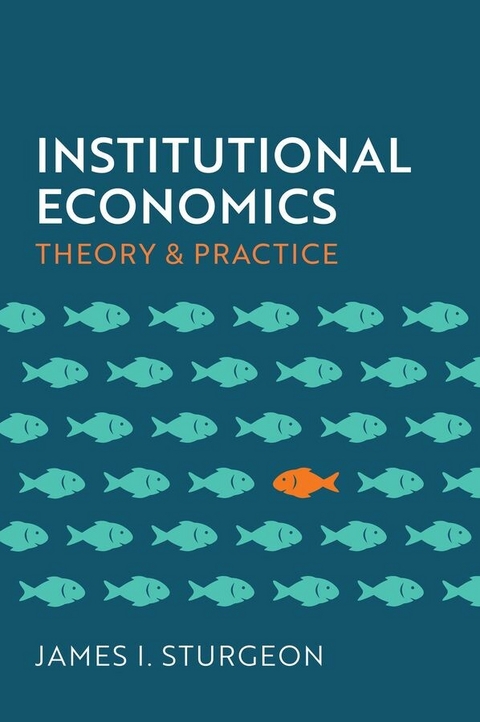
Institutional Economics (eBook)
402 Seiten
Polity (Verlag)
978-1-5095-5671-7 (ISBN)
This much-needed text provides students with a comprehensive introduction to the increasingly influential field of Institutional economics. Across its ten chapters, it unpacks the history, theory, applications, policies, and methods of Institutional economics, carefully blending theoretical, conceptual and empirical elements that together illuminate the complexity of the modern economy. Topics covered include production, consumption, class and distribution, development, value theory, and specific institutions including the corporation, property, labor, and government. Each chapter concludes with selected questions or issues posed as a basis for class discussion and further research.
Written in a lively and accessible style for students new to the topic, this book is set to become the go-to resource for classes on institutional economics across the world.
James I. Sturgeon is Economics Professor Emeritus at the University of Missouri-Kansas City. He taught Institutional Economics for over forty years and served as Economics Department chair. He is an Honorary Fellow at Bremen University, Germany, a Senior Fellow at the Levy Economics Institute, and previously a staff economist at the United States Federal Trade Commission. He was co-founder and past president of the Association for Institutional Thought and past president of the Association for Evolutionary Economics.
Institutions are the controlling force at the center of any economy. They organize and control all economic activity from markets to producers, consumers to governments, and more. Institutions determine how fundamental economic questions such as, what, how, and for whom, are answered. Thus, scientific analysis of economic activity requires a deep and systematic understanding of institutions. This much-needed text provides students with a comprehensive introduction to the increasingly influential field of Institutional economics. Across its ten chapters, it unpacks the history, theory, applications, policies, and methods of Institutional economics, carefully blending theoretical, conceptual and empirical elements that together illuminate the complexity of the modern economy. Topics covered include production, consumption, class and distribution, development, value theory, and specific institutions including the corporation, property, labor, and government. Each chapter concludes with selected questions or issues posed as a basis for class discussion and further research. Written in a lively and accessible style for students new to the topic, this book is set to become the go-to resource for classes on institutional economics across the world.
1
Introducing Institutional Economics
Institutional economics is a way of analyzing economic behavior based on the evolution of social practices and their relationship to making a living. Institutions are the controlling force at the center of the economy. They determine how fundamental economic questions – such as what, how, and for whom – are answered. Institutions organize and control economic activity including producers, consumers, markets, government, and more. Hence, scientific analysis of economic activity requires understanding institutions. The theory of institutional evolution forms the basis for scientific economics relevant to real economies. A main task is to understand how institutions have developed, and their consequences for the life process, including the health and well-being of individuals; and, through the understanding of these dynamics, to examine potential paths for future developments.
This book is an introduction to Institutional economics in the tradition of Thorstein Veblen, John Commons, Wesley Mitchell, and Walton Hamilton, sometimes referred to as Original Institutional economics. It offers a systematic introduction. Institutional economics includes two major parts: (1) an evolutionary theory and practice of economic analysis; and (2) a critical analysis of the Mainstream approach to economics. The purpose of this text is an explanation of the former. Attention to the latter occurs to point to contrasting approaches. Institutional economics is an alternative way of thinking about the economy and economic organization, rather than a modification or appendage to Mainstream economics. There are substantial misunderstandings, misperceptions, and errors regarding the content and importance of Institutional economics. Along the way some of these may be resolved.
Institutional economics is distinct from other theories in four ways. First, the cultural level of analysis forms the basis for theoretical development. The individual level is understood and analyzed as part of the cultural level. Second, an evolutionary method is used because economies evolve rather than move toward equilibrium. Third, economies are seen as embedded in and controlled by institutions, not by economic laws. In turn, institutions combine the interconnected forces of technology and ceremony which shape economic activity. Fourth, values and value judgments are legitimate subjects for scientific analysis. They are not mere opinions. They are not dualized with facts. There is a distinction between instrumental values, which are based on scientifically warranted cause and effect, and ceremonial values which are culture specific and based on spurious or imaginary cause and effect.
Organization and Terms
This chapter outlines the rationale and logic of the subsequent chapters. It also briefly introduces the tools and concepts explained in following chapters. Chapter 2 is a brief history of economic thought, tracing the evolution of Mainstream economic thought and situating Institutional economics in the field. Chapter 3 covers the principal theoretical elements of Institutional economics. Two important concepts – culture and evolutionary theory – and three theoretical tools – the Veblenian Dichotomy, the Principles of Institutional Adjustment, and the Enduring Tension – are introduced. Each is briefly explained below and in later chapters is applied to specific activities. With these in place, the simple elegance of the theory at the core of Institutional economics provides a story sorting out the complexity of economic activity and bringing it into clearer focus. Drawing on the concepts and tools in chapter 3, chapter 4 examines the evolutionary history of economic society. This leads to analysis of central economic activities in subsequent chapters. Chapter 5 combines doing, knowing, and valuing to present a unified approach to method and behavior. The elements of human behavior, habit and instinct, are discussed in the context of cognitive control theory. A model of the evolutionary, pragmatic method, and research tools illustrates how doing, knowing, and valuing are connected. A discussion of valuing covers the distinction between instrumental and ceremonial valuation and their application to economic valuation and completes the chapter. Chapter 6 is devoted to the theory of production, resources, and the organization of production. Chapter 7 lays out the theory of consumption and the forces and patterns affecting the demand for goods and services. Chapter 8 deals with class and distribution, while chapter 9 brings together threads from the previous chapters to analyze economic development. Chapter 10 examines the dynamics of specific institutions – government, the modern corporation, labor, money and its controlling organizations, and social security – as they have evolved and impacted economic life. The Conclusion is future looking. It outlines areas for potential new work and economic problems to be addressed. Not all issues and concepts are included in each chapter. At the end of each chapter, selected questions or issues are posed as a basis for discussion in extension of the material in the chapter. Users are invited to delve into areas to which their interests are drawn.
For the purpose of clarity in the remainder of the book, when referring to Institutional economics or Mainstream economics, the names will have an initial capital. Mainstream economics, as referred to here, includes Classical, Neo-classical, and Marginalism. In the literature, these go by various names such as “standard,” “conventional,” “received,” and so on. Mainstream economics refers to those approaches in which the market, scarce resources, equilibrium, supply and demand determined by price, and price as a measure of value are the central focus. It does not include Marxian economics, the economics of Keynes, or Post-Keynesian economics. Institutional economics includes Original Institutional economics and extensions and modifications introduced by Neo-Institutionalists, but not by New Institutionalists.1
Definition of Economics: Scope and Nature
A significant difference between Institutional economics and other approaches lies in definition. Definition sets the tone and scope of a subject matter. It frames the questions and issues to be raised. The Institutionalist definition is: economics is the study of the ways humans make a living.2 Making a living takes place in the institutions embedded in society. The Mainstream view is that economics is the study of the allocation of scarce resources among alternative uses. The framework is supply and demand determined by price in the context of market equilibrium. This means the focus is on production using scarce resources, and consumption as the end of economic activity. The scarce productive factors – land, labor, capital, and entrepreneurship – produce combinations of goods that satisfy some wants and not others. To be sure, the supply, demand, and distribution of goods and services lie at the heart of economic activity. This provisioning includes production, distribution, and consumption to meet human needs and wants. On this point there is little dispute. Yet the main concern is the forces that affect the supply and demand involved in provisioning. These forces go well beyond price and market allocation.
Simply stated, an economy is an instituted process involving economic and noneconomic activities. Government, religion, class, and social values are important.3 The study of the economy starts with the evolutionary behavioral patterns of institutions. These patterns are expressed in the interaction of technology and ceremony and how they jointly affect and determine the material well-being of all. These are the principal forces for the study of production, consumption, distribution, class, value theory, and economic development. Supply, demand, and prices are determined by these forces. The Mainstream definition does not include the institutions and social conventions in which economies are embedded and thus leaves out important forces and factors that affect making a living.
The Institutionalist definition of economics means more questions and issues may be raised. When a specific economic activity is under consideration, the examination occurs in the context of human behavior. Political, environmental, legal, and other activities are not necessarily separated from economic ones. Economic activity is not entirely distinct from social and political activity. This does not mean that all areas of knowledge must be brought to bear on each question or issue. It does mean that other areas are not automatically excluded because they lie outside of the scope of “economic” inquiry. The reason is straightforward: human activity occurs as a whole.
A criticism of Institutional economics is that it is too materialist. As the saying goes, “Man does not live by bread alone.” This is true for the simple reason that bread does not occur alone. Bread, like all other “materials” of life, occurs as part of a social process – an increasingly complex social process, and thus an increasingly complex provisioning process. Life is about more than bread, but without it there is no life. The production, distribution, and consumption of bread are up to those with the expertise, judgment, and power to conduct the life-provisioning processes. Economics as a social science is responsible for helping to understand these processes, explain their organization, and how...
| Erscheint lt. Verlag | 25.3.2025 |
|---|---|
| Sprache | englisch |
| Themenwelt | Wirtschaft ► Volkswirtschaftslehre |
| Schlagworte | consumption • Distribution • economy • heterdox economics • Institutional Change • Institutional Economics • Labor Economics • Production • resources theory • Valuation • Wealth distribution • what is institutional economics? |
| ISBN-10 | 1-5095-5671-0 / 1509556710 |
| ISBN-13 | 978-1-5095-5671-7 / 9781509556717 |
| Informationen gemäß Produktsicherheitsverordnung (GPSR) | |
| Haben Sie eine Frage zum Produkt? |
 EPUB (Adobe DRM)
Kopierschutz: Adobe-DRM
Adobe-DRM ist ein Kopierschutz, der das eBook vor Mißbrauch schützen soll. Dabei wird das eBook bereits beim Download auf Ihre persönliche Adobe-ID autorisiert. Lesen können Sie das eBook dann nur auf den Geräten, welche ebenfalls auf Ihre Adobe-ID registriert sind.
Details zum Adobe-DRM
Dateiformat: EPUB (Electronic Publication)
EPUB ist ein offener Standard für eBooks und eignet sich besonders zur Darstellung von Belletristik und Sachbüchern. Der Fließtext wird dynamisch an die Display- und Schriftgröße angepasst. Auch für mobile Lesegeräte ist EPUB daher gut geeignet.
Systemvoraussetzungen:
PC/Mac: Mit einem PC oder Mac können Sie dieses eBook lesen. Sie benötigen eine
eReader: Dieses eBook kann mit (fast) allen eBook-Readern gelesen werden. Mit dem amazon-Kindle ist es aber nicht kompatibel.
Smartphone/Tablet: Egal ob Apple oder Android, dieses eBook können Sie lesen. Sie benötigen eine
Geräteliste und zusätzliche Hinweise
Buying eBooks from abroad
For tax law reasons we can sell eBooks just within Germany and Switzerland. Regrettably we cannot fulfill eBook-orders from other countries.
aus dem Bereich