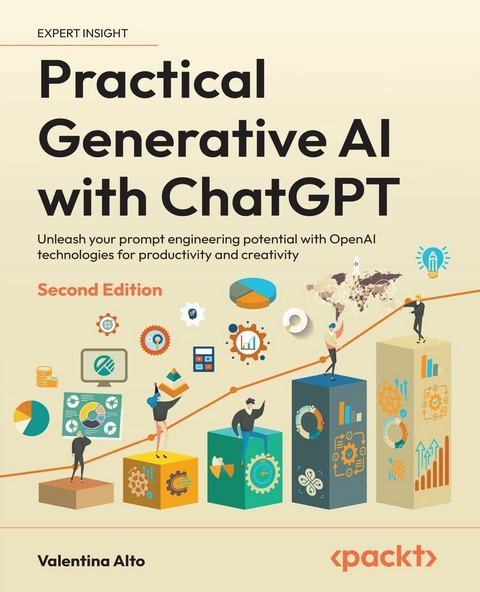
Practical Generative AI with ChatGPT (eBook)
396 Seiten
Packt Publishing (Verlag)
978-1-83664-784-3 (ISBN)
Practical Generative AI with ChatGPT is your hands-on guide to unlocking the full potential of ChatGPT. From building AI assistants and mastering prompt engineering to analyzing documents and images and even generating code, this book equips you with the skills to integrate generative AI into your workflow.
Written by a technical architect specializing in AI and intelligent applications, this book provides the tools and knowledge you need to streamline tasks, enhance productivity, and create intelligent solutions. You'll learn how to craft precise prompts, leverage ChatGPT for daily efficiency, and develop custom AI assistants tailored to your needs.
The chapters show you how to use ChatGPT's multimodal capabilities to generate images with DALL·E and even transform images into code. This ChatGPT book goes beyond basic interactions by showing you how to design custom GPTs and integrate OpenAI's APIs into your applications. You'll explore how businesses use OpenAI models, from building AI applications, including semantic search, to creating an AI roadmap. Each chapter is packed with practical examples, ensuring you can apply the techniques right away.
By the end of this book, you'll be well equipped to leverage OpenAI's technology for competitive advantage.
Transform your professional world with ChatGPT and OpenAI-master prompt design to revolutionize development, marketing, research, and enterprise implementationKey FeaturesTurn ChatGPT into your companion for marketing, research, personal productivity, art and codingLearn prompt engineering techniques that deliver consistent, relevant, and ethical AI-powered resultsBuild custom GPTs and assistants tailored to your specific business needs and workflowsPurchase of the print or Kindle book includes a free PDF eBookBook DescriptionPractical Generative AI with ChatGPT is your hands-on guide to unlocking the full potential of ChatGPT. From building AI assistants and mastering prompt engineering to analyzing documents and images and even generating code, this book equips you with the skills to integrate generative AI into your workflow. Written by a technical architect specializing in AI and intelligent applications, this book provides the tools and knowledge you need to streamline tasks, enhance productivity, and create intelligent solutions. You ll learn how to craft precise prompts, leverage ChatGPT for daily efficiency, and develop custom AI assistants tailored to your needs. The chapters show you how to use ChatGPT s multimodal capabilities to generate images with DALL E and even transform images into code. This ChatGPT book goes beyond basic interactions by showing you how to design custom GPTs and integrate OpenAI s APIs into your applications. You ll explore how businesses use OpenAI models, from building AI applications, including semantic search, to creating an AI roadmap. Each chapter is packed with practical examples, ensuring you can apply the techniques right away. By the end of this book, you ll be well equipped to leverage OpenAI's technology for competitive advantage.What you will learnExplore the fundamentals of generative AI and GPT modelsMaster prompt engineering to consistently get relevant and reliable outputs from ChatGPTDevelop marketing strategies and conduct meaningful A/B testing with AI assistanceBoost your coding with code generation, review, and optimizationEnhance research with real-time knowledge miningEnhance your visual creativity with image generation, image understanding, and style transferDesign custom GPTs and assistants tailored to specific business functionsDiscover how enterprises are leveraging large language models for their AI appsWho this book is forThis book is ideal for business professionals, developers, marketers, researchers, and decision-makers who want to leverage AI to enhance productivity. No advanced technical background is required for the foundational sections, making the content accessible to beginners, while later chapters provide depth for technical professionals implementing enterprise solutions. If you re seeking practical applications of generative AI in business contexts, you ll find immediate, actionable value in this book.]]>
1
Introduction to Generative AI
Hello! Welcome to Practical Generative AI with ChatGPT! In this book, we will explore the fascinating world of generative artificial intelligence (AI) and its groundbreaking applications, with a particular focus on ChatGPT.
Generative AI has transformed the way we interact with machines, enabling computers to create, predict, and learn without explicit human instruction. Since the launch of OpenAI’s ChatGPT in November 2022, we have witnessed unprecedented advances in natural language processing, image and video synthesis, and many other fields. Whether you are a curious beginner or an experienced practitioner, this guide will equip you with the knowledge and skills to effectively navigate the exciting landscape of generative AI. So, let’s dive in and start the book with some definitions of the context we are moving in.
In this chapter, we focus on the applications of generative AI to various fields, such as image synthesis, text generation, and music composition, highlighting the potential of generative AI to revolutionize various industries with concrete examples and recent developments. Being aware of the research journey toward the current state of the art of generative AI will give you an understanding of the foundations of recent developments and state-of-the-art models.
All this, we will cover through the following topics:
- Introducing generative AI
- Exploring the domains of generative AI
- Main trends and innovation after 2 years of ChatGPT
- Legal and ethical landscape of generative AI
By the end of this chapter, you will be familiar with the exciting world of generative AI, its applications, the research history behind it, and the current developments that could have – and are currently having – a disruptive impact on businesses.
Free Benefits with Your BookYour purchase includes a free PDF copy of this book along with other exclusive benefits. Check the Free Benefits with Your Book section in the Preface to unlock them instantly and maximize your learning experience. |
Introducing generative AI
Generative AI is an exciting branch of AI that focuses on creating new content, such as text, images, music, or even videos, that is often indistinguishable from something made by humans.
To understand where it fits, let’s break it down:
- AI: AI is the broad field that enables machines to mimic human-like tasks, such as decision-making or problem-solving.
- Machine learning (ML): Within AI, ML refers to techniques where machines learn patterns from data to make predictions or decisions without being explicitly programmed. The process of learning is made possible by sophisticated mathematical models called algorithms.
- Deep learning (DL): A subset of ML, DL uses complex algorithms inspired by the human brain to process large amounts of data and recognize intricate patterns. Because of their architecture – inspired by our brains and neural connections – these algorithms are called artificial neural networks.
Definition
An artificial neural network is a type of computer program designed to learn patterns by processing information in a way that’s inspired by the human brain. Instead of following strict, step-by-step rules, it uses interconnected “nodes” (like virtual brain cells) that work together and adjust their connections over time. By repeatedly reviewing examples, it gradually improves at tasks like recognizing images, understanding speech, or predicting outcomes—all without needing explicit instructions for each step.
Generative AI emerges from DL and uses specialized algorithms to generate something entirely new based on what it has learned from existing data. For example, a generative AI model trained on thousands of paintings could create brand-new art that blends different styles or themes.
The following figure shows how these areas of research are related to each other:
Figure 1.1: Relationship between AI, ML, DL, and generative AI
Generative AI models are trained on vast amounts of data and then they can generate new examples based on user’s requests. And the game-changer element here is that these requests are made in the easiest way possible – using our natural language. These models are called large language models (LLMs).
Definition
LLMs are a type of artificial neural network featured by a particular architectural framework called “Transformer.” They are characterized by a huge number of parameters (in the order of billions) and have been trained on billions of words. Given the training set, LLMs are capable of inferring language patterns and intents in user queries and generating natural language responses.
The possibility of interacting in natural language with LLMs is disruptive, and a whole new science has been born around that activity. This science is called “prompt engineering,” named after the term “prompt,” which we are going to cover in Chapter 3.
Definition
A prompt is the specific text, question, or description you provide to a generative AI model to guide it toward producing the kind of output you want—whether that’s a helpful explanation, a creative story, or a detailed solution. How you phrase the prompt can greatly affect the AI’s response. This practice of carefully designing and refining prompts, often called “prompt engineering,” involves experimenting with different word choices, instructions, and formats to improve both the quality and accuracy of the AI’s output. By learning how to craft effective prompts, you help ensure the AI more consistently gives you results that are useful, engaging, and aligned with your goals.
Even though text understanding and generation is probably one of the most outstanding features of Generative AI, this field covers many domains, which we will cover next.
Domains of generative AI
In recent years, generative AI has made significant advancements and has expanded its applications to a wide range of domains, such as art, music, fashion, and architecture. In some of them, it is indeed transforming the way we create, design, and understand the world around us. In others, it is improving and making existing processes and operations more efficient.
For example, in the context of the pharmaceutical industry, generative AI is revolutionizing drug discovery by enabling the rapid design of novel therapeutic molecules, thereby significantly reducing development timelines and costs. By analyzing extensive datasets of chemical and biological information, generative AI models can identify promising drug candidates and predict their interactions within the human body. For instance, Insilico Medicine utilized generative AI to develop ISM001-055, a drug candidate for idiopathic pulmonary fibrosis, which progressed to Phase II clinical trials in 2023 (https://insilico.com/blog/first_phase2).
Another example is the way generative AI is revolutionizing game development by enabling the creation of dynamic and adaptive environments that respond to player actions, thereby enhancing immersion and replayability. By leveraging generative AI, developers can procedurally generate vast, ever-changing game worlds, ensuring that each playthrough offers a unique experience. This technology facilitates the creation of realistic non-playable characters (NPCs) with behaviors that adapt to player interactions, making game narratives more engaging. Additionally, generative AI streamlines the development process by automating asset creation, which reduces production time and costs.
As a result, developers can focus more on crafting innovative gameplay mechanics and rich storytelling, ultimately delivering more personalized and captivating gaming experiences (https://www.xcubelabs.com/blog/generative-ai-in-game-development-creating-dynamic-and-adaptive-environments/).
Lastly, generative AI can have a great impact on advertising and visual asset generation. For example, in March 2023, Coca-Cola launched the “Create Real Magic” platform (https://www.coca-colacompany.com/media-center/coca-cola-invites-digital-artists-to-create-real-magic-using-new-ai-platform), inviting digital artists worldwide to craft original artwork using iconic brand assets from its archives. Developed in collaboration with OpenAI and Bain & Company, this innovative platform combines the capabilities of GPT-4 and DALL-E, enabling users to generate unique pieces that blend Coca-Cola’s heritage with modern AI technology. Participants had the opportunity to submit their creations for a chance to be featured on Coca-Cola’s digital billboards in New York’s Times Square and London’s Piccadilly Circus, exemplifying the brand’s commitment to fostering creativity through cutting-edge technology. These are just a few examples of how generative AI can reshape...
| Erscheint lt. Verlag | 25.4.2025 |
|---|---|
| Sprache | englisch |
| Themenwelt | Mathematik / Informatik ► Informatik ► Office Programme |
| Mathematik / Informatik ► Informatik ► Programmiersprachen / -werkzeuge | |
| Wirtschaft ► Betriebswirtschaft / Management ► Marketing / Vertrieb | |
| ISBN-10 | 1-83664-784-0 / 1836647840 |
| ISBN-13 | 978-1-83664-784-3 / 9781836647843 |
| Informationen gemäß Produktsicherheitsverordnung (GPSR) | |
| Haben Sie eine Frage zum Produkt? |
 EPUB (Ohne DRM)
Digital Rights Management: ohne DRM
Dieses eBook enthält kein DRM oder Kopierschutz. Eine Weitergabe an Dritte ist jedoch rechtlich nicht zulässig, weil Sie beim Kauf nur die Rechte an der persönlichen Nutzung erwerben.
Dateiformat: EPUB (Electronic Publication)
EPUB ist ein offener Standard für eBooks und eignet sich besonders zur Darstellung von Belletristik und Sachbüchern. Der Fließtext wird dynamisch an die Display- und Schriftgröße angepasst. Auch für mobile Lesegeräte ist EPUB daher gut geeignet.
Systemvoraussetzungen:
PC/Mac: Mit einem PC oder Mac können Sie dieses eBook lesen. Sie benötigen dafür die kostenlose Software Adobe Digital Editions.
eReader: Dieses eBook kann mit (fast) allen eBook-Readern gelesen werden. Mit dem amazon-Kindle ist es aber nicht kompatibel.
Smartphone/Tablet: Egal ob Apple oder Android, dieses eBook können Sie lesen. Sie benötigen dafür eine kostenlose App.
Geräteliste und zusätzliche Hinweise
Buying eBooks from abroad
For tax law reasons we can sell eBooks just within Germany and Switzerland. Regrettably we cannot fulfill eBook-orders from other countries.
aus dem Bereich