


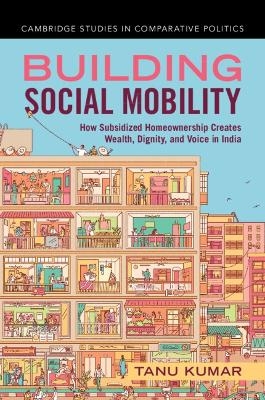
Building Social Mobility
How Subsidized Homeownership Creates Wealth, Dignity, and Voice in India
Seiten
2025
Cambridge University Press (Verlag)
978-1-009-63699-5 (ISBN)
Cambridge University Press (Verlag)
978-1-009-63699-5 (ISBN)
This book is for policymakers, social scientists, and readers interested in policies that can transform household trajectories. It reveals how homeownership programs drive economic growth, empower citizens, and influence local politics. It also offers valuable insights into how wealth shapes dignity and, in turn, political participation.
Which policies can help households improve their economic, social and political status? Building Social Mobility is an in-depth exploration of how policies to subsidize homeownership in low- and middle-income countries shape beneficiaries' decision-making in nearly every facet of their lives. Tanu Kumar develops a multidimensional and cross-disciplinary theory that argues that these initiatives affect how citizens invest in the future, climb out of poverty, develop agency in their social relationships, and exert power in local politics. Kumar supports the theory using a multi-method study of three policies in India. Evidence includes a natural experiment, original surveys, paired qualitative interviews, and an 18-year matched panel study. Building Social Mobility is a book about both housing and behavior. It goes beyond assessing the effects of an important policy to provide deep insights about how upwardly mobile citizens make decisions and the interactions between wealth, dignity, and voice in low- and middle-income countries.
Which policies can help households improve their economic, social and political status? Building Social Mobility is an in-depth exploration of how policies to subsidize homeownership in low- and middle-income countries shape beneficiaries' decision-making in nearly every facet of their lives. Tanu Kumar develops a multidimensional and cross-disciplinary theory that argues that these initiatives affect how citizens invest in the future, climb out of poverty, develop agency in their social relationships, and exert power in local politics. Kumar supports the theory using a multi-method study of three policies in India. Evidence includes a natural experiment, original surveys, paired qualitative interviews, and an 18-year matched panel study. Building Social Mobility is a book about both housing and behavior. It goes beyond assessing the effects of an important policy to provide deep insights about how upwardly mobile citizens make decisions and the interactions between wealth, dignity, and voice in low- and middle-income countries.
Tanu Kumar is Assistant Professor in the Department of Politics and Economics at Claremont Graduate University. She was named as a Susan Clarke Young Scholar by the American Political Science Association and is an affiliate of the Center for Effective Global Action at the University of California, Berkeley.
1. Building social mobility; 2. Policies to improve housing quality; 3. Wealth; 4. Dignity; 5. Voice; 6. Implications for effective policy.
| Erscheinungsdatum | 04.09.2025 |
|---|---|
| Reihe/Serie | Cambridge Studies in Comparative Politics |
| Zusatzinfo | Worked examples or Exercises |
| Verlagsort | Cambridge |
| Sprache | englisch |
| Gewicht | 250 g |
| Themenwelt | Sozialwissenschaften ► Politik / Verwaltung ► Vergleichende Politikwissenschaften |
| Sozialwissenschaften ► Soziologie | |
| Wirtschaft ► Volkswirtschaftslehre ► Wirtschaftspolitik | |
| ISBN-10 | 1-009-63699-5 / 1009636995 |
| ISBN-13 | 978-1-009-63699-5 / 9781009636995 |
| Zustand | Neuware |
| Informationen gemäß Produktsicherheitsverordnung (GPSR) | |
| Haben Sie eine Frage zum Produkt? |
Mehr entdecken
aus dem Bereich



aus dem Bereich
Geschichte, Parteistruktur, Radikalisierung
Buch | Softcover (2024)
UTB (Verlag)
CHF 38,95
neue Formen politischer Organisation in Europa
Buch | Softcover (2024)
Campus (Verlag)
CHF 82,55


