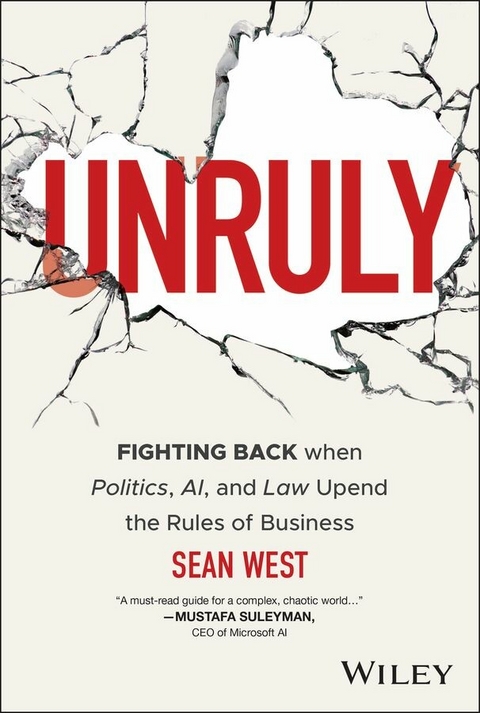
Unruly (eBook)
344 Seiten
Wiley (Verlag)
978-1-394-31846-9 (ISBN)
A bold exploration of modern business risk in a volatile world where traditional rules no longer apply
In Unruly: Fighting Back when Politics, AI, and Law Upend the Rules of Business, co-founder of software company Hence Technologies and former Global Deputy CEO of Eurasia Group, Sean West, delivers a startlingly insightful new take on how politics, technology and law are converging to upend the rules of business, generating dangerous risks and incredible opportunities. West convincingly argues that we must understand all three factors to get leverage over the future - a future filled with eroding rule of law, deepfakes that upend elections and court decisions, government pressure for businesses to be patriotic, robot lobbyists, a flood of automated legal claims pointed directly at your company and much more.
Unruly offers detailed, practical advice for how to understand the world ahead, how to be resilient in the face of innumerable and complex challenges, and how to surround your business with the people and technology you need to excel in this environment.
Inside the book:
- A framework for understanding all of the pressures on modern corporations from the convergence of geopolitics, technology and law.
- Strategies for turning your company's legal department into a source of enduring competitive advantage
- How to navigate government pressure for nationalism when you have a global footprint
- Approaches to winning in a world where courts are politicized and the law is increasingly automated, built on interviews with top experts
- Ways to deal with the backlash to ESG at a company level
Perfect for executives, managers, entrepreneurs, founders, and other business leaders, Unruly is also a must-read for general counsels and the advisors who serve them.
SEAN WEST is co-founder of the award-winning AI software company Hence Technologies, which empowers businesses to win in an unruly world. He served for many years as Deputy CEO of Eurasia Group, the leading global affairs firm, where he advised top CEOs, general counsel and investors. He writes the popular newsletter GeoLegal Notes, which explores the intersection of politics, technology, and law.
CHAPTER ONE
THE UNRULY TRIANGLE
One morning I received a phone call from a Connecticut number while I was meeting with some colleagues. It might be a hedge fund with an urgent question, so I answered.
“Hey, Sean, can you talk?” I immediately recognized the voice on the other line, a well‐known global macro investor. I had logged more than 900 interactions with this client that year including no less than five emails that morning. But he had never called my cell phone.
“I'm actually in the middle of a meeting right now. Can I call you back in 20 minutes?” I asked, knowing there's no way that would be good enough.
“Sure, Sean. I just have one question for you, it will only take a minute. WHAT THE F—K IS GOING ON IN WASHINGTON?!”
Of course, that was not a one‐minute conversation.
This type of interaction was representative of my life as a geopolitical forecaster, where I honed the ability to rapidly digest any political shift in the world and put it into the context of “the economy” or “markets.” Such skills are highly sought after by Wall Street because an early understanding that a new political leader may crush a particular asset class is immediately actionable—investors can sell that asset, perhaps juiced by high leverage, and make a killing. When the political tides look likely to turn, they can buy it back. “Trump Trades”—Election Day bets on industries that would win or lose when the President returned to office—provide one such example.
The crux of such analysis is to get the trigger prediction correct. What are the odds a government will do a specific negative or positive thing in the next week? In the next month? In the next year? If you can consistently predict policy shocks, investors can make a lot of money expressing that thesis in the market.
In stable political environments, such prediction is possible. But world politics is becoming too complex to model and predict with any high degree of likelihood. As one artificial intelligence (AI) pioneer told me when I suggested using tech to model politics a decade ago: the smartest minds in the world had not figured out how to predict if you want to stream a tenth cat video after you watch nine of them. So predicting what an unstable and complex political system will do next feels somewhere between an educated guess and a fool's errand.
The good news is that, for corporations, the probability of an event is less important than anticipating or rapidly understanding impact. If you mine in South Africa and an antibusiness leader may come to power, you don't really have a choice about whether to stay or go—you're fixed there for a while. Thus, your real focus is not predicting who will win but understanding the impact and extent of such policy shifts so you can respond. This is more than figuring out what is being discussed so that the corporation can lobby against it. This is about figuring out what growth opportunities will be open or closed for that company in South Africa in the future with some level of specificity.
To do that, you need to bring political risk down to a much more concrete level. From my vantage point, the law provides grounding that suddenly makes such analysis much more actionable.
When a policy idea or a political promise meets the administrative state, it becomes a law or a regulation. It becomes something that the government could or will enforce in the courts. It becomes grounds for a commercial competitor to launch a legal challenge. It can create avenues for success in a place, or it can shut them down completely. With the exception of security risk—which is often conflated with political risk—most other politics is just noise.
The trick here is to realize that this is not just politics or law raising risk, but it is the intersection between the two. Throw in the way technology intersects with politics and law, and then the risk landscape become much more complex.
This is the essence of what I call “unruliness,” which is the concept that underlies this book. Unruliness results from the dynamic interplay of politics, technology, and law to create risks that don't fit neatly in any corporate silo. Crucially, it creates risks that change shape in real time and require agility to counter.
To conceptualize unruliness, I rely on a simple schematic called the “Unruly Triangle.” The core insight of the triangle is that each of the vertices—geopolitics, law, and technology—are connected to each other generating new risks that are constantly in flux.
Traditional risk frameworks tend to view the three vertices either as separate factors for risk analysis or as somewhat static such that an analysis of these factors can be done at a single moment of time and assumed to hold. To be clear, the world does present traditional political, legal, and technological risks. But the real source of anxiety for corporate leaders in the years ahead will be the way these intersections manifest.
Thus, we need to think about risk flowing up and down each leg of the triangle from the interactions of these factors. Politics determines not just what the law is but how, when, where, and even if it is applied. Stable politics allows for rule of law and rule of law supports stable politics. The law defines the conditions under which political contestation is permitted, proceeds, and is ultimately settled.
The law does the same for the arenas and pace of technological advancement. Technology transforms the broad social and economic conditions that influence how politics is played at home and abroad and can be used to determine narrow political outcomes. It is also an instrument that can revolutionize all modalities of law for better or for worse—surveillance, enforcement, representation, adjudication, and punishment. New technologies require new legal frameworks, and those frameworks ensure technology remains appropriately regulated.
Rather than being separate risks, for each of these three factors, there is a push and pull that's largely imperfect and rarely stable. But historically a rough equilibrium is achieved and populations, businesses, and lawmakers understand and may even respect the parameters.
This book is sounding the alarm that we are in an extended moment of flux where the process of getting to a new equilibrium will be nasty, risky, and long. This generates three novel risks—Geolegal Risk, Artificial Politics Risk, and LegalAI Risk.
Politics and law intersect into what I refer to as “Geolegal Risk.” Geolegal Risk is the manifestation of politics through the legal channel or vice versa. For instance, losing in court because a politically appointed judge favors a given political interest is much different than losing on the merits. But Geolegal Risk is also about the breakdown of international institutions that uphold international law or expansive sanctions driven by politics. There are many other examples where politics and law intersect to shift the landscape of business.
Politics and technology intersect into what I call “Artificial Politics Risk,” buttressed by advances in AI. Artificial Politics is when an election outcome has been fundamentally altered by fake news generated by a foreign or malicious actor, causing irreparable damage. It is also when technological advancement is constrained by nonexpert regulators wielding blunt instruments for political gain, to serve entrenched interests or simply out of fear. It is when technology is used to change political systems once and for all; for instance, when an authoritarian government implements surveillance to achieve a decisive advantage over its political opposition. Most importantly, it is when technological advancement so fundamentally shifts the economic landscape—for instance, through technological unemployment—that political systems fundamentally realign either in the domestic political economy or among geopolitical rivals.
The third leg of the triangle is what I call “LegalAI Risk.” LegalAI the automation of the law, which brings with it novel risks. It gives the potential to overwhelm governments or competitors with automated lawsuits or to fight back against legal injustices using new AI‐assisted tools. Crucially, it raises the specter that technology may shift what the law means at the most fundamental level.
I'll walk through each of these synthetic risks in turn.
GEOLEGAL RISK
As political cooperation erodes, so do rules and laws, presenting the intersectional challenge of Geolegal Risk. Limits on impunity and arbitrariness are established via political codification into laws and norms—and when political convergence no longer exists within a country or across countries, there is often a rise in arbitrary exercises of power through the legal system or despite the legal rights one may have in a particular legal system. Thus, if I can convince you that political convergence at national and international levels is evaporating—which may not be particularly hard to do—you will start to grasp the risk that the rules of a particular country or of international trade will be more open to interpretation than they have been before. When the rules are gray, there is more space for actors to use the legal system against you. Combine that gray area with the advent of technology that makes it easy to exploit targets using the legal system, and you have an unruly world of new...
| Erscheint lt. Verlag | 17.3.2025 |
|---|---|
| Sprache | englisch |
| Themenwelt | Wirtschaft ► Betriebswirtschaft / Management ► Unternehmensführung / Management |
| Schlagworte | AI • Business Law • Business risk • Business Strategy • Geopolitical risk • Geopolitics • International affairs • International Law • legal AI • legal profession • Legal Technology • Litigation • Management • Political Risk • Politics • Strategic Planning |
| ISBN-10 | 1-394-31846-4 / 1394318464 |
| ISBN-13 | 978-1-394-31846-9 / 9781394318469 |
| Informationen gemäß Produktsicherheitsverordnung (GPSR) | |
| Haben Sie eine Frage zum Produkt? |
 EPUB (Adobe DRM)
Kopierschutz: Adobe-DRM
Adobe-DRM ist ein Kopierschutz, der das eBook vor Mißbrauch schützen soll. Dabei wird das eBook bereits beim Download auf Ihre persönliche Adobe-ID autorisiert. Lesen können Sie das eBook dann nur auf den Geräten, welche ebenfalls auf Ihre Adobe-ID registriert sind.
Details zum Adobe-DRM
Dateiformat: EPUB (Electronic Publication)
EPUB ist ein offener Standard für eBooks und eignet sich besonders zur Darstellung von Belletristik und Sachbüchern. Der Fließtext wird dynamisch an die Display- und Schriftgröße angepasst. Auch für mobile Lesegeräte ist EPUB daher gut geeignet.
Systemvoraussetzungen:
PC/Mac: Mit einem PC oder Mac können Sie dieses eBook lesen. Sie benötigen eine
eReader: Dieses eBook kann mit (fast) allen eBook-Readern gelesen werden. Mit dem amazon-Kindle ist es aber nicht kompatibel.
Smartphone/Tablet: Egal ob Apple oder Android, dieses eBook können Sie lesen. Sie benötigen eine
Geräteliste und zusätzliche Hinweise
Buying eBooks from abroad
For tax law reasons we can sell eBooks just within Germany and Switzerland. Regrettably we cannot fulfill eBook-orders from other countries.
aus dem Bereich