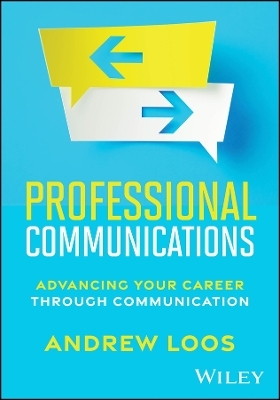
Professional Communications, with eBook Access Code
John Wiley & Sons Inc (Verlag)
978-1-394-28889-2 (ISBN)
- Noch nicht erschienen (ca. Januar 2026)
- Versandkostenfrei
- Auch auf Rechnung
- Artikel merken
In today’s fast-paced workplace, communication skills can make or break career success. Professional Communications: Advancing Your Career through Communication immerses learners in the art of effective workplace communication, empowering students and young professionals to strengthen relationships, navigate challenging conversations, and present ideas with confidence.
Communication is central to everyone’s professional success, whether that be collaborating with teams, managing clients, or building interpersonal relationships. This student-friendly textbook emphasizes the power of listening, mastering in-person and live interactions, and applying best practices for seamless communication in professional emails, texts, and virtual meetings. Strategic communication expert Andrew Loos equips readers with the tools to navigate these interactions confidently and effectively in today’s ever-evolving workplace.
Each chapter offers not only insights but also practical strategies that empower readers to master communication in its many forms—from in-person discussions to the nuances of digital platforms. By the end of this book, students will be better prepared to foster trust, gain professional credibility, and influence those around them, all through the power of their words and actions.
Professional Communications: Advancing Your Career Through Communication is an ideal textbook for courses in Business Communication, Professional Development, and Career Readiness, as well as an essential guide for anyone looking to enhance their communication skills and accelerate their career growth.
WILEY ADVANTAGE
Equips students with practical communication strategies to enhance their professional presence and career trajectory
Provides real-world scenarios and case studies to illustrate effective workplace communication
Incorporates mini-simulations that engage learners in email, project-based, and team collaboration activities
Breaks down complex communication principles into simple, actionable lessons for immediate application
Strengthens critical thinking and problem-solving skills through application-based exercises and assessments
AN INTERACTIVE, MULTIMEDIA LEARNING EXPERIENCE
Professional Communications: Advancing Your Career Through Communication includes an enhanced e-text that engages students with a variety of interactive content designed to complement and enrich the reading experience. Every new copy of the paperback textbook includes access to the e-text, and icons throughout the print book signal corresponding digital content in the e-text.
Professional Communication integrates video content developed to complement the text and engage readers more deeply.
Content Review Videos: We provide author-led video content for each learning objective in the chapter. These videos feature a diverse group of industry practitioners supporting module learning objectives through shared experiences, tips, and advice to the learner
Explainer Videos: In addition, Explainer Videos cover important scenarios that support the specific communication concept of that section
Each learning objective includes a self-scoring Concept Check Quiz to help students prepare for higher-stakes assessments and exams.
ANDREW LOOS, early in his career in advertising, recognized a widespread struggle among companies to humanize their brands and communicate effectively with consumers. This led him to start Attack!, a staffing and field marketing agency designed to place brand ambassadors who embodied the products they were promoting. Eight years in, Andrew helped grow Attack! into one of the country’s top experiential marketing firms, reaching millions of consumers through live events and retail engagement.This success, paired with author credits on John Wiley and Sons', Applied Marketing and You Got This! business series, immersed him in the world of higher education where he sees a very similar challenge: classrooms struggling to integrate experiential learning into a student’s academic journey. Andrew believes – just as sales cycles shorten when consumers get to experience a product for themselves – that students achieve mastery of a skill faster when they have the opportunity to apply their classroom learning to the real world.
Preface ix
Acknowledgments xiii
About the Author xv
1 Understanding Today’s Professional Communication Landscape 1
Strong Communication Skills and Career Success 2
Greater Comprehension of Your Role and Responsibilities 2
Improved Team Collaboration and Follow- Through 2
Career Mobility Through Positive Communication Habits 3
Moving Forward 3
Types of Communication Used in Today’s Job Marketplace 5
Verbal Communication 6
Nonverbal Communication 6
Listening as Communication (“Active Listening”) 7
When in Doubt – RACI 7
Moving Forward 8
Communication in a Connected Global Workforce 9
Cultural Differences in Communication 9
Importance of Context 9
Flexibility and Adaptability 10
The Art of Practicing Empathy 10
Moving Forward 11
Collaboration Tools and the Ever- Changing Communication Ecosystem 12
The Rise of Remote and Global Teams 13
The Power of Automation: Transparency and Accountability 13
Enhanced Communication and Improved Team Dynamics 14
Key Terms 16
Moving Forward to Module 2 16
2 Listening as a Form of Communication 17
Forms of Listening 18
Internal Listening for Self- Reflection and Growth 18
Focused Listening to Enhance Understanding and Problem- Solving 18
Global Listening 19
Building Trust and Forming Bonds Through Listening 19
Listening as a Tool for Empathy and Emotional Intelligence 19
Moving Forward 20
Listening Best Practices 21
What Is Nonverbal Communication? 21
Why Body Language and Eye Contact Matter 22
Avoiding Multitasking While Listening 22
Being Mindful of Interrupting and On- Topic Responses 23
Moving Forward 23
Appropriate Ways of Asking Questions 24
Seeking Clarification: Why It’s Important 25
Pause, Consider Ask! 25
Tone and Delivery 26
Active Listening: Asking Appropriate Questions 26
Moving Forward 27
Considerations When Listening 28
What Is Diversity in Communication? 28
Equity in Participation 29
Inclusion in Practice 29
Best Practices for Embedding DEI in Professional Communications 29
Key Terms 32
Moving Forward to Module 3 32
3 In- Person, Live Communication Mastery 33
Knowing When to Use In- Person Communication 34
Collaboration Around Proprietary Company Information 34
HR- Related Topics (Promotions, Complaints, Etc.) 35
Performance Reviews 35
Enhancing In- Person Meetings and Presentations 37
Practicing Positive Body Language 37
What Your Attire Communicates 38
Being Present and Staying Attentive 38
Moving Forward 39
Communication Around Interpersonal Encounters 40
Fostering Collaboration with Peers 41
Communicating Effectively with Superiors 41
Resolution- Based Communication Practices 42
Moving Forward 44
Over- Communicating (and Why You Should Avoid It) 45
The Pitfalls 45
Strategies to Avoid Over- Communicating 46
Tips for Concise Communication in a Professional Setting 46
Key Terms 49
Moving Forward to Module 4 49
4 Email and Texting as a Form of Communication 50
Email as Documentation 51
Adhering to Company Policies on Work Email Usage 51
Appropriate Versus Inappropriate Work Emails 51
The Integral Role of Work Emails in HR Evaluations 52
Understanding Your Audience 52
Permanence and Documentation of Emails 53
Moving Forward 53
Demonstrating Mastery in Email Structure 54
Let’s Start at the Beginning 54
Professional Greetings and Salutations 55
Importance Notations and Tags 55
Professional Signature Block 55
Best Practices for Out- of- Office Messaging 56
Moving Forward 57
Best Practices for Email Content 58
Content, Structure, and Finding an Ideal Email Length 59
Follow- Up and Closing 59
Reread and Review Before Sending 60
Replying, Forwarding, and When to Initiate a New Thread 61
Promptness in Email Reply Times 61
Use of Emojis and Abbreviations in Professional Emailing 61
Moving Forward 62
Texting and Direct Messaging (DMing) in Professional Communication 63
Texting and Direct Messaging Platforms 63
Practice and Professional Use 64
Company Policies on Texting 65
Texting Versus Email: Making the Appropriate Choice 65
Moving Forward 66
Professional Texting and DM Best Practices 67
The Pillars of Effective Workplace DMs: Context, Tone, Brevity, and Timing 67
Understanding the Medium 68
Group Versus Individual Communications 68
Tone, Professionalism, and Conciseness Are Key 69
Respecting Boundaries 69
Key Terms 71
Moving Forward to Module 5 71
5 Mastering Communication in Virtual Meetings 72
Virtual Meetings and Presentations 73
Best Practices for Virtual Meetings 73
Best Practices for Virtual Presentations 74
Moving Forward 76
Effective Planning for Virtual Meetings and Presentations 77
Scheduling and Timing 78
Crafting and Distributing Invites 78
Preparing the Agenda 79
Pre- Meeting Coordination and Role Assignments 80
Fostering Engagement During Virtual Meetings and Presentations 82
Post- Event Follow- Up 83
Moving Forward 84
Being Tech- Prepped Before and During Virtual Meetings 85
Understanding Your Platform 85
Maximizing Connectivity for Seamless Virtual Meetings 86
Hardware Readiness 87
Troubleshooting Common Tech Issues 87
Moving Forward 88
Best Practices and Virtual Meeting Mastery 89
The Not- So- Little Things: Enhancing Virtual Meeting Environments 89
Dressed for Success 90
Managing Communication and Knowing When to “Mute” 90
Respecting Start and End Times 91
Moving Forward 91
Communicating Through Presentation Design 92
Choosing the Right Template 93
Mastery in Formatting and Design 93
Constructing Effective Presentations 93
Balancing Your Information and Visuals 94
Leveraging Videos and Visual Imagery 94
Key Terms 95
Moving Forward to Module 6 96
6 Digital Collaboration Tools as a Form of Communication 97
Introduction to Digital Collaboration Tools 98
Advantages of Digital Collaboration Tools 98
Moving Forward 99
Email and Digital Collaboration Communication – Key Differences 101
Response Time and “Real- Time” Communication 101
Confirming Receipts 102
Making Agreements and Setting Deadlines 102
Ensuring Follow- Through 102
Moving Forward 104
When to Use Email, Digital Collaboration Tools, and Live Communication 105
Good Old, Dependable Email 105
Digital Collaboration Platforms 105
Live and In- Person Communication 106
Moving Forward 107
AI Best Practices in Today’s Business Landscape 108
AI Dos and Don’ts in Work Email Creation 108
Best Practices for Meeting Notes and Summaries Using AI 109
Other Ways AI Can Benefit Workplace Communication 109
Moving Forward 110
Digital Collaboration Best Practices 111
Keeping Team Communication Within the Digital Collaboration Ecosystem 111
Understanding and Respecting Your Role Within Your Team 112
Prompt Response Times 112
Avoiding Siloed Communication 113
Respecting Team Deadlines 113
Key Terms 115
Glossary 117
Index 123
| Erscheinungsdatum | 14.01.2026 |
|---|---|
| Verlagsort | New York |
| Sprache | englisch |
| Maße | 178 x 252 mm |
| Gewicht | 227 g |
| Themenwelt | Wirtschaft ► Betriebswirtschaft / Management ► Logistik / Produktion |
| Wirtschaft ► Betriebswirtschaft / Management ► Marketing / Vertrieb | |
| ISBN-10 | 1-394-28889-1 / 1394288891 |
| ISBN-13 | 978-1-394-28889-2 / 9781394288892 |
| Zustand | Neuware |
| Informationen gemäß Produktsicherheitsverordnung (GPSR) | |
| Haben Sie eine Frage zum Produkt? |
aus dem Bereich