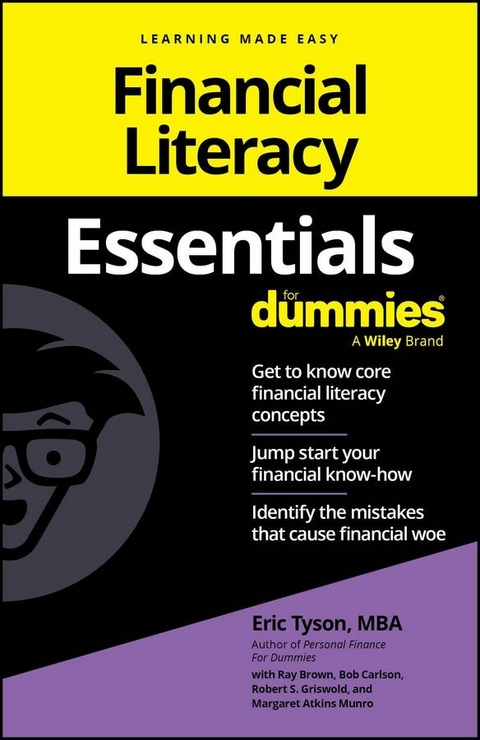
Financial Literacy Essentials For Dummies (eBook)
263 Seiten
For Dummies (Verlag)
978-1-394-32617-4 (ISBN)
Your to-the-point guide on the essentials of managing your finances
The first step in becoming a better personal financial manager is understanding the pillars of personal finance. Financial Literacy Essentials For Dummies is your cheat sheet on understanding how to better manage your finances. Distilled down to the essentials, this book makes it easy for anyone to learn the basics of managing money. You won't be able to escape life's many expenses, but with this book, you can get a grip on smart spending, saving, investing, and beyond. Start by creating a realistic budget for your situation and make a plan for achieving your goals. Money doesn't have to be scary with this Essentials guide.
- Get quick-and-easy explanations budgeting, savings accounts, and debt
- Understand how much you can really afford to spend, and learn to spend smarter
- Make a plan for getting out of debt-or avoid getting into debt in the first place
- Ensure that you have enough of a buffer to deal with unexpected expenses
Need easy-to-understand information to help get your finances on track? Financial Literacy Essentials For Dummies is the guide for you.
Eric Tyson is a veteran financial counselor who has dedicated his life to helping people achieve financial success. He is the author of bestselling titles including Personal Finance For Dummies, Investing For Dummies, Investing in Your 20s & 30s For Dummies, and Personal Finance in Your 20s & 30s For Dummies. This book includes insight from Eric's expert co-authors: Ray Brown and Robert S. Griswold MSBA CRE CPM (Home Buying Kit For Dummies), Bob Carlson (Personal Finance After 50 For Dummies), and Margaret Atkins Munro EA (Taxes For Dummies).
Your to-the-point guide on the essentials of managing your finances The first step in becoming a better personal financial manager is understanding the pillars of personal finance. Financial Literacy Essentials For Dummies is your cheat sheet on understanding how to better manage your finances. Distilled down to the essentials, this book makes it easy for anyone to learn the basics of managing money. You won't be able to escape life's many expenses, but with this book, you can get a grip on smart spending, saving, investing, and beyond. Start by creating a realistic budget for your situation and make a plan for achieving your goals. Money doesn't have to be scary with this Essentials guide. Get quick-and-easy explanations budgeting, savings accounts, and debt Understand how much you can really afford to spend, and learn to spend smarter Make a plan for getting out of debt or avoid getting into debt in the first place Ensure that you have enough of a buffer to deal with unexpected expenses Need easy-to-understand information to help get your finances on track? Financial Literacy Essentials For Dummies is the guide for you.
Chapter 2
Budgeting Basics
IN THIS CHAPTER
Making a budget
Tracking what you spend
Calculating your savings rate
Determining your financial net worth
Planning for emergencies
Creating a budget may sound like a daunting task, but it doesn’t have to be. In fact, it’s a great way to get a leg up on your savings so that you have the future funds to pay for the things you want.
This chapter shows you how to create a budget and provides the tools you need to track what you spend, calculate your savings rate, determine your financial net worth, and plan for common financial emergencies that you may encounter along the way.
Creating a Budget
When most people hear the word budgeting, they think unpleasant thoughts — like those associated with dieting — and rightfully so. But budgeting can help you move from knowing how much you spend on various things to successfully reducing your spending.
The first step in the process of budgeting, or planning your future spending, is to analyze where your current spending is going. After you do that, calculate how much more you’d like to save each month. Then comes the hard part: deciding where to make cuts in your spending.
Suppose that you’re currently not saving any of your monthly income and you want to save 10 percent for retirement. If you can save and invest through a tax-sheltered retirement account — for example, a 401(k), 403(b), or a SEP-IRA — you don’t actually need to cut your spending by 10 percent to reach a savings goal of 10 percent (of your gross income). When you contribute money to a tax-deductible retirement account, you reduce your federal and state taxes. If you’re a moderate income earner paying, say, 30 percent in federal and state taxes on your marginal income, you actually need to reduce your spending by only 7 percent to save 10 percent. The other 3 percent of the savings comes from the lowering of your taxes. (The higher your tax bracket, the less you need to cut your spending to reach a particular savings goal. To find your tax bracket, see Chapter 9.)
So to boost your savings rate to 10 percent, go through your current spending category by category until you come up with enough proposed cuts to reduce your spending by 7 percent. Make your cuts in the areas that will be the least painful and where you’re getting the least value from your current level of spending. (If you don’t have access to a tax-deductible retirement account, budgeting still involves the same process of assessment and making cuts in various spending categories, but your cuts need to add up to the entire amount you want to save, in this example, 10 percent rather than 7 percent.)
Another method of budgeting involves starting completely from scratch rather than examining your current expenses and making cuts from that starting point. Ask yourself how much you’d like to spend on different categories. The advantage of this approach is that it doesn’t allow your current spending levels to constrain your thinking. You’ll likely be amazed at the discrepancies between what you think you should be spending and what you actually are spending in certain categories.
Tracking Expenses: From Lattes to Rent
Most folks should be tracking their spending. The one category of people I would exempt from needing to monitor (categorize) where their money goes are those who are satisfied with the portion of their income they’re able to save and who are saving enough to accomplish their goals. In this section, I provide some guidelines and frameworks for tracking your spending and getting a handle on overspending.
Tracking spending the “low-tech” way
Analyzing your spending is a little bit like being a detective. Your goal is to reconstruct the spending. You probably have some major clues at your fingertips or somewhere on the desk or computer where you handle your finances.
Unless you keep meticulous records that detail every dollar you spend, you won’t have perfect information. Don’t sweat it! A number of sources can enable you to detail where you’ve been spending your money. To get started, get out/access your
- Recent pay stubs
- Recent tax returns (federal and state)
- Online banking/bill payment record
- Log of checks paid and monthly debit-card transactions
- Credit- and charge-card bills and transactions
Ideally, you want to assemble the information needed to track 12 months of spending. But if your spending patterns don’t fluctuate greatly from month to month (or you won’t complete the exercise if it means compiling a year’s worth of data), you can reduce your data gathering to one six-month period, or to every second or third month for the past year. If you take a major vacation or spend a large amount on gifts during certain months of the year, make sure that you include these months in your analysis. Also account for insurance or other payments that you may choose not to pay monthly and instead pay quarterly, semiannually, or annually.
Purchases made with cash are the hardest to track because they don’t leave a paper trail. Over the course of a week or perhaps even a month, you could keep a record of everything you buy with cash. Tracking cash can be an enlightening exercise, but it can also be tedious. (See the section “Tracking your spending on ‘free’ websites and apps” later in this chapter.) If you lack the time and patience, you can try estimating. Think about a typical week or month — how often do you buy things with cash? For example, if you eat lunch out four days a week, paying around $8 per meal, that’s about $130 a month. You may also want to try adding up all the cash withdrawals from your checking account statement (or any other account from which you do cash transactions) and then working backward to try to remember where you spent the cash.
Separate your expenditures into as many useful and detailed categories as possible. Table 2-1 gives you a suggested format; you can tailor it to fit your needs. Remember, if you lump too much of your spending into broad, meaningless categories like “Other,” you’ll end up right back where you started — wondering where all the money went. (Note: When completing the tax section in Table 2-1, report the total tax you paid for the year as tabulated on your annual income-tax return — and take the total Social Security and Medicare taxes paid from your end-of-year pay stub — rather than the tax withheld or paid during the year.)
TABLE 2-1 Detailing Your Spending
| Category | Monthly Average ($) | Percent of Total Gross Income (%) |
|---|
| Taxes, taxes, taxes (income) | __________ |
| FICA (Social Security & Medicare) | __________ |
| Federal | __________ |
| State and local | __________ |
| The roof over your head | __________ |
| Rent | __________ |
| Mortgage | __________ |
| Property taxes | __________ |
| Gas/electric/oil | __________ |
| Water/garbage | __________ |
| Phones | __________ |
| Cable TV, streaming & internet services | __________ |
| Gardener/housekeeper | __________ |
| Furniture/appliances | __________ |
| Maintenance/repairs | __________ |
| Food, glorious food | __________ |
| Supermarket | __________ |
| Restaurants and takeout | __________ |
| Getting around | __________ |
| Gasoline | __________ |
| Maintenance/repairs | __________ |
| State registration fees | __________ |
| Tolls and parking | __________ |
| Taxi, on-demand car services, rentals | __________ |
| Bus or subway... |
| Erscheint lt. Verlag | 11.3.2025 |
|---|---|
| Sprache | englisch |
| Themenwelt | Sachbuch/Ratgeber ► Beruf / Finanzen / Recht / Wirtschaft ► Geld / Bank / Börse |
| Recht / Steuern ► Wirtschaftsrecht | |
| Wirtschaft ► Betriebswirtschaft / Management | |
| Schlagworte | best finance books for beginners • Finance for Beginners • finance guide • finance help • financial independence • financial literacy • Financial Planning • financial planning 101 • getting out of debt • out of deb • personal finance • personal finance book • personal finance guide • personal loan • saving money |
| ISBN-10 | 1-394-32617-3 / 1394326173 |
| ISBN-13 | 978-1-394-32617-4 / 9781394326174 |
| Informationen gemäß Produktsicherheitsverordnung (GPSR) | |
| Haben Sie eine Frage zum Produkt? |
 EPUB (Adobe DRM)
Kopierschutz: Adobe-DRM
Adobe-DRM ist ein Kopierschutz, der das eBook vor Mißbrauch schützen soll. Dabei wird das eBook bereits beim Download auf Ihre persönliche Adobe-ID autorisiert. Lesen können Sie das eBook dann nur auf den Geräten, welche ebenfalls auf Ihre Adobe-ID registriert sind.
Details zum Adobe-DRM
Dateiformat: EPUB (Electronic Publication)
EPUB ist ein offener Standard für eBooks und eignet sich besonders zur Darstellung von Belletristik und Sachbüchern. Der Fließtext wird dynamisch an die Display- und Schriftgröße angepasst. Auch für mobile Lesegeräte ist EPUB daher gut geeignet.
Systemvoraussetzungen:
PC/Mac: Mit einem PC oder Mac können Sie dieses eBook lesen. Sie benötigen eine
eReader: Dieses eBook kann mit (fast) allen eBook-Readern gelesen werden. Mit dem amazon-Kindle ist es aber nicht kompatibel.
Smartphone/Tablet: Egal ob Apple oder Android, dieses eBook können Sie lesen. Sie benötigen eine
Geräteliste und zusätzliche Hinweise
Buying eBooks from abroad
For tax law reasons we can sell eBooks just within Germany and Switzerland. Regrettably we cannot fulfill eBook-orders from other countries.
aus dem Bereich