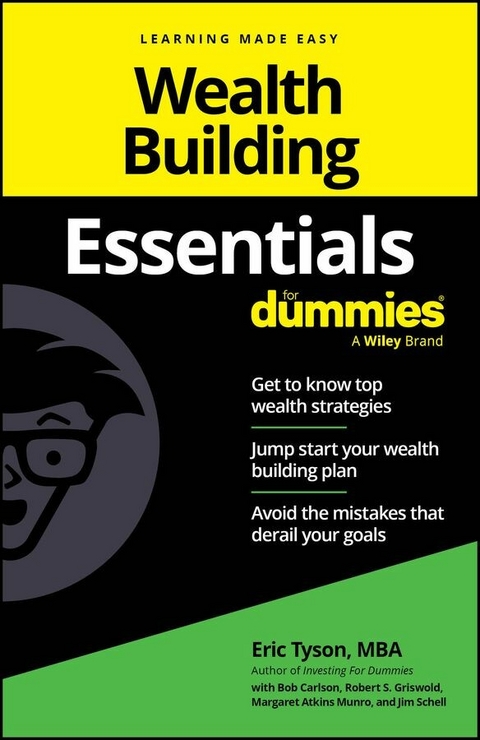
Wealth Building Essentials For Dummies (eBook)
256 Seiten
For Dummies (Verlag)
978-1-394-32620-4 (ISBN)
The quick-and-easy guide to unlocking the potential of your income
Building Wealth Essentials For Dummies is your go-to guide for learning the key concepts involved in growing your finances, no matter where you're starting. Small and value priced for the budget conscious, this book breaks down investing, taxes, retirement planning, and all the other wealth-building fundamentals you need to know. Each section gives you tips and strategies you can use to increase your net worth. Investment strategies, real estate advice, retirement account basics-and everything you need to make sure you're not getting too risky with your money. Make a plan and stay on track for your savings goal, with easy-to-understand information and guidance in this Essentials guide.
- Get to-the-point information on saving, investing, and managing your money
- Discover strategies for building wealth and increasing net worth faster
- Easily reference details on retirement accounts and other money matters
- Ensure you're making smart decisions with risk management and spending tips
Building Wealth Essentials For Dummies is a great buy for personal finance beginners who are ready to start putting their money to work.
Your path to profitable, purpose-driven sales starts here.
Eric Tyson is a veteran financial counsel or who has dedicated his life to helping people achieve financial success. He is the author of many best- selling titles including Personal Finance For Dummies, Investing For Dummies, and Real Estate Investing For Dummies. This book includes insight from Eric's expert co-authors: Bob Carlson (Personal Finance After 50 For Dummies), Robert S. Griswold, MSBA, CRE, CPM (Real Estate Investing For Dummies), Margaret Atkins Munro, EA (Taxes For Dummies), and Jim Schell (Small Business For Dummies).
Chapter 1
Developing a Wealth Mindset
IN THIS CHAPTER
Shifting your mindset toward abundance
Applying a wealth mindset to debt
In this chapter, I encourage you to consider what wealth means to you. I explain how to think in terms of abundance, which is essential to cultivating a healthy wealth mindset. I also help you recognize the common flaws in mindset that lead to counterproductive financial habits, such as over-saving and accumulating too much debt. Think of this chapter as a touchstone you can revisit as you define your financial goals.
Focusing on Abundance
Wealthy people with a healthy and balanced perspective on wealth and life possess a mindset that focuses on abundance. They use and enjoy their money, and although this may sound counterintuitive, they resist over-saving.
Yes, it’s true: Over-saving is possible. Some people, in fact often the best savers, get hooked on amassing more and more money and have trouble enjoying and using their money. Super savers and money amassers generally equate more money with more financial security. Theirs is a scarcity mindset.
This section can help you recognize this scarcity mindset in yourself and others, and provides tips to address and temper it.
Avoiding a scarcity mindset
Over-savers possess a scarcity mindset. Just as some people think that their financial problems would be solved if only they could earn a higher income, over-savers typically believe that if they could reach a greater level of assets, they’d be more relaxed and could do what they really want with their lives. The bar, however, continually gets raised, and the level of “enough” is rarely attained. For this reason, some of the best savers and money accumulators also have the most difficulty spending money, even in retirement.
Some super savers have insecurities relating to money. Specifically, they view amassing financial assets as providing them with safety and security that extend far beyond the financial realm. While having more financial assets, in theory, provides greater financial peace of mind, these riches don’t necessarily provide more of the other types of security — friendships, for example, for which hoarders are searching.
Achieving a certain level of affluence can provide for greater access to quality healthcare. However, once one reaches the point at which quality healthcare is the norm, the incessant pursuit of more money can have a negative impact on an individual’s long-term health and quality of life. For example, super savers often believe that they will be better protected as seniors and better able to enjoy their retirement years with hefty account balances. But the pursuit of more money, which typically entails longer work hours and greater stress, can lead to more health problems before and in retirement.
Many super savers, who also tend to be obsessed with work, come from homes and families where they felt on the edge economically and emotionally. Although there are so many things that we can’t control in the world, money amassers typically derive a sense of both economic and emotional security from saving a lot of money.
Super savers have an amazing ability to selectively hear particular stories that reinforce rather than question their tendencies and beliefs. For example, stories periodically surface about how the legions of baby boomers retiring will bankrupt Social Security and cause a stock market collapse. Super savers batten down the hatches, save more, and invest even more conservatively when such stories worry them. News stories about stock market declines, corporate layoffs, budget deficits, terrorism risks, rising energy prices, and conflicts in the Middle East and elsewhere cause super savers to close their wallets, clutch their investments, and worry and save more.
Balancing spending and saving
Most people don’t want to work their entire adulthood. And, even if they do enjoy working for pay that much, who wants to live on the edge economically, always dependent upon the next paycheck to be able to pay the monthly bills?
That’s why you should avoid the extremes of overspending and over-saving. Consider the analogy to eating food: Eat too little or not enough of the right kinds of foods, and you go hungry and possibly suffer deficiencies of energy and nutrition; too much eating, on the other hand, leads to obesity and other health problems.
Overspending and its companion, under-saving, hamper your ability to accomplish future personal and financial goals and in the worst cases, can lead to bankruptcy. Over-saving can lead to not living in the moment and constantly postponing for tomorrows that we may not live to enjoy.
Remember Goldilocks and her quest at the bear’s home for the bowl of porridge that was not too hot and not too cold and a bed to rest in that was not too hard and not too soft. Everyone should save money as a cushion and to accomplish important personal and financial goals.
-
Keeping money accumulation in proper perspective: As with any good habit, you can get too much of a good thing. Washing your hands and maintaining proper hygiene is worthwhile, but it becomes problematic when you obsess over cleanliness and it interferes with your life and personal relationships.
Conquering over-saving and an obsession with money typically requires a mix of education and specific incremental behavioral changes. Substantive change typically comes over months and years, not days and weeks.
The vast majority of super savers work many hours and may neglect their loved ones and themselves. They typically need to work less and lead more balanced lives. That may involve changing jobs or careers or simply coming up with a “stop-doing list,” the opposite of a “to-do list.”
- Giving yourself permission to spend more: Money amassers usually need to discover how to loosen the purse strings. Figuring out how to spend more and save less is a problem more folks wish they had, so consider yourself lucky in that regard! Give yourself permission to spend knowing that the money you’ve saved will continue to grow and be available to you as you need it.
-
Doing some retirement analysis: Understand the standard of living that can be provided by the assets you’ve already accumulated. There are numerous useful retirement planning analytic tools you can use to assess where you currently stand in terms of saving for retirement.
Among the various mass market website retirement tools, I really like T. Rowe Price’s (
www.troweprice.com/usis/advice/tools/retirement-income-calculator) and Vanguard’s (investor.vanguard.com/calculator-tools/retirement-income-calculator/). -
Getting smart about investing your money: While super savers love watching their money grow, some have trouble with investing in volatile wealth-building investments like stocks because they generally abhor losing money. Even bonds can be a turn-off because they, too, can fluctuate in value.
So, part of the challenge with getting comfortable with spending more of your money is to get wiser about investing. Please see Chapter 3.
-
Going on a news diet: Super savers often benefit from minimizing and even avoiding news programs that dwell on the negative, which only reinforces your fears about never having enough money. One justification that super savers use for their actions that constantly resurfaces in the news is the litany of fears surrounding the tens of millions of baby boomers hitting retirement age around the same time. The story goes that retiring boomers will cause a mammoth collapse of the stock market as they sell out to finance their golden years. Real estate prices are supposed to plummet as well, as everyone sells their larger homes and retires to small condominiums in the Sun Belt.
Such doomsaying about the future of financial and real estate markets is unfounded. The fear that boomers will suddenly sell everything when they hit retirement is bogus. Nobody sells off their entire nest egg the day after they stop working; retirement can last up to 30+ years, and assets are depleted quite gradually. On top of that, boomers vary in age by up to 16 years and, thus will be retiring at different times. The wealthiest (who hold the bulk of real estate and stocks) won’t even sell most of their holdings but will, like the wealthy of previous generations, pass on many of their assets.
-
Treating yourself to something special: Regularly buy something that you historically have viewed as frivolous but which you can truly afford. Once a week or once a month, treat yourself!
By all means, spend the money on something that brings you the most joy, whether it’s eating out occasionally at a pricey restaurant or taking an extra vacation during the year. How about tickets to your favorite sporting events or other performances?
-
Buying more gifts for the people you love: Money hoarders actually tend to be more generous with loved ones than they are with themselves. However, over-savers still tend to squelch their desires to buy gifts or help out those they care about.
Think about those you care most about and what would bring joy to their lives. Try hard to think about what they really value and enjoy.
-
Going easy when it comes to everyday expenses: How would you like it if a family member or...
| Erscheint lt. Verlag | 11.3.2025 |
|---|---|
| Sprache | englisch |
| Themenwelt | Sachbuch/Ratgeber ► Beruf / Finanzen / Recht / Wirtschaft ► Geld / Bank / Börse |
| Recht / Steuern ► Wirtschaftsrecht | |
| Wirtschaft ► Betriebswirtschaft / Management | |
| Schlagworte | get out of debt • investing beginners • investing tips • manage finances • Money Management • Net Worth • personal finance • personal finance book • personal finance guide • retirement planning book • retirement saving • Tax tips • wealth building |
| ISBN-10 | 1-394-32620-3 / 1394326203 |
| ISBN-13 | 978-1-394-32620-4 / 9781394326204 |
| Informationen gemäß Produktsicherheitsverordnung (GPSR) | |
| Haben Sie eine Frage zum Produkt? |
 EPUB (Adobe DRM)
Kopierschutz: Adobe-DRM
Adobe-DRM ist ein Kopierschutz, der das eBook vor Mißbrauch schützen soll. Dabei wird das eBook bereits beim Download auf Ihre persönliche Adobe-ID autorisiert. Lesen können Sie das eBook dann nur auf den Geräten, welche ebenfalls auf Ihre Adobe-ID registriert sind.
Details zum Adobe-DRM
Dateiformat: EPUB (Electronic Publication)
EPUB ist ein offener Standard für eBooks und eignet sich besonders zur Darstellung von Belletristik und Sachbüchern. Der Fließtext wird dynamisch an die Display- und Schriftgröße angepasst. Auch für mobile Lesegeräte ist EPUB daher gut geeignet.
Systemvoraussetzungen:
PC/Mac: Mit einem PC oder Mac können Sie dieses eBook lesen. Sie benötigen eine
eReader: Dieses eBook kann mit (fast) allen eBook-Readern gelesen werden. Mit dem amazon-Kindle ist es aber nicht kompatibel.
Smartphone/Tablet: Egal ob Apple oder Android, dieses eBook können Sie lesen. Sie benötigen eine
Geräteliste und zusätzliche Hinweise
Buying eBooks from abroad
For tax law reasons we can sell eBooks just within Germany and Switzerland. Regrettably we cannot fulfill eBook-orders from other countries.
aus dem Bereich