


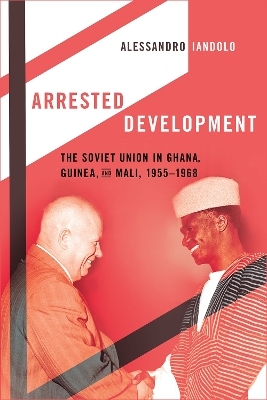
Arrested Development
The Soviet Union in Ghana, Guinea, and Mali, 1955–1968
Seiten
2025
Cornell University Press (Verlag)
978-1-5017-8505-4 (ISBN)
Cornell University Press (Verlag)
978-1-5017-8505-4 (ISBN)
Winner of the Marshall Shulman Book Prize of the Harriman Institute of Columbia University
Winner of the W. Bruce Lincoln Book Prize of the Association for Slavic, East European, and Eurasian Studies
In Arrested Development, Alessandro Iandolo examines the USSR's role in West Africa during the 1950s and 1960s as an aid donor, trade partner, and political model for newly independent Ghana, Guinea, and Mali.
With a strong economy in the 1950s, the USSR expanded its global outreach, supporting economic development in post-colonial Africa and Asia. Many nations saw the Soviet model as a path to political and economic independence. Drawing on extensive Russian and West African archival research, Iandolo explores Soviet ideas, sponsored projects, and their lasting impact.
Soviet specialists worked alongside West African colleagues to design ambitious development plans, build infrastructure, establish collective farms, survey mineral resources, and manage banking and trade. These collaborations - and the tensions they created - shed light on how Soviet and West African visions of development intersected. Arrested Development positions the USSR as a key player in twentieth-century economic history, reshaping global approaches to modernization.
Winner of the W. Bruce Lincoln Book Prize of the Association for Slavic, East European, and Eurasian Studies
In Arrested Development, Alessandro Iandolo examines the USSR's role in West Africa during the 1950s and 1960s as an aid donor, trade partner, and political model for newly independent Ghana, Guinea, and Mali.
With a strong economy in the 1950s, the USSR expanded its global outreach, supporting economic development in post-colonial Africa and Asia. Many nations saw the Soviet model as a path to political and economic independence. Drawing on extensive Russian and West African archival research, Iandolo explores Soviet ideas, sponsored projects, and their lasting impact.
Soviet specialists worked alongside West African colleagues to design ambitious development plans, build infrastructure, establish collective farms, survey mineral resources, and manage banking and trade. These collaborations - and the tensions they created - shed light on how Soviet and West African visions of development intersected. Arrested Development positions the USSR as a key player in twentieth-century economic history, reshaping global approaches to modernization.
Alessandro Iandolo is Lecturer in Soviet and Post-Soviet History at University College London.
Introduction
1. A Farewell to Arms: De-Stalinization, the Soviet Economy, and the Global Cold War
2. Brave New World: The Soviet Union and the Making of the Third World
3. First Contact
4. The Heart of the Matter
5. Things Fall Apart
6. The End of the Affair
Conclusion
| Erscheinungsdatum | 05.11.2025 |
|---|---|
| Zusatzinfo | 6 b&w halftones, 4 maps - 6 Halftones, black and white - 4 Maps |
| Verlagsort | Ithaca |
| Sprache | englisch |
| Maße | 152 x 229 mm |
| Gewicht | 454 g |
| Themenwelt | Geisteswissenschaften ► Geschichte ► Allgemeine Geschichte |
| Geisteswissenschaften ► Geschichte ► Regional- / Ländergeschichte | |
| Wirtschaft ► Volkswirtschaftslehre | |
| ISBN-10 | 1-5017-8505-2 / 1501785052 |
| ISBN-13 | 978-1-5017-8505-4 / 9781501785054 |
| Zustand | Neuware |
| Informationen gemäß Produktsicherheitsverordnung (GPSR) | |
| Haben Sie eine Frage zum Produkt? |
Mehr entdecken
aus dem Bereich
aus dem Bereich
eine Reise um die Welt zu außergewöhnlichen Persönlichkeiten, …
Buch | Softcover (2023)
Piper (Verlag)
CHF 25,20
Eine wahre Geschichte von Schiffbruch, Mord und Meuterei
Buch | Hardcover (2024)
C.Bertelsmann (Verlag)
CHF 34,95


