


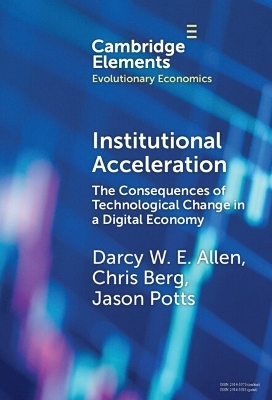
Institutional Acceleration
The Consequences of Technological Change in a Digital Economy
Seiten
2025
Cambridge University Press (Verlag)
978-1-009-63863-0 (ISBN)
Cambridge University Press (Verlag)
978-1-009-63863-0 (ISBN)
This Element develops a theory of institutional acceleration to explain the transformation to a digital economy through a cluster of frontier technologies: artificial intelligence, blockchain, quantum computing, cryptography, and low-earth orbit infrastructure. It also shows how this process reshapes our institutional economic architecture.
This Element develops a theory of institutional acceleration to explain the transformation to a digital economy through a cluster of frontier technologies: artificial intelligence, blockchain, quantum computing, cryptography, and low-earth orbit infrastructure. Unlike previous technological revolutions, these technologies transform not how we organise things, but how we coordinate economic activity. The authors' supertransition thesis explains why these digital technologies shouldn't be understood in isolation, but rather should be understood in how they combine to create new institutional possibilities, leading to more open, complex, and global economic systems. Drawing on evolutionary economics and institutional theory, this Element shows how this evolutionary process is reshaping our institutional economic architecture. Ultimately, institutional acceleration drives greater computation and knowledge into our economic systems.
This Element develops a theory of institutional acceleration to explain the transformation to a digital economy through a cluster of frontier technologies: artificial intelligence, blockchain, quantum computing, cryptography, and low-earth orbit infrastructure. Unlike previous technological revolutions, these technologies transform not how we organise things, but how we coordinate economic activity. The authors' supertransition thesis explains why these digital technologies shouldn't be understood in isolation, but rather should be understood in how they combine to create new institutional possibilities, leading to more open, complex, and global economic systems. Drawing on evolutionary economics and institutional theory, this Element shows how this evolutionary process is reshaping our institutional economic architecture. Ultimately, institutional acceleration drives greater computation and knowledge into our economic systems.
Introduction; 1. The supertransition thesis; 2. Vectors of technological change; 3. Combinatorial innovation and the supertransition; 4. Institutional acceleration; 5. An economy of digital institutions; 6. Adaptation and agency in the supertransition; References.
| Erscheinungsdatum | 20.05.2025 |
|---|---|
| Reihe/Serie | Elements in Evolutionary Economics |
| Zusatzinfo | Worked examples or Exercises |
| Verlagsort | Cambridge |
| Sprache | englisch |
| Gewicht | 268 g |
| Themenwelt | Wirtschaft ► Betriebswirtschaft / Management ► Marketing / Vertrieb |
| Wirtschaft ► Betriebswirtschaft / Management ► Unternehmensführung / Management | |
| Wirtschaft ► Volkswirtschaftslehre | |
| ISBN-10 | 1-009-63863-7 / 1009638637 |
| ISBN-13 | 978-1-009-63863-0 / 9781009638630 |
| Zustand | Neuware |
| Informationen gemäß Produktsicherheitsverordnung (GPSR) | |
| Haben Sie eine Frage zum Produkt? |
Mehr entdecken
aus dem Bereich



aus dem Bereich
Grundlagen marktorientierter Unternehmensführung : Konzepte, …
Buch (2024)
Springer Gabler (Verlag)
CHF 69,95
Wie Sie mit starken Geschichten Ihre Kunden überzeugen
Buch | Softcover (2025)
Vahlen (Verlag)
CHF 31,95
Aufgaben, Werkzeuge und Erfolgsfaktoren
Buch | Softcover (2023)
Vahlen (Verlag)
CHF 30,65


