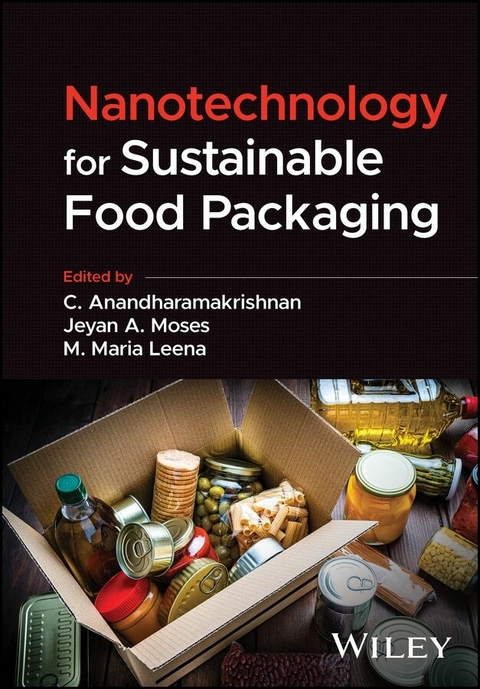
Nanotechnology for Sustainable Food Packaging (eBook)
477 Seiten
Wiley (Verlag)
978-1-119-87513-0 (ISBN)
Latest techniques for the development of biodegradable food packaging casings with commentary on safety concerns and regulatory frameworks
Nanotechnology for Sustainable Food Packaging covers the latest techniques and applications of nanotechnology, demonstrating capabilities to revolutionize the food packaging sector. This includes concepts of biodegradable food packaging, approaches to improve material functionality, robust sensing systems, and the scope of employing advanced analytical and computational approaches to support progress in the field. Throughout, the text focuses on the United Nations Sustainable Development Goals, including life cycle analysis, biodegradability, green practices, eco-friendliness, and sustainability.
This book explores the major food packaging matrixes (polymers, edible films, and multilayers), different categories of advances (composites, active and intelligent packaging), labeling considerations, region- and country-specific regulatory frameworks, and safety concerns. Readers will also find a futuristic preview of this rapidly advancing field and an overview of lab-ready technologies with the potential for commercialization.
Written by a team of highly qualified authors, Nanotechnology for Sustainable Food Packaging discusses sample topics including:
- Nanotechnology's potential to improve the shelf life of food products, the chemistry and functionality of different materials based on merits and possible challenges
- Sources, chemistry, and functionality of various bio-based sources and their usage as nanocomposites, and bio-based alternatives, drawbacks, and research trends
- Bioactive compounds in food packaging and their benefits, preparation methods, characterization approaches, delivery, and assessment
- Surface modification approaches through sustainable physico-chemical approaches, and the development of flexible packaging materials suitable for specific requirements such as nonthermal processing
Nanotechnology for Sustainable Food Packaging is an essential scientific and technological reference for scientists and R&D personnel who are interested in advancing food packaging technologies. The book is also valuable for students, researchers, and food industry professionals studying nanotechnology in food, food packaging, and food science and technology.
C. Anandharamakrishnan, Director, CSIR - National Institute for Interdisciplinary Science and Technology (NIIST), Ministry of Science and Technology - Government of India, Thiruvananthapuram, India
Jeyan A. Moses, Assistant Professor and In-charge, Computational Modeling and Nanoscale Processing Unit, National Institute of Food Technology, Entrepreneurship and Management, Thanjavur (NIFTEM-T), Thanjavur, India
M. Maria Leena, Assistant Professor, Department of Biotechnology, Faculty of Engineering and Technology, SRM Institute of Science and Technology, Tiruchirappalli, India
Latest techniques for the development of biodegradable food packaging casings with commentary on safety concerns and regulatory frameworks Nanotechnology for Sustainable Food Packaging covers the latest techniques and applications of nanotechnology, demonstrating capabilities to revolutionize the food packaging sector. This includes concepts of biodegradable food packaging, approaches to improve material functionality, robust sensing systems, and the scope of employing advanced analytical and computational approaches to support progress in the field. Throughout, the text focuses on the United Nations Sustainable Development Goals, including life cycle analysis, biodegradability, green practices, eco-friendliness, and sustainability. This book explores the major food packaging matrixes (polymers, edible films, and multilayers), different categories of advances (composites, active and intelligent packaging), labeling considerations, region- and country-specific regulatory frameworks, and safety concerns. Readers will also find a futuristic preview of this rapidly advancing field and an overview of lab-ready technologies with the potential for commercialization. Written by a team of highly qualified authors, Nanotechnology for Sustainable Food Packaging discusses sample topics including: Nanotechnology s potential to improve the shelf life of food products, the chemistry and functionality of different materials based on merits and possible challengesSources, chemistry, and functionality of various bio-based sources and their usage as nanocomposites, and bio-based alternatives, drawbacks, and research trendsBioactive compounds in food packaging and their benefits, preparation methods, characterization approaches, delivery, and assessmentSurface modification approaches through sustainable physico-chemical approaches, and the development of flexible packaging materials suitable for specific requirements such as nonthermal processing Nanotechnology for Sustainable Food Packaging is an essential scientific and technological reference for scientists and R&D personnel who are interested in advancing food packaging technologies. The book is also valuable for students, researchers, and food industry professionals studying nanotechnology in food, food packaging, and food science and technology.
| Erscheint lt. Verlag | 7.3.2025 |
|---|---|
| Sprache | englisch |
| Themenwelt | Naturwissenschaften ► Biologie |
| Wirtschaft ► Betriebswirtschaft / Management | |
| Weitere Fachgebiete ► Land- / Forstwirtschaft / Fischerei | |
| Schlagworte | 3D printed packaging • Active packaging • biopolymer packaging • edible packaging. • food nanotechnology • Food Packaging • intelligent packaging • nano packaging • nanostructures in packaging • Smart Packaging |
| ISBN-10 | 1-119-87513-7 / 1119875137 |
| ISBN-13 | 978-1-119-87513-0 / 9781119875130 |
| Informationen gemäß Produktsicherheitsverordnung (GPSR) | |
| Haben Sie eine Frage zum Produkt? |
 PDF (Adobe DRM)
Kopierschutz: Adobe-DRM
Adobe-DRM ist ein Kopierschutz, der das eBook vor Mißbrauch schützen soll. Dabei wird das eBook bereits beim Download auf Ihre persönliche Adobe-ID autorisiert. Lesen können Sie das eBook dann nur auf den Geräten, welche ebenfalls auf Ihre Adobe-ID registriert sind.
Details zum Adobe-DRM
Dateiformat: PDF (Portable Document Format)
Mit einem festen Seitenlayout eignet sich die PDF besonders für Fachbücher mit Spalten, Tabellen und Abbildungen. Eine PDF kann auf fast allen Geräten angezeigt werden, ist aber für kleine Displays (Smartphone, eReader) nur eingeschränkt geeignet.
Systemvoraussetzungen:
PC/Mac: Mit einem PC oder Mac können Sie dieses eBook lesen. Sie benötigen eine
eReader: Dieses eBook kann mit (fast) allen eBook-Readern gelesen werden. Mit dem amazon-Kindle ist es aber nicht kompatibel.
Smartphone/Tablet: Egal ob Apple oder Android, dieses eBook können Sie lesen. Sie benötigen eine
Geräteliste und zusätzliche Hinweise
Buying eBooks from abroad
For tax law reasons we can sell eBooks just within Germany and Switzerland. Regrettably we cannot fulfill eBook-orders from other countries.
aus dem Bereich