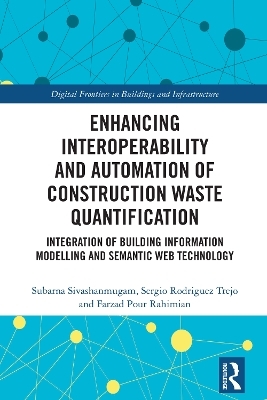
Enhancing Interoperability and Automation of Construction Waste Quantification
Routledge (Verlag)
978-1-032-99854-1 (ISBN)
The research in this book shapes the development of a semantic framework that supports the built environment in quantifying construction waste (CW) and informing optimal material choices from early design stages to minimise the quantity and diversity of waste generation. The book also demonstrates the application of the proposed framework using an ontology (PROduct CIRcularity Ontology) and a BIM-integrated digital tool (Building Waste Tool [BWT]). The PRODCIRO and BWT inform how data, standardisation, consistency, and granularity could streamline and automate the CWQ process. The book also presents the outputs of a test-case building used to validate the adaptability and accuracy of the framework.
This book is a valuable resource for BIM and sustainability practitioners. It provides a comprehensive discussion on the significance of CW, its impacts on sustainability, advancements in CWQ, and data and information gaps within the existing CWQ practices. The solution proposed in the book will help the built environment to shift from reactive to proactive and preventive waste management.
Subarna Sivashanmugam is Research Associate at the School of Computing, Engineering and Digital Technologies, Teesside University, UK. Sergio Rodriguez-Trejo is Associate Professor of Research at the School of Computing, Engineering and Digital Technologies, Teesside University, UK. Farzad Rahimian is Professor of Digital Engineering at the School of Computing, Engineering and Digital Technologies, Teesside University, UK
Chapter 1: Introduction
Chapter 2: Construction Waste - Definition, Classification, Sources Impacts, Management and Quantification
Chapter 3: Building Information Modelling, Semantic Web Technology, and Life Cycle Assessment
Chapter 4: BIM-based Semantic Construction Waste Quantification Framework
Chapter 5 Product Circularity Ontology - Design, Development and Validation
Chapter 6 Building Waste Tool - Design, Development and Validation
Chapter 7: Potentialities of the Construction Waste Quantification Framework
Chapter 8 Conclusions and Future Directions
| Erscheinungsdatum | 19.07.2025 |
|---|---|
| Reihe/Serie | Digital Frontiers in Buildings and Infrastructure |
| Zusatzinfo | 4 Line drawings, black and white; 59 Halftones, color; 59 Illustrations, color; 4 Illustrations, black and white |
| Verlagsort | London |
| Sprache | englisch |
| Maße | 156 x 234 mm |
| Gewicht | 460 g |
| Themenwelt | Naturwissenschaften ► Biologie ► Ökologie / Naturschutz |
| Technik ► Bauwesen | |
| Wirtschaft ► Betriebswirtschaft / Management ► Projektmanagement | |
| ISBN-10 | 1-032-99854-7 / 1032998547 |
| ISBN-13 | 978-1-032-99854-1 / 9781032998541 |
| Zustand | Neuware |
| Informationen gemäß Produktsicherheitsverordnung (GPSR) | |
| Haben Sie eine Frage zum Produkt? |
aus dem Bereich