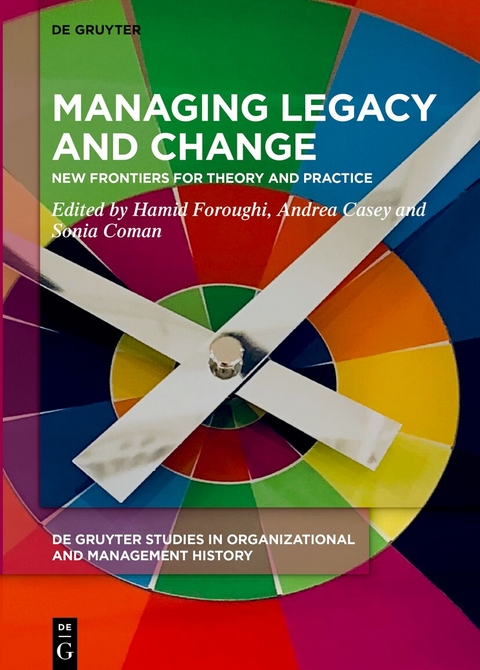
Managing Legacy and Change
De Gruyter (Verlag)
978-3-11-163133-2 (ISBN)
The book provides insights on managing legacy and change in organizations from some of the pioneering researchers in the field. It explores how past legacies both enable and restrict opportunities for organizational renewal, social change, and new forms of organizing. On the one hand, tangible and intangible legacies can be a source of authentication, legitimation, and strategy restoration; on the other hand, past legacies can restrict our imagination by enforcing path dependency.
Managing legacy is a vital process for both old and new organizations. Older organizations often find that their legacy is at odds with present realities or future directions. In contrast, newly formed organizations often feel they have a deficit in legacy compared with long-established organizations and seek to boost credibility by engaging in activities that can be retrospectively claimed as their legacy. In either case, when aspects of an organization's raison d'être change, the organizational identity is threatened, and legacy can become an obstacle or an opportunity.
By bringing together varied perspectives on legacy, including heritage, collective memory, rhetorical history, storytelling, and imprinting theory, this volume contributes to a deeper understanding of the interplay of legacies and imagined futures as it pertains to organizational identity and change.
Hamid Foroughi is Associate Professor in Responsible Management at Warwick Business School, University of Warwick. He currently serves as a senior editor for Leadership and a media review editor for Organization Studies. His research delves into the historical turn in organization studies, offering insights into the processes of organizing, identities, legitimation, and change across diverse empirical contexts. He is best known for his contribution to the study of collective memory in management. He has published extensively on these topics in internationally leading journals, such as Academy of Management Annals, Organization Studies, Journal of Management Studies, Academy of Management Learning and Education, and Journal of World Business.
Dr. Andrea Casey is Associate Professor Emerita of Human and Organizational Learning at The George Washington University, where she taught doctoral courses in organizational culture, organizational dynamics, and research. Her research interests include organizational memory and history and identity-related theories such as organizational and professional identity. Her recent books include Organizational Identity and Memory: A Multidisciplinary Approach (Routledge) and New Directions in Organizational and Management History (De Gruyter). She has served on the Board of Governors of the Academy of Management and as Division Chair for the Managerial and Organizational Cognition Division. Before joining the George Washington University faculty, Dr. Casey was a consultant focusing on organizational change, strategic planning, and leadership development.
Dr. Sonia Coman is the Director of Digital Engagement at Washington National Cathedral. She leads the institution's digital transformation and serves on the core team of The World Innovation Network, where she advises on visual content strategy. She has a PhD from Columbia University, where she brought social network analysis to bear on a transcultural art study. Dr. Coman is the co-author of the book New Directions in Organizational and Management History. Her research focuses on the intersection of art, business, and history. She has published extensively on creativity and distinctiveness and on legacy and organizational history in internationally recognized journals and edited volumes.
"This book is a remarkable contribution to the field of organizational studies. The editors are weaving together a rich tapestry of theoretical and empirical perspectives on the interplay between legacy and change. Their deep expertise and thoughtful curation shine through, as they bring together a diverse array of scholars to explore how organizations navigate their historical roots while envisioning dynamic futures. The book's exploration of topics such as organizational memory, identity, and the strategic management of legacy offers both academic rigor and practical relevance, making it an invaluable resource for researchers, students, and practitioners alike. With its compelling case studies and forward-looking insights, this book stands as a testament to the editors' dedication and the enduring importance of understanding legacy in today's ever-evolving organizational landscape."
Diana Doroftei, Head of Cybersecurity Governance, Risk and Compliance, Bose Corporation
"Managing Legacy and Change is a volume that brings fresh theoretical insight and empirical richness to the study of legacy in and around organizations. This book nicely illuminates how legacies are constructed, contested, and reimagined in the face of change. The contributions in this volume offer compelling frameworks for understanding how the past shapes organizational identity and strategic possibility providing deep insights for exploring memory, imprinting, heritage, and rhetorical history."
Tina Dacin, Professor and Chair of Strategy and Organizational Behavior at Smith School of Business, Queen's University, Canada
| Erscheinungsdatum | 05.08.2025 |
|---|---|
| Reihe/Serie | De Gruyter Studies in Organizational and Management History ; 2 |
| Zusatzinfo | 6 b/w ill., 6 b/w tbl. |
| Verlagsort | Berlin/Boston |
| Sprache | englisch |
| Maße | 170 x 240 mm |
| Gewicht | 543 g |
| Themenwelt | Sozialwissenschaften |
| Wirtschaft ► Betriebswirtschaft / Management ► Planung / Organisation | |
| Wirtschaft ► Betriebswirtschaft / Management ► Unternehmensführung / Management | |
| Schlagworte | Change • Future-Making • legacy • Organisationsgeschichte • Organisatorisches Gedächtnis • organizational history • Organizational Memory • Tradition • Vermächtnis • Wandel • Zukunftsgestaltung |
| ISBN-10 | 3-11-163133-8 / 3111631338 |
| ISBN-13 | 978-3-11-163133-2 / 9783111631332 |
| Zustand | Neuware |
| Informationen gemäß Produktsicherheitsverordnung (GPSR) | |
| Haben Sie eine Frage zum Produkt? |
aus dem Bereich