Structural Reliability in Civil Engineering (eBook)
641 Seiten
Wiley-Scrivener (Verlag)
978-1-119-41905-1 (ISBN)
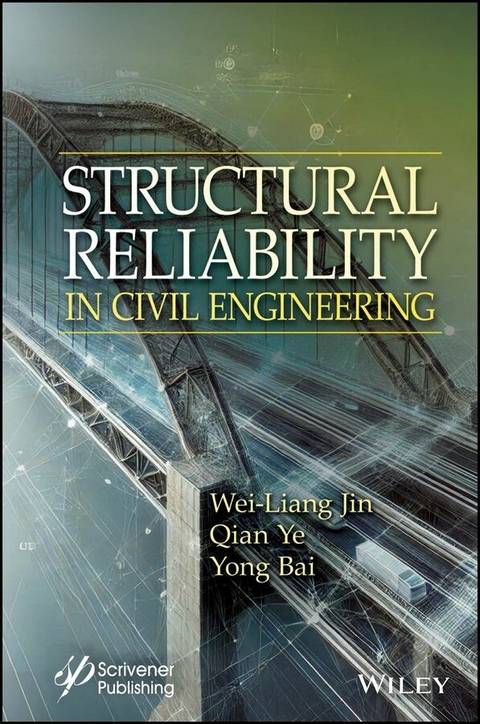
Structural Reliability in Civil Engineering gives essential insights into the complexities of uncertainty in engineered structures, along with practical examples and advanced methods, making it an invaluable resource for both theory and real-world application in your civil engineering projects.
Uncertainties are associated with the design, evaluation, and dynamic analysis of engineered structures. Structural Reliability in Civil Engineering introduces a developmental overview and basic concepts of reliability theory, uncertainty analysis methods, reliability calculation methods, numerical simulation methods of reliability, system reliability analysis methods, time-varying structural reliability, load and load combination methods, the application of reliability in specifications, and the application of reliability theory in practical engineering. This book not only discusses reliability theory in civil structural engineering but also presents valuable examples to illustrate the application of reliability theory to practical questions and comprehensively elaborates on some theories related to reliability from a brand-new perspective.
Wei-Liang Jin, PhD, is a professor in the College of Civil Engineering and Architecture, Zhejiang University, Hangzhou, China. For a number of years, he has been engaged in research on full life analysis of engineering structures, basic performance of concrete structures, theory of masonry structures, and their applications. He has successfully undertaken over 100 research projects for several organizations and has published over 500 papers, ten academic monographs, and three textbooks in domestic and foreign academic journals.
Qian Ye, PhD, received his doctoral degree in structural engineering from Zhejiang University in 2013. Since then, he has published nearly 20 papers and has led three department level projects. His research areas include steel structures and offshore floating structures.
Yong Bai, PhD, is a professor and doctoral supervisor in the Institute of Structural Engineering, School of Construction and Engineering, Zhejiang University. He is a member of Zhejiang Province's Hundred Talents Plan and the American Society of Shipbuilding and Marine Engineers. In 2000, he won the Best Paper Award at the International Conference on Ocean Mechanics and Polar Engineering.
Structural Reliability in Civil Engineering gives essential insights into the complexities of uncertainty in engineered structures, along with practical examples and advanced methods, making it an invaluable resource for both theory and real-world application in your civil engineering projects. Uncertainties are associated with the design, evaluation, and dynamic analysis of engineered structures. Structural Reliability in Civil Engineering introduces a developmental overview and basic concepts of reliability theory, uncertainty analysis methods, reliability calculation methods, numerical simulation methods of reliability, system reliability analysis methods, time-varying structural reliability, load and load combination methods, the application of reliability in specifications, and the application of reliability theory in practical engineering. This book not only discusses reliability theory in civil structural engineering but also presents valuable examples to illustrate the application of reliability theory to practical questions and comprehensively elaborates on some theories related to reliability from a brand-new perspective.
Notations
| a | Current crack length in Fracture mechanics model |
| A | Deflection of structural systems; Experience adjustment coefficient |
| aa | The limit on crack length under certain functions after bearing secondary cyclic loads within its designed service life |
| Aeff | Effective sample area |
| Alimit | Maximum deflection of structural system |
| a0 | Initial crack length |
| Aq | Gross area of pile tip |
| As | Surface area of pile body |
| Awhole | Sampling area |
| B | Proposition supported by new experimental results |
| b(X) | Stress at any position in the structural system |
| BQ | Deviation coefficient of Q |
| BSC | Deviation coefficient of SC |
| C | Test constants in Fracture Effect coefficient for converting load into effect The specified limits for the structure or component body to meet the requirements for normal use |
| CkX | Kurtosis coefficient |
| CL | Lift coefficient of wave force |
| CsX | Skewness coefficient |
| d | Truncated values in truncated distribution functions |
| D | Fatigue damage Outer diameter of pile Effects caused by dead load |
| Effects caused by the average value of dead load |
| Df | Structural damage area |
| dij | Fatigue damage due to wave, low or high frequency combination stress Si under the sea case i and the wave direction j |
| DS | Safety region of stochastic process in the whole life of structure |
| de | The displacement vector of all nodes in the element |
| E | Standard value effect of seismic loads |
| EF | Error factor |
| Ei | Subjective uncertainty |
| ejk | Error term due to spatial averaging |
| Ek | Plastic failure of the first failure mode |
| f | Surface friction force per unit area |
| f(X) | Joint density function of variables X(=(x1, x2, …, xn)) |
| fGray(z) | The built-in function of gray variable |
| fHi | Zero crossing rate of high-frequency mooring force |
| fi | Average zero crossing rate |
| Fi | ith failure mode |
| fk | Standard values of material properties |
| fLi | Zero crossing rate of low-frequency mooring force |
| fwi | Wave zero crossing rate |
| ft | Concrete tensile strength |
| Fij | ith failed component in the jth failure mode |
| Fmax X | Cumulative distribution function of X at maximum value |
| FMi(x) | Cumulative distribution function for maximum load effects of various combinations |
| FN(n) | Cumulative distribution function in time integration method |
| fR() | Probability density function for the whole structure |
| fR(t) | Instantaneous probability density function of structural time-varying resistance |
| fRi() | Probability density function of the strength of the i-th link |
| frsf (x) | Response surface function |
| Fs | Structural failure function |
| fS(t) | Instantaneous probability density function of time-varying load effects |
| fX(x, t) | Probability density function with time-varying state |
| Probability density function of Xi at xi point |
| Conditional probability density function under given condition X2|X1 |
| g(•) | Functional function space composed of single limit state function |
| G(•) | Functional function space composed of multiple limit state functions |
| Gi | The importance of subjective uncertainty |
| Gmax | Maximum allowable stress of structural system |
| H(ω) | Frequency response function |
| h(x) | Importance sampling probability density function for the variable x |
| H(x) | Shannon entropy |
| Hk | Characteristic wave height |
| hT(t) | Risk function |
| hN(n) | Risk function in time integration method |
| hV() | Importance sampling probability density function for the variable v |
| i | Radius of gyration |
| I | Total error of commonly used |
| J | Jacobian matrix |
| K | Structural stiffness Traditional model describing the fatigue life of components or structures under constant stress amplitude Lateral earth pressure coefficient |
| k | Initial modulus of soil |
| KA | The ratio of actual and standard values of geometric features of structural components |
| Ka | Rankine active earth pressure coefficient |
| Klimit | Ultimate structural stiffness |
| K0 | Coefficient of static earth pressure |
| l | Number of support vectors in SVM |
| L | Effects caused by live load Unit length |
| Li | Persistent live load |
| lij | Number of ith effective mode under jth condition |
| LN(n) | Reliability function in time integration method |
| Effect caused by the average distribution of live load at any time point |
| Lr | Standard value effect of roof live load Temporary live load |
| The effect caused by the average distribution of the maximum service life of live load |
| m | Random variables in Traditional model describing the fatigue life of components or structures under constant stress amplitude Test constants in fracture mechanics model |
| mE | Influence degree of human error |
| Mi | The magnitude of subjective uncertainty |
| Mj | Plastic resistance moment in the jth segment |
| n | Number of components in the ith failure mode in the failure mode method number of times a given load is applied in a time integration method |
| N | Total number of structural failures/sampling simulations |
| N(s) | Relationship between material fatigue parameters |
| Nc | Dimensionless bearing capacity coefficient of cohesive soil |
| ni | Actual number of cycles under stress amplitude Si |
| Ni | Number of stress cycles at constant stress amplitude |
| nL | Number of... |
| Erscheint lt. Verlag | 24.2.2025 |
|---|---|
| Sprache | englisch |
| Themenwelt | Naturwissenschaften ► Physik / Astronomie |
| Technik ► Elektrotechnik / Energietechnik | |
| Wirtschaft | |
| Schlagworte | Characteristic/Nominal Combination • Civil Engineering • Durability Limit State • Failure Mode • Limit State of Bearing Capacity • Load Combination • Partial Coefficient • Reliability Analysis • Serviceability Limited State • Structural Design Code • Structural Reliability • Target Reliability • Time-Various Reliability • Uncertainty |
| ISBN-10 | 1-119-41905-0 / 1119419050 |
| ISBN-13 | 978-1-119-41905-1 / 9781119419051 |
| Informationen gemäß Produktsicherheitsverordnung (GPSR) | |
| Haben Sie eine Frage zum Produkt? |
 EPUB (Adobe DRM)
Kopierschutz: Adobe-DRM
Adobe-DRM ist ein Kopierschutz, der das eBook vor Mißbrauch schützen soll. Dabei wird das eBook bereits beim Download auf Ihre persönliche Adobe-ID autorisiert. Lesen können Sie das eBook dann nur auf den Geräten, welche ebenfalls auf Ihre Adobe-ID registriert sind.
Details zum Adobe-DRM
Dateiformat: EPUB (Electronic Publication)
EPUB ist ein offener Standard für eBooks und eignet sich besonders zur Darstellung von Belletristik und Sachbüchern. Der Fließtext wird dynamisch an die Display- und Schriftgröße angepasst. Auch für mobile Lesegeräte ist EPUB daher gut geeignet.
Systemvoraussetzungen:
PC/Mac: Mit einem PC oder Mac können Sie dieses eBook lesen. Sie benötigen eine
eReader: Dieses eBook kann mit (fast) allen eBook-Readern gelesen werden. Mit dem amazon-Kindle ist es aber nicht kompatibel.
Smartphone/Tablet: Egal ob Apple oder Android, dieses eBook können Sie lesen. Sie benötigen eine
Geräteliste und zusätzliche Hinweise
Buying eBooks from abroad
For tax law reasons we can sell eBooks just within Germany and Switzerland. Regrettably we cannot fulfill eBook-orders from other countries.
aus dem Bereich