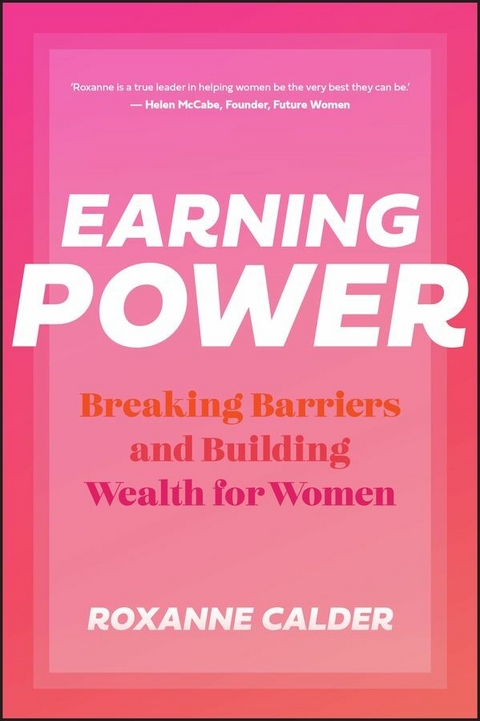
Earning Power (eBook)
269 Seiten
Wiley (Verlag)
978-1-394-31344-0 (ISBN)
Discover how to boost your earnings so you can close the million-dollar pay gap
Did you know that over a lifetime, the gender pay gap can cost women over one million dollars? In Earning Power, you'll find the knowledge, strategies and confidence you need to make work and life decisions that maximise your personal earning potential. Most of us assume the pay gap is not an issue in our industry or workplace-or we think it only matters when it comes to negotiating salary. But from your super contributions to maternity leave, what you do with your pay can have a compounding and lifelong effect on your finances. Everyday workplace decisions like simply putting up your hand in a meeting can have a crucial impact on your long-term financial goals.
Earning Power reveals the mindset and the tools that will help you bridge the gap and take control of your financial future. It features interviews with real women on the career challenges and choices they've faced, with stories and advice from Nagi Maehashi of RecipeTin Eats, kikki.K founder Kristina Karlsson, journalist and presenter Leila McKinnon, pioneering burns surgeon Professor Fiona Woods, and more.
Uncover the data and insights that show where and how women fall behind in their earnings-and learn to identify opportunities for boosting your worth.
- Discover the million-dollar formula that will guide your decision-making.
- Read powerful, inspirational stories from women who have struggled with stereotypes, bias, setbacks, anxiety and imposter syndrome.
- Get crucial tips and immediate, actionable advice for the critical crossroads in your career.
- Foster your growth and purpose-and cultivate the confidence and resilience you need for success.
- Align your earnings goals with life's milestones and its curveballs.
It's time to find financial equity and close the gap. With Earning Power, you'll discover the simple, small steps and key decisions that can make a million dollars' worth of difference.
'Roxanne is a true leader in helping women be the very best they can be. This is an essential guide to the everyday actions critical for boosting your worth professionally and financially.'
-Helen McCabe, Founder, Future Women
ROXANNE CALDER is a recruiter, career advisor, and employment expert. As the Managing Director of EST10, one of Australia's leading recruitment agencies, Roxanne has spent her career navigating the intricate intersections of talent and opportunity, reshaping how individuals and businesses approach success in the modern workplace.
Introduction
WHO WEARS THE PANTS?
In 1995, gender equality was a distant dream. For starters, where I worked, the company policy for women was ‘skirts only’. Matching suit jackets were, of course, also the norm. Trousers were not allowed, and stockings or pantyhose were a must. No bare legs, no open‐toed or flat shoes and categorically no trainers. The word used in the policy manual was ‘polished’. As for ‘casual Fridays’, we didn't have them. There was no negotiation, compromise or pandering. If you didn't like it, you didn't join the company
The economic conditions were also vastly different. When I entered the workforce — with youth unemployment at 28.1 per cent and the overall unemployment rate at 10 per cent — I was grateful to have any job. With the surplus of job seekers, there was always someone ready and available to take your position. Being so easily replaceable was part of the psychological carry‐all you took with you to work.
Just before starting my new job, I was to learn the gravity of the ‘no pants’ policy. I nervously but oh so carefully selected an outfit to wear when returning my signed contract. It was a cool August day and I remember wearing navy woollen tailored Country Road pants, a fitted, grey, long‐sleeved cotton top, also from Country Road, and brown Timberland loafers. It was the quintessential 1990s preppy look and I had it down pat!
My boss, however, was not impressed. She took my contract, shook my hand and with an assertive, throaty laugh, said, ‘You won't be wearing that outfit on Monday.’ It was the pants. I'm tough‐skinned, but I was taken aback. I had always been, and remain, a tiny bit rebellious — not to mention an enormous and sometimes annoying supporter of female ‘anything’. I loved being a ‘girl’ but pushed the boundaries on how that was defined, especially when it came to competing with males.
As a child, I was described as ‘complex’, and I'm certain my parents were frequently confounded. I was the tomboy building rafts, but I had a Barbie, a doll's house and every other doll imaginable. I wore surfer‐style boys' board shorts but, at the same time, insisted on the fashionable 1970s maxi dresses, long boots and Farrah Fawcett (Charlie's Angels) hairstyle. I challenged the boys at school, never tolerated their nonsense and aspired to have a ‘man's job’ when I grew up. I wanted to be an engineer, like my dad — that is, until I realised it involved physics.
So, the ‘no pants’ policy was confronting and a tough pill to swallow. But I am a huge pragmatist and a bit vain. Frankly, I don't look great in trousers. My legs aren't long enough to carry the look. The Country Road ones were pretty much my limit and only on ‘skinny days’. I tackled the dilemma in the practical way I usually do: I preferred skirts anyway, so I got on with it.
I should mention I was also conditioned. In a world where conformity often disguised itself as tradition, I was conditioned to accept a ‘no trouser policy’ as perfectly acceptable. I mean, my own school, which I had left not that long before, had a skirts‐only rule. I was also conditioned to accept and not question authority (another sign of the times). Despite my innate rebellious disposition, I accept authority when I respect it, and I respected and trusted my new bosses. I was hungry to embark on my career and to learn all I could.
It might seem disappointing to contemporary readers that my boss — being a woman — enforced a ‘skirts only’ policy. Don't be too quick to judge though. It was a necessary and clever approach to navigating the bias and discrimination of the 1990s, which was rife. The aim of the policy was for women to ‘fit in’. My boss was a feminist, and her goal was to empower other women. She also innately and intuitively understood that women needed to fit in by stealth back then.
By ‘fitting in’ when we went to a meeting — which was typically run by a male 20 years older than us — we lessoned the likelihood of judgement and rejection. I assure you, if I went to a meeting back then in jeans or looking remotely masculine in trousers — or didn't wear a jacket or heels, for that matter — it is safe to say the client would have chosen another consultant to work with. Someone ‘more professional’.
I am grateful to have worked in such a culture in my formative years. Being a pragmatist, the emphasis on presentation and business polish at that age helped me to overcome feelings of self doubt and instead instilled in me confidence and pride. I felt empowered despite, or maybe because of, the mandated skirt culture. My strong value set and ardent belief in supporting all things female remain, and have developed into a job with purpose in a profession I love.
I have the fondest memories of my first ‘proper’ job due to the amazing and powerful women I worked with. They were innovative, entrepreneurial and pushed all boundaries. I was given every opportunity to shine and advance, and I took it. When I interview women today, they often tell me they don't want to work for a female boss or in a predominantly female environment. I am perplexed and saddened when I hear this and think, ‘Oh, shame, you don't know what you are missing out on!’
Today I run my own recruitment business, EST10. I have managed corporate recruitment firms throughout Australia, the UK, Singapore and Hong Kong. I have completed my MBA, and Earning Power is my second book. I know the workplace back to front: I have placed thousands of women in jobs and assisted thousands more with career advice.
The attitudes of 1995 are thankfully in the past. The ‘skirts only’ policies are long gone. But don't be fooled: the sayonara is superficial. I consider it a token gesture by society and corporations. I am sure it's only intended to keep us quiet for a bit. A stall tactic even. But not if, like me, you stand up for those who can't, and choke loudly on injustice.
So what is the real litmus test for gender equality? The ultimate truth serum? It's pay equity. Progress in this area is practically prehistoric. In March 2023, the Australian federal parliament passed the Workplace Gender Equality Amendment (Closing the Gender Pay Gap) Bill 2023.
Ahem … that's nearly 30 years after our ‘skirts only’ era, and the only way to achieve pay equity is by enshrining it in law. A stark reality, difficult to comprehend and even harder to accept in our supposedly enlightened times.
As a recruitment expert who has worked with countless women over the years, I can attest to the harsh reality of the earnings discrepancies. The inequities are bold, in your face and, sadly, entrenched — and the facts back this up.
$1 million and counting …
Data and statistics show women to be consistently financially worse off than men. The average gender‐based pay discrepancy over a lifetime is $1 million … and counting. Along comes retirement, and it's too late.
I've long known about the million‐dollar disparity in earnings. I formulated my own calculations and estimates long ago, and I am not sure whether to be deeply concerned or somewhat proud that my findings are eerily similar to those of the Workplace Gender Equality Agency (WGEA).
Financial independence empowers and liberates. Financial resources grant us the freedom to choose our own paths in life, fostering responsibility, innovation and creativity. What I cherish most about economic independence is the ability to help others. So yes, while women benefit from financial independence, so does society.
The workplace gender law underscores the harsh reality of wage inequality. It rightfully points the finger at companies, executives and society. The WGEA, and others, attribute the gap in earnings to social, economic and structural factors. They are accurate in their assessments and the external pressure is necessary and justified.
Still, it's not enough. Waiting for these structural changes to ‘make things better’, fair and equitable is simply too long. At this pace, even our grandchildren will be too old to benefit from the reforms.
When it comes to my future, I have a problem attributing accountability and responsibility solely to external forces. And it's not a debate on whether what they are saying is right or wrong. It's more about it being out of my control and in the hands of others.
I've never been good at handing over control, especially when it has to do with my earnings, finances, dreams and future. This might be why I am often considered pushy, ballsy or bossy. This also might be why this rebellious ‘pro‐female anything’ advocate has written this book.
The premise of Earning Power is self‐efficacy: to help women be in control of their financial future, to earn more and work towards closing the gender pay gap for themselves. It looks at the gender pay gap from a different angle — an employment and personal agency lens — and distils my experience and knowledge to help women to be a million...
| Erscheint lt. Verlag | 21.2.2025 |
|---|---|
| Sprache | englisch |
| Themenwelt | Wirtschaft ► Betriebswirtschaft / Management |
| Schlagworte | best women empowerment books • business • business books for women • Career • career development • confidence • Diversity and inclusion • earn more • empowering women • est10 • female empowerment • female leadership • Feminism • Gender equality • Get a promotion • Get a raise • Heather Swan • Julia Ross • Leadership • Networking • Parental leave • Personal development • personal finance • Personal Growth • Phil Kearns • professional development • Recruitment • Retirement • salary negotiation • Self-Help • success books for women • superannuation • wallabies • Wingsuit • Women in Business |
| ISBN-10 | 1-394-31344-6 / 1394313446 |
| ISBN-13 | 978-1-394-31344-0 / 9781394313440 |
| Informationen gemäß Produktsicherheitsverordnung (GPSR) | |
| Haben Sie eine Frage zum Produkt? |
 EPUB (Adobe DRM)
Kopierschutz: Adobe-DRM
Adobe-DRM ist ein Kopierschutz, der das eBook vor Mißbrauch schützen soll. Dabei wird das eBook bereits beim Download auf Ihre persönliche Adobe-ID autorisiert. Lesen können Sie das eBook dann nur auf den Geräten, welche ebenfalls auf Ihre Adobe-ID registriert sind.
Details zum Adobe-DRM
Dateiformat: EPUB (Electronic Publication)
EPUB ist ein offener Standard für eBooks und eignet sich besonders zur Darstellung von Belletristik und Sachbüchern. Der Fließtext wird dynamisch an die Display- und Schriftgröße angepasst. Auch für mobile Lesegeräte ist EPUB daher gut geeignet.
Systemvoraussetzungen:
PC/Mac: Mit einem PC oder Mac können Sie dieses eBook lesen. Sie benötigen eine
eReader: Dieses eBook kann mit (fast) allen eBook-Readern gelesen werden. Mit dem amazon-Kindle ist es aber nicht kompatibel.
Smartphone/Tablet: Egal ob Apple oder Android, dieses eBook können Sie lesen. Sie benötigen eine
Geräteliste und zusätzliche Hinweise
Buying eBooks from abroad
For tax law reasons we can sell eBooks just within Germany and Switzerland. Regrettably we cannot fulfill eBook-orders from other countries.
aus dem Bereich