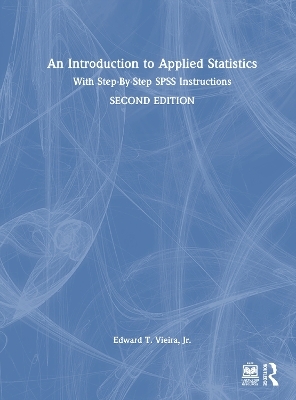
An Introduction to Applied Statistics
Routledge (Verlag)
978-1-032-57995-5 (ISBN)
With a systematic, beginner-friendly approach, the author assumes no prior knowledge, making complex statistical foundations accessible to students from a variety of disciplines. Concise, digestible chapters build statistical competencies within a practical, evidence-based framework, minimizing technical jargon to facilitate comprehension. Now in its latest edition, the book is fully updated with SPSS v29.0 instructions and screenshots, ensuring compatibility with the most recent software developments. It also includes expanded content on addressing nonrandom sampling issues, such as case weighting, and delves into advanced topics like factor analysis, logistic regression, cluster analysis, and discriminant analysis, catering to the evolving needs of students and professionals alike.
An invaluable resource for introductory quantitative research methods courses in psychology, social sciences, business, and marketing, this text combines practical examples, online resources, and an approachable format to support both learning and application.
Key Features:
Concise chapters integrating real-world applications: Seamlessly blends statistical skills with practical scenarios, illustrating the flexible use of statistics in evidence-based decision-making.
Accessible presentation: Offers practical explanations of statistical procedures with minimal technical jargon, enhancing understanding and retention.
Foundational preparation: Early chapters are designed to equip students for advanced statistical procedures, building a strong foundational knowledge.
Step-by-step SPSS instructions: Provides detailed SPSS v29.0 guidance with screenshots to reinforce comprehension and hands-on skills.
Real-world exercises with answers: Includes practical exercises complete with solutions to facilitate active learning and application.
Comprehensive instructor resources: Offers extensive teaching support with chapter PowerPoints and test banks to enhance the educational experience.
Edward T. Vieira, Jr., a professor of marketing and statistics at Simmons University's School of Management for over two decades, brings a wealth of experience as both an academic and a former marketing and business consultant to multinational corporations across North America and Europe. His extensive body of work includes numerous books, book chapters, and articles published in peer-reviewed journals and presented at international conferences.
PART I: GETTING STARTED 1. An Introduction to Applied Statistics 2. Statistics: Descriptive, Inferential, and Correlational 3. Data and Types of Variables 4. SPSS 29 Statistics Data Management Basics – Preparing Data for Analysis; PART II: SAMPLING CONSIDERATIONS 5. Sampling Strategies 6. Sample Size 7. Sources and Types of Statistical Error 8. Missing Data; PART III: DATA SCREENING, DESCRIBING, AND PROBABILITIES 9. Describing Categorical Variables 10. Basic Probabilities for Categorical Variables 11. The Concepts of Data Distribution, Probability Values, and Significance Testing 12. Numeric Variables: Data Screening and Removing Outliers; PART IV: STATISTICAL ANALYSIS Categorical Variables 13. Chi-Square Goodness of Fit Test: Comparing Counts in a Single Variable With Two or More Categories 14. Chi-Square Test of Independence: Comparing Counts Between Two Variables Each With Two or More Categories 15. Chi-Square Test of the Same Sample: Comparing Counts of the Same Sample Measured Twice Using a Categorical Variable Numeric Variables 16. t-Test: Comparing a Single-Sample Mean to a Specific Value 17. t-Test: Comparing Two Independent Samples’ Variable Means 18. Analysis of Variance (ANOVA): Comparing More Than Two Independent Samples’ Means to Test for Differences Among Them 19. Paired t-Test: Comparing the Means of the Same Sample Measured Twice Using a Numeric Variable Association and Regression 20. General Linear Model Repeated Measures: Comparing Means of the Same Sample Measured More Than Twice Using a Numeric Variable 21. Bivariate Correlation: The Association Between Two Variables 22. Linear Regression 23. Logistic Regression Data Reduction 24. Factor Analysis: From Data Reduction to Latent Variables 25. Classification Using Cluster Analysis; APPENDICES Appendix A: Glossary Appendix B: Chapter Statistical Exercise Solutions Appendix C: Statistics Flow Chart
| Erscheinungsdatum | 12.06.2025 |
|---|---|
| Zusatzinfo | 242 Tables, black and white; 340 Line drawings, black and white; 287 Halftones, black and white; 627 Illustrations, black and white |
| Verlagsort | London |
| Sprache | englisch |
| Maße | 210 x 280 mm |
| Gewicht | 2080 g |
| Themenwelt | Mathematik / Informatik ► Mathematik ► Statistik |
| Wirtschaft ► Betriebswirtschaft / Management ► Unternehmensführung / Management | |
| ISBN-10 | 1-032-57995-1 / 1032579951 |
| ISBN-13 | 978-1-032-57995-5 / 9781032579955 |
| Zustand | Neuware |
| Informationen gemäß Produktsicherheitsverordnung (GPSR) | |
| Haben Sie eine Frage zum Produkt? |
aus dem Bereich