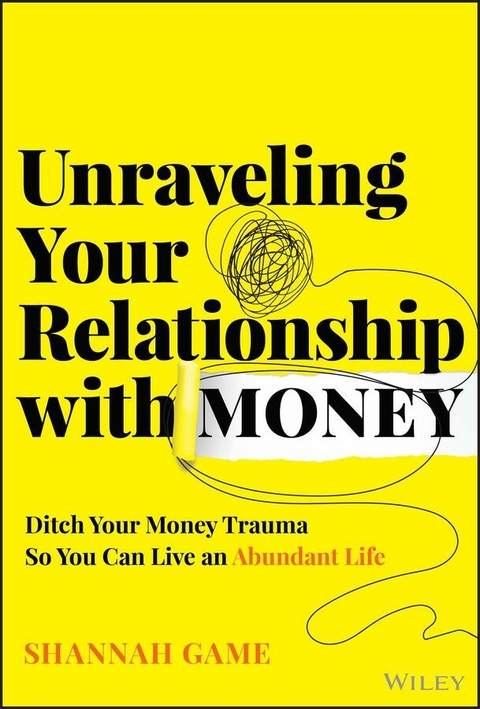
Unraveling Your Relationship with Money (eBook)
259 Seiten
Wiley (Verlag)
978-1-394-29987-4 (ISBN)
Inspiring guide to reimagining your relationship with money and finally reach your financial goals
In Unraveling Your Relationship with Money: Ditch Your Money Trauma So You Can Live an Abundant Life, renowned Financial Expert and Certified Trauma of Money Specialist Shannah Game delivers an inspiring, informative, and at times cathartic guide to improve your behavioral finance skills, gently resolving deep-rooted trauma related to emotions like shame, fear, and panic surrounding money, and finally start reaching your financial goals.
This book includes dozens of stories of financial trials and tribulations from individuals from all walks of life, helping readers realize they're not alone and learn lessons from others who have faced similar situations. From Chapter 1, Game addresses the internal battles that so many of us face when it comes to money:
- You can't enjoy life or feel happy unless you have a certain amount of money in your bank account
- You feel you should be further along in your quest to build wealth
- You feel like it's too late to save for retirement, change careers, start a business, etc.
Unraveling Your Relationship with Money: Ditch Your Money Trauma So You Can Live an Abundant Life is an essential read for anyone who wants to go deeper than spreadsheets and fancy apps to create an unshakeable psychological foundation for long-term wealth creation and emotional stability.
SHANNAH GAME is a renowned financial expert and host of a popular behavioral finance podcast, Everyone's Talkin' Money. Inspired by her tumultuous journey trying to get her own financial life on track, she now helps others reshape their perspective towards finances and live their best lives.
Inspiring guide to reimagining your relationship with money and finally reach your financial goals In Unraveling Your Relationship with Money: Ditch Your Money Trauma So You Can Live an Abundant Life, renowned Financial Expert and Certified Trauma of Money Specialist Shannah Game delivers an inspiring, informative, and at times cathartic guide to improve your behavioral finance skills, gently resolving deep-rooted trauma related to emotions like shame, fear, and panic surrounding money, and finally start reaching your financial goals. This book includes dozens of stories of financial trials and tribulations from individuals from all walks of life, helping readers realize they're not alone and learn lessons from others who have faced similar situations. From Chapter 1, Game addresses the internal battles that so many of us face when it comes to money: You can't enjoy life or feel happy unless you have a certain amount of money in your bank account You feel you should be further along in your quest to build wealth You feel like it's too late to save for retirement, change careers, start a business, etc. Unraveling Your Relationship with Money: Ditch Your Money Trauma So You Can Live an Abundant Life is an essential read for anyone who wants to go deeper than spreadsheets and fancy apps to create an unshakeable psychological foundation for long-term wealth creation and emotional stability.
Introduction
“Above all, be the heroine of your life, not the victim.”
—Nora Ephron
There used to be an old‐school wooden rollercoaster at Six Flags Magic Mountain named Colossus that makes me queasy just thinking about it. I've only ridden this beast a few times, but I've been terrified each time I set foot on the plank, ready to hop into the car. A few times, I've just turned around and chickened out (true story).
If you've ever been on an old wooden rollercoaster, you know how uncomfortable the ride is. Every twist and turn and bump you feel to the core of your body. The most horrifying part of the ride for me is the two‐ to three‐second pause that happens just as you creep up the first hill before the first steep drop. I understand this is what rollercoaster enthusiasts live for, but why, I'll never quite understand. Each time I reach this stationary hang and the adrenaline starts to race through my body, I question how in the world I convinced myself this was a good idea.
The fear, panic, stress, and slight excitement at the top of the first hill on Colossus is kind of like what I call your relationship with money.
If the concept of having any kind of “relationship” with money is new to you, you've come to the right place. I've spent more than 20 years teaching, coaching, writing, and speaking about all things finance. I've learned one really important fact – money is always slightly terrorizing, even in the best of times, and utterly terrorizing in the worst of times. These strong feelings are what dictate your relationship with money: how you think, act, and feel about your finances. Your relationship with money is the foundation for every money decision you make and don't make.
Most people go their entire lives before they understand the power of their relationship with money. I get it. We're doing a pretty terrible job teaching financial literacy at a base level. Only 25 states currently require a standalone financial literacy class for high school students in the United States, so it may not be a surprise that many other countries, including Denmark, Sweden, Norway, and Canada, far surpass the United States in financial literacy education. Even with the best efforts, however, one thing that isn't taught in schools or universities or during your upbringing is how to deal with the mounting and heavy emotions around money. Why is this? That's a really good question, my friend, and one I've been searching for years to find the answers to.
Throughout my career, I've been deeply interested in how to help people just like you create change with their finances and, ultimately, lives. I often tell my students and coaching clients, if there isn't anything you want to do with your money or goals you want to reach, then learning about money should be put on the back burner. What does it matter in this situation? However, that's not reality. You've got stuff you want to do and aren't progressing toward it. And that just plain sucks. I think it's time to try a new approach because reading all the money how‐to books, listening to all the podcasts, and scouring the internet for answers doesn't seem to be helping you create a well‐lived life. If it were enough, you wouldn't still be searching for answers.
I'll let you in on a little secret. While I haven't done a formal poll of every human on earth, I'm guessing that most of us share a few common beliefs around money: (i) You can't enjoy life or feel happy unless you have a certain amount of money in your bank account. (ii) You feel you should be further along in your quest to build wealth. (iii) You feel like it's too late to learn about money, save for retirement, change careers, earn more money, pay off your debt, start a business, etc. (iv) You feel like there's never enough money to go around.
How would it feel to know that every person to your left and right shares these same core beliefs, no matter how much money they make or have?
Before you go shaming yourself for believing one of these common beliefs about money, I want to stop you. I'm writing this book to teach you about the power of your relationship with money and to help you discover that shame and judgment aren't emotions you need to hang onto anymore. I know that's easier said than done, and these days, everyone's a critic. But we're all out here trying to do our best, you included. So, if someone has not given you a permission slip to drop shame and judgment around money, let me be the first to offer this to you.
It's also hard to do because money is either the giant gray elephant in the room or the boogie monster, whichever feels most real to you. It's a taboo topic that you avoid talking about at all costs. You don't learn about money how‐tos from your parents, mainly because they didn't learn about it from their parents, so the cycle of not talking about money continues for generations. This leads to trauma, fear, shame, regret, blame, judgment, panic, and so many other feelings that linger inside you. (Don't worry; we'll gently dive into all those feelings in this book.)
At this point, I'm sure you're asking yourself how you managed to be today years old before learning this. It's not your fault. Most money books leave out conversations about behavioral finance – the thoughts and feelings about money that are crucial building blocks in your financial plan. Instead, they teach how to save for your emergency fund. How to start investing in the stock market. How to buy a house. How to set up your 401(k). How to create a budget. And all of that stuff is great and helpful information to know, but if your relationship with money is messy, you don't have a chance at achieving your money goals. I know this to be true because that has been my story – even as a money expert – for years now. Before you can start to make better outward money decisions, you have to go inward and deal with your emotions.
If you feel like you've been treading water (or waking up in cold sweats) trying to pay off that credit card debt or wondering how you can save 20% for a down payment on that house you've been eyeing, let me give you some sweet relief: You are not broken. You have not made any original mistakes. You are not a failure when it comes to money. You are human and deeply intertwined with your relationship with money, formed when you came out of the womb. Your relationship with money is what's messed up – not you.
In this book, I'm going to talk about the other side of money. Beyond the numbers and spreadsheets and fancy mobile apps. I'm deeply interested in helping you do three things: (i) Heal your relationship with money so you let go of doing what you think is “right” with your money and start doing what you want to, (ii) Learn how to create a money plan that feels good and empowered, and (iii) Start building wealth toward the vision of life you have. How does that sound?
I also add a caveat that this book is not meant to serve as a quick fix or to suggest that changing your relationship with money will solve all your money problems. There are some real issues at play for many people, including poverty, homelessness, a lack of financial education, wage gaps, financial abuse, and more. Simply thinking better money thoughts won't solve those issues. However, whatever money situation you find yourself in, I want you to understand that this book is meant to introduce a different way of interacting with money. One that might be a little less stressful. A little less shameful. A little less judgmental. But a lot more empowering.
I've long searched for answers to help myself deal with money worries. I'm a money expert, and money is still a tricky subject for me, as you'll read in this book. Here's the Cliff Notes version of my life to show you that my road has been full of twists and turns: I started my first business in college, which collapsed during the dotcom bubble burst, was lost searching for a career, found my way to business school, got an MBA, started working with my dad in the financial industry, let my expenses get too high, took on $60K of graduate school debt, bought a house I couldn't really afford, got divorced, lost almost all of my assets and had to start over, spent way too much money (again), got remarried and moved into an expensive apartment, struggled financially in my business, started teaching financial literacy to thousands of students, started my podcast (which currently has more than 26 million downloads), had a miscarriage of twins that mentally devastated me for years, had an accident and became deaf in my left ear permanently and had to learn how to live with an invisible disability, moved across the country, and decided to write this book.
Ahhh, deep breath out! I share my story rather openly in this book to help you relate to the struggles that we all share around money. I've never met anyone whose money story was a solid upward line filled with only good things. That's both the beauty and the pain of living life; thankfully, we don't have to do it alone. We can work together.
The people's stories I share in this book are also meant to be an example of the hilarity and complexity around money. I've changed everyone's names and slight story details to keep my commitment to confidentiality. I hope you can see yourself in these stories and not feel alone.
So, if you're ready to shake...
| Erscheint lt. Verlag | 10.2.2025 |
|---|---|
| Sprache | englisch |
| Themenwelt | Sachbuch/Ratgeber ► Beruf / Finanzen / Recht / Wirtschaft ► Geld / Bank / Börse |
| Recht / Steuern ► Wirtschaftsrecht | |
| Wirtschaft ► Betriebswirtschaft / Management | |
| Schlagworte | Behavioral Finance • Budget • Financial advice • financial goals • financial trauma • Financial Wellbeing • money happiness • money plan • money stress • money trauma • personal finance • psychology of money • relationships • save for retirement • Wealth Creation |
| ISBN-10 | 1-394-29987-7 / 1394299877 |
| ISBN-13 | 978-1-394-29987-4 / 9781394299874 |
| Informationen gemäß Produktsicherheitsverordnung (GPSR) | |
| Haben Sie eine Frage zum Produkt? |
 EPUB (Adobe DRM)
Kopierschutz: Adobe-DRM
Adobe-DRM ist ein Kopierschutz, der das eBook vor Mißbrauch schützen soll. Dabei wird das eBook bereits beim Download auf Ihre persönliche Adobe-ID autorisiert. Lesen können Sie das eBook dann nur auf den Geräten, welche ebenfalls auf Ihre Adobe-ID registriert sind.
Details zum Adobe-DRM
Dateiformat: EPUB (Electronic Publication)
EPUB ist ein offener Standard für eBooks und eignet sich besonders zur Darstellung von Belletristik und Sachbüchern. Der Fließtext wird dynamisch an die Display- und Schriftgröße angepasst. Auch für mobile Lesegeräte ist EPUB daher gut geeignet.
Systemvoraussetzungen:
PC/Mac: Mit einem PC oder Mac können Sie dieses eBook lesen. Sie benötigen eine
eReader: Dieses eBook kann mit (fast) allen eBook-Readern gelesen werden. Mit dem amazon-Kindle ist es aber nicht kompatibel.
Smartphone/Tablet: Egal ob Apple oder Android, dieses eBook können Sie lesen. Sie benötigen eine
Geräteliste und zusätzliche Hinweise
Buying eBooks from abroad
For tax law reasons we can sell eBooks just within Germany and Switzerland. Regrettably we cannot fulfill eBook-orders from other countries.
aus dem Bereich