


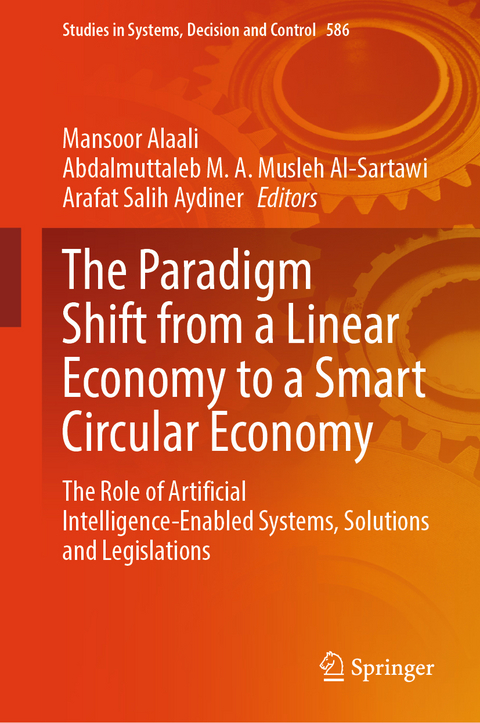
The Paradigm Shift from a Linear Economy to a Smart Circular Economy
Springer International Publishing
978-3-031-87549-6 (ISBN)
The concept of the circular economy has attracted the attention of scholars, researchers, professionals, and policymakers in recent years. The notion is characterised as an economy that intends to keep products, stocks, work in progress and materials at their highest utility and value continually, distinguishing between their technical and biological cycles. It is devised as a continuous positive development cycle that reserves and improves natural resources, optimizes outputs, and minimizes supply chain related risks by overseeing limited stocks and renewable flows of the stocks. Several legislations and policies are being developed to motivate and integrate SDGs and net zero-related approaches in companies, among which the circular economy (CE) is gaining momentum due to its documented impact on the elements of the SDGs and net zero.
Efficient management of resources and utility via artificial intelligence is vital towards a smart circular economy by minimising waste/losses, pollution, and extraction of virgin resources. It is important to note that there is a difference between smart and traditional circular economies. This book focuses on the former and makes distinctions in terms of how technology systems and solutions can be effectively and efficiently implemented.
This book The Paradigm Shift from a Linear Economy to a Smart Circular Economy: The Role of Artificial Intelligence-Enabled Systems, Solutions and Legislations discusses the transition from linear to smart circular economy by dissecting the role of artificial intelligence and other technologies such as big data, IoT and blockchain in such transformations. The book further aims to provide a platform for researchers, professionals, and students to closely investigate, discuss and examine the
1. Optimal Posting Times for Social Media Engagement: Analyzing Reactions to Tweets by HEIs in Abu Dhabi.- 2. Advancing Sustainability in Consumption Behaviour and Entrepreneurial Intentions through Education for Sustainability: Evidence from HEIs in the UAE.- 3. Opportunities and Challenges in Applying Environmental Accounting Techniques to Monitor Sustainability Progress in UAE Economy.- 4. Exploring Consumer Perceptions of Electric Vehicle Sustainability: A Multidimensional Analysis.- 5. Analysing the Impact of Key Macroeconomic Factors on India's GDP.
| Erscheint lt. Verlag | 29.7.2025 |
|---|---|
| Reihe/Serie | Studies in Systems, Decision and Control |
| Zusatzinfo | XXI, 1989 p. 286 illus., 250 illus. in color. In 2 volumes, not available separately. |
| Verlagsort | Cham |
| Sprache | englisch |
| Maße | 155 x 235 mm |
| Themenwelt | Informatik ► Theorie / Studium ► Künstliche Intelligenz / Robotik |
| Technik ► Elektrotechnik / Energietechnik | |
| Wirtschaft ► Volkswirtschaftslehre | |
| Schlagworte | Artificial Intelligence • Digital Economy • linear economy • Smart Economy • sustainability |
| ISBN-10 | 3-031-87549-4 / 3031875494 |
| ISBN-13 | 978-3-031-87549-6 / 9783031875496 |
| Zustand | Neuware |
| Informationen gemäß Produktsicherheitsverordnung (GPSR) | |
| Haben Sie eine Frage zum Produkt? |
aus dem Bereich


