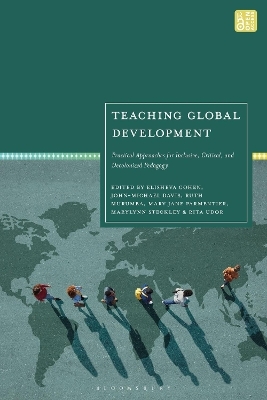
Teaching Global Development
Bloomsbury Academic (Verlag)
9781350426016 (ISBN)
- Noch nicht erschienen (ca. Februar 2026)
- Versandkostenfrei
- Auch auf Rechnung
- Artikel merken
The first volume of its kind, Teaching Global Development offers a unique open access collection of current approaches to teaching development in ways that foreground such core ethical issues. Hailing from a range of disciplines and from across the world, the contributors gathered here describe what "global development" means in their context, offer strategies for more ethical syllabi, describe innovative ways to explore equity and diversity through readings and activities, and provide detailed case studies of GDS-related programs. Throughout, these chapters showcase new and innovative approaches to service learning, lesson plans, and activities that demonstrate what critical, decolonized, DEI-sensitive knowledge actually looks like.
For its topical breadth, theoretical sophistication, and uniquely concrete examples and suggestions, this book is a must-read for scholars, instructors, and students interested in the ethics not only of global development, but also of curriculum-setting and pedagogy more broadly.
The ebook editions of this book are available open access under a CC BY-NC-ND 4.0 licence on bloomsburycollections.com. Open access was funded by Indiana University and Worcester Polytechnic Institute.
Elisheva Cohen is Director of International Education Programs at the Hamilton Lugar School for Global and International Studies at Indiana University, USA. She holds a PhD in International Development and Education from the University of Minnesota. For two years, she convened an international conference on pedagogy in international development studies. John-Michael Davis is an Assistant Teaching Professor in the Department of Integrated and Global Studies at Worcester Polytechnic Institute, USA. He co-directs the Puerto Rico Project Center where he builds relationships with Puerto Rican organizations to facilitate reciprocal and impactful project-based learning opportunities for students. Ruth Murumba holds an MA in Development Studies from the University of Glasgow and is a PhD candidate who studied development studies at Moi University in Kenya (graduation expected in December 2022). Her research focuses on the social sustainability of development projects in informal settlements in Nairobi, Kenya. She has over ten years of experience teaching international development studies. Mary Jane Parmentier is a Clinical Professor at Arizona State University, USA, in the School for the Future of Innovation in Society and the College of Global Futures. For over 20 years she has published research on innovative pedagogy for teaching global development studies in the classroom, online, and in the field. Marylynn Steckley is an Assistant Professor in Global and International Studies at Carleton University, Canada. Dr. Steckley is deeply interested in pedagogical innovations in virtual international experiential learning to enhance inclusive learning opportunities for students. Rita Udor is a lecturer at Simon Diedong Dombo University of Business and Integrated Development Studies, Ghana, and is affiliated with the Department of Development Studies. She teaches gender and development, community mobilization and development, population and development among others courses.
List of Contributors
Preface
Rosalba Icaza Garza
Introduction: The Journey Towards Teaching Global Development
Marylynn Steckley, Rita Udor, Mary Jane Parmentier, Ruth Murumba, John-Michael Davis, and Elisheva Cohen
Section I: Decolonization in Global Development Studies
Chapter 1. The Pedagogy of Decolonial Development Futures: Building on Decolonizing Past and Present in Development Studies Teaching Praxis
Jonathan Langdon and Ajay Parasram
Chapter 2: Conversations in Decolonizing GDS: Process, Obstacles and Opportunities
Georgina Alonso, Jess Notwell, and Adrian Murray
Chapter 3: Conceptualizing Decolonization as an “Actionable” Framework: What’s the Syllabus Got to Do with It?
Theresa E. Cann
Chapter 4: A Decolonial and Experiential Learning Course Design: Global Social Thought
Saleena Saleem
Section II: Innovative Approaches to Program and Course Design in Global Development Studies
Chapter 5: Designing a Pre/Post Engagement Course Series for Global Development Undergraduates Using the Interdependence: Global Solidarity and Local Actions Toolkit
Julie Ficarra and Kathryn Foster
Chapter 6: Opening Global Development Studies: Promoting Equity and Representation through Inclusive Pedagogy
Courtney Kurlanska and Sarah Stanlick
Chapter 7: Building Critical Development Research Skills Through Co-learning and Practice
Roberta Hawkins
Chapter 8: Teaching Food Systems through Living Heritage: Enhancing Academia with Intangible Cultural Heritage (ICH) Pedagogies
Agnieszka Pawlowska-Mainville
Chapter 9: Linking Theory to Practice through the Practical Training Program at the Simon Diedong Dombo University of Business and Integrated Development Studies in Ghana
Abdulai Adams and Rita Udor
Section III: Pedagogical Practices in the GDS Classroom
Chapter 10: Personalizing Critical Development Studies: Using Diaries as Pedagogical Tool for Deep Reflection
Kamna Patel and Lee Rensimer
Chapter 11: Culturally-Relevant Gender-Based Analysis (CRGBA) as a Pedagogical Tool in Global Development Studies Contexts
Chloë E. Carley, Rae S. M. Vanille, and Tiffany C. E. Walsh
Chapter 12: Photovoice as a Tool for Decolonial Pedagogy: Adapting Photovoice for Critical Self-Reflection, Re-Embodiment, and Healing in Classroom and Community Settings
Juan Carlos Jimenez
Chapter 13: The Pedagogy of a Multi-Day Role-Play: Local Partnerships and Shifting Power in Global South Communities
David Kupp and Ian DeVilliers
| Erscheint lt. Verlag | 5.2.2026 |
|---|---|
| Verlagsort | London |
| Sprache | englisch |
| Maße | 156 x 234 mm |
| Themenwelt | Sozialwissenschaften ► Pädagogik |
| Sozialwissenschaften ► Soziologie ► Spezielle Soziologien | |
| Wirtschaft ► Betriebswirtschaft / Management ► Unternehmensführung / Management | |
| ISBN-13 | 9781350426016 / 9781350426016 |
| Zustand | Neuware |
| Informationen gemäß Produktsicherheitsverordnung (GPSR) | |
| Haben Sie eine Frage zum Produkt? |
aus dem Bereich