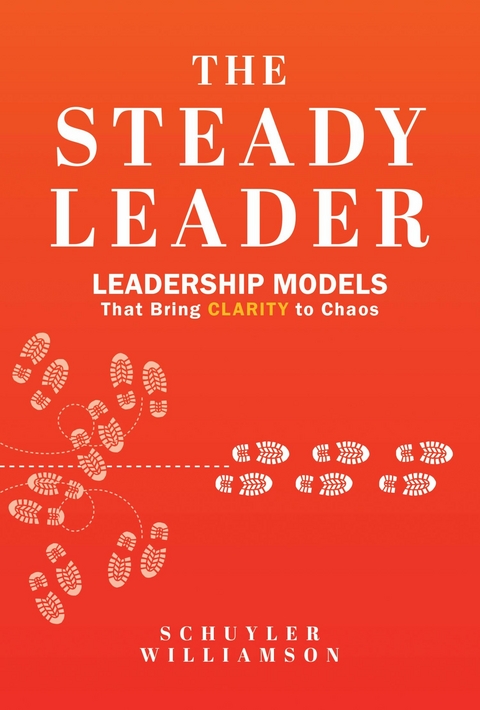
Steady Leader (eBook)
308 Seiten
Ballast Books (Verlag)
978-1-964934-33-4 (ISBN)
Schuyler Williamson is a leadership expert and keynote speaker, award-winning entrepreneur, and military veteran who has consistently achieved at the highest level in every facet of his career. As the author of his debut book, The Steady Leader: Leadership Models That Bring Clarity to Chaos, Schuyler provides a blueprint for leading through turbulent times, offering actionable strategies for thriving amid uncertainty. With an MBA from The McCombs School of Business, where he ranked #3 in his graduating class, Schuyler blends academic rigor with real-world experience as he inspires, motivates, and coaches leaders to navigate chaos with steadiness and confidence. As a globally recognized keynote speaker, he has addressed major organizations like Oracle, Dell, Keller Williams Realty, Care.com, Logitech, Smith + Nephew, and Financial Executives International, showcasing his ability to equip others to lead through disruption and chaos while achieving excellence. Schuyler's expertise in leadership through chaos is rooted in his military service as a combat officer with the 1st Cavalry and 82nd Airborne Divisions, where he was deployed to Iraq and Afghanistan. Awarded the Bronze Star Medal and Meritorious Service Medal, he led in some of the most demanding environments imaginable. He also earned the honor grad distinction in the mountain phase of Ranger School, exemplifying his ability to excel in extreme conditions. His military foundation was solidified at the United States Military Academy at West Point, where he graduated in the top 10 percent of his class. Schuyler is no stranger to peak achievement in the business world. After being drafted by the Detroit Tigers in 2005 and completing his active-duty US Army career, he transitioned to a career in real estate, where he now ranks in the top 1 percent of agents nationwide, with hundreds of millions in sales. He has been honored with the prestigious Platinum Top 50 and Austin Under 40 awards in Austin real estate and owns over fifty-five investment properties. His entrepreneurial ventures include founding Williamson Group Real Estate, Mission Home Builders in Austin, and the Laundry Luv franchise. As the host of the Money Mission YouTube channel with hundreds of thousands of video views, Schuyler regularly shares insights on leadership, wealth building, and resilience. He also spearheads the Corporate Battlefield Mastermind in Austin, Texas, an elite group focused on leadership and wealth creation for high achievers facing complex challenges. Committed to giving back, Schuyler's Corporate Battlefield Mastermind donates generously to teachers in need, and he volunteers with SCORE and Marbridge in addition to serving as a foster parent. Schuyler's leadership journey is a testament to thriving under pressure, achieving at the highest levels, and guiding others to do the same. Whether leading teams in combat, building wealth through real estate, or inspiring business leaders at global conferences, Schuyler's message is clear: true leadership shines brightest in times of chaos.
Lead yourself. Lead your team. Lead your company. Most people try to target one of these at a time, but the truth is, they all build off each other. Want to lead your team better? Learn how to lead yourself first. Want to lead your company well? Learn how to lead your team. In the chaos of running a business, we can complicate what it means to lead. But at the end of the day, leadership really boils down to one clear tenet: taking care of people. It's about teaching others how to think so that they can get what they want. It's about enabling people to be and to do their best. While there's no formula for great leadership, there are opportunities to "e;stand on the shoulders of giants,"e; to follow the example of those who have gone before us, to mimic and adapt techniques that have worked for others. That's precisely what this book is: a collection of models that will help you lead better. Each chapter will provide real stories and examples, leadership and business principles, and actionable items and advice with the goal of equipping you to lead yourself, your team, and your company better. The Steady Leader is your guide to unlocking your full potential as an individual, leader, and advocate both in and out of the workplace.
When I opened my eyes, I couldn’t see anything but dust. So much dust. I felt a searing pain in my legs, and I heard my guys in the back of the truck screaming and voices shouting on the radio, but it all felt muted and a million miles away because of the deafening ringing in my ears. I looked over to see my gunner in the turret—unconscious. But there was my driver, turning the key in the truck’s ignition over and over again, though it wouldn’t start. And just like that, it all came back to me.
The explosion had occurred on the commander’s side of the vehicle, just against my door. I had heard the pop of the initiator first, like the sound of a match strike, just before the big boom of the improvised explosive device (IED) that blew up our Humvee. It was the middle of the day in Baghdad—sunny, dry, felt like 140 degrees. The wind puffed on our faces like a hot blow-dryer, and our skin was cracked, hardened and darkened, as if it had been baked in the sun for months.
That afternoon, we were on a normal patrol, securing a portion of the city and trying to gather information on high-value targets from the local people. Halfway through our mission, we received word that another unit was under attack. We started moving immediately, taking the quickest route to them on a bypass we had never traveled before. The time we would save to get there was worth the risk—this was a calculated, thoughtful decision. These guys were in a bad firefight. It was when I started turning to get off the bypass that the IED hit our truck.
Suddenly, I heard a loud banging to my right, and through the swirling smoke and dust, I saw my medic’s face pressed up against the window, his palm banging against it over and over again. He was trying to peer inside to see if we were OK, to see if we were alive. The door was too mangled to open, so I screamed for him to get back in his vehicle. I knew the enemy often exploded one IED to bait help, just to explode a second one.
Moments later, I felt the medic’s vehicle hit the back of ours, pushing us forward, and finally, finally, our truck cranked to life again. But it wouldn’t go past idle, so the vehicle behind us inched us forward, little by little, as we limped our way out of the kill zone on four flat tires.
When we got to a safe area, we exited the vehicle to assess the damage. The trucks were all totaled. The bomb was so big that it had ruined all four vehicles we had on that patrol, bending the frame of the first truck and shooting off enough shrapnel to annihilate all the others. Thankfully, our group of men were in better shape than the trucks. The guys in the back of my truck had flesh wounds from shrapnel, my driver’s ears were bleeding, we were all concussed, and the door had slammed into my right leg so hard that I was barely able to walk for four weeks after that.
A piece of shrapnel about four inches long went through the door armor next to me. Instead of traveling up, it traveled down and went right through the seat that I was sitting on. This piece of metal cut through the paneling, ripped through the vehicle, and embedded itself into the frame. If that piece of shrapnel had gone up instead of down, if it had entered the door just two inches in any other direction, it would have sliced me in half at the waist. I’d be dead.
My guys were shaken up. I was shaken up. But there was no doubt—we were lucky to be alive.
Back on base, my platoon took some time to regroup, debrief the mission, and recenter ourselves. Then, we started reloading and getting ready for the next one. We were back out on patrol a few hours later. There was no rest. There was no period of relaxation and recuperation because we had gotten hit by an IED. We had to get right back out there and do our jobs. This was the mission. This was the expectation. Soldier on.
I’ll never forget this experience—the disorientation, the ringing in my ears, the dust and smoke, the screams of the guys in the back of my truck, the sheer chaos of it all. I’ll never forget the look in my guys’ eyes when we realized that we were all OK but were also punched with the reality that we would have to go right back out there and do it again, put ourselves in danger, and risk our lives, knowing what awaited us. I’ll never forget what it felt like to lead my soldiers that day. I didn’t have another choice. I had to figure it out. I had to draw resilience from where I had it and pass that strength, pass that confidence, pass that belief on to my soldiers. I had to lead them back into the war zone—focused, calm, steady.
It was during these days, in the thick of combat, that I discovered many areas in my own life that I needed to work on. These, to this day, are some of my hardest-won leadership lessons, many of which you’ll hear in the pages to follow. I put in the work. I put in the preparation. I put in the time and whatever else was needed to strengthen my own leadership capabilities so that I could keep saving my soldiers’ lives, keep taking care of them, and keep ensuring they were ready and motivated for the battle before us.
I begin with this story because I want you to understand that I know what it feels like to dig deep—even when you don’t want to—to find courage, to find strength in others, to find love and gratitude in so much abundance that it trumps fear . . . every time. I know what it feels like to believe that you can accomplish anything so that when things do get hard, you can lead through it. I know how bad things can get. And I also know what leaders are capable of.
And that’s just it—anybody can lead through chaos. Anybody can lead through attacks on their life. But it takes intentionality; it takes health; it takes a certain level of unselfishness to put yourself in a position to do that. To lead from a place of internal steadiness so that you can show up for everyone else—externally—as a truly steady leader who can guide their people through even the fiercest of storms.
For me, this posture of a steady leader was hard-earned. It continues to be hard-earned—through experience, failures, victories, challenges, joys, and a whole lot of prayer; through faith, study, conversations, curiosity, and trust; alongside fellow athletes, students, soldiers, teammates, clients, and leaders. In the pages to follow, I’ll share many of the models and practices that have helped get me there with the hope that they’ll guide you in the right direction with more confidence, clarity, and assurance than I felt in those early days of leadership.
THE POWER OF MODELS
There is no fast-track formula for becoming an extraordinary leader. Some of it is personality and talent. Some of it is experience and opportunity. Some of it is purely time and the willingness to stay in the game. But I do wholeheartedly believe that we can expedite our learning and effectiveness by simply looking toward those who have gone before us and mimicking and adapting techniques that have worked for others—standing on the shoulders of giants, as they say.
Call them best practices, models, tools, guides, whatever you wish—these are the framework for how something gets done. A model is an answer to a curiosity question. How do I train for a marathon? Take your pick of the training plans out there. How do I build an app? There are all sorts of guides that walk you through this. How do I care for a newborn baby? Check out the book Happiest Baby on the Block by Dr. Harvey Karp. (We send it to all our clients after they have their first kid because of how well the model worked for my family!) How do I lead myself? My team? My company? Keep reading.
In these pages, you’ll find a combination of the experiences, guidance, and models I’ve collected along the way through professional sports, fighting in two wars, and many years starting and running several successful companies. These are frameworks that I’ve gathered both from the military and from other leaders, that I’ve adapted and implemented on a day-to-day basis, and that have proven effective in truly great leadership—enabling other people to be and do their best.
As leaders, we have to be creative, effective, and constant thinkers. We must be committed to making continuous progress and guiding people forward every day. That means we must be constant innovators, and models are the foundation for innovation. When you don’t start with a model, you have to innovate your way to creating your own models, which is a difficult, time-consuming task, and one that’s impossible for most people. Personally, I’d rather innovate on top of an already established model, start with success and innovate for even more success. That’s why I love models—they’re easy to remember, they’re deployable, they’re replicable, and they’re proven.
Think about it—the steadiest businesses out there are franchises. Why? Because they offer a model. You can start right away and run a very stable business with very low risk because it’s been done before. This is exactly why I’m on the constant lookout for models everywhere I go. What’s working for other people and businesses? How can I adapt this to my own life, team, business? When you’re a leader of models, your output will be predictable. Predictability turns into productivity, which turns into success and influence.
THREEFOLD MODEL OF LEADERSHIP
You don’t have to look far to find someone...
| Erscheint lt. Verlag | 29.4.2025 |
|---|---|
| Sprache | englisch |
| Themenwelt | Wirtschaft ► Betriebswirtschaft / Management ► Unternehmensführung / Management |
| ISBN-10 | 1-964934-33-8 / 1964934338 |
| ISBN-13 | 978-1-964934-33-4 / 9781964934334 |
| Informationen gemäß Produktsicherheitsverordnung (GPSR) | |
| Haben Sie eine Frage zum Produkt? |
 EPUB (Ohne DRM)
Größe: 3,9 MB
Digital Rights Management: ohne DRM
Dieses eBook enthält kein DRM oder Kopierschutz. Eine Weitergabe an Dritte ist jedoch rechtlich nicht zulässig, weil Sie beim Kauf nur die Rechte an der persönlichen Nutzung erwerben.
Dateiformat: EPUB (Electronic Publication)
EPUB ist ein offener Standard für eBooks und eignet sich besonders zur Darstellung von Belletristik und Sachbüchern. Der Fließtext wird dynamisch an die Display- und Schriftgröße angepasst. Auch für mobile Lesegeräte ist EPUB daher gut geeignet.
Systemvoraussetzungen:
PC/Mac: Mit einem PC oder Mac können Sie dieses eBook lesen. Sie benötigen dafür die kostenlose Software Adobe Digital Editions.
eReader: Dieses eBook kann mit (fast) allen eBook-Readern gelesen werden. Mit dem amazon-Kindle ist es aber nicht kompatibel.
Smartphone/Tablet: Egal ob Apple oder Android, dieses eBook können Sie lesen. Sie benötigen dafür eine kostenlose App.
Geräteliste und zusätzliche Hinweise
Buying eBooks from abroad
For tax law reasons we can sell eBooks just within Germany and Switzerland. Regrettably we cannot fulfill eBook-orders from other countries.
aus dem Bereich