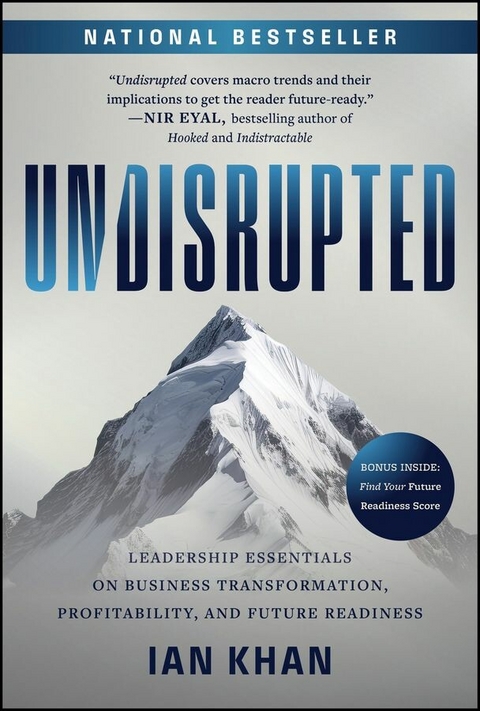
Undisrupted (eBook)
Ready your organization for the future-regardless of what it may bring-with one of the world's foremost business strategists
In Undisrupted: Leadership Essentials on Creating a Future-Ready Organiztion, Ian Khan, a distinguished futurist, filmmaker, and author delivers a compelling message that challenges the conventional approach to future-proofing businesses with technology, offering a fresh, comprehensive strategy for thriving in an uncertain future.
In the book, Khan introduces the innovative Future Readiness Score?, a tool developed through his extensive research and experience with over 750 organizations. This score assesses a company's ability to adapt to unforeseeable changes, preparing them to handle both challenges and opportunities. The book elaborates on the seven pillars of future readiness-Engagement, Learning, Collaboration, People, Culture, Innovation, and Execution-demonstrating how to safeguard your company against adverse events and capitalize on positive ones. You'll also discover:
- The proprietary Future Readiness Score? to evaluate and enhance organizational adaptability
- Practical insights into the seven pillars of future readiness for robust business strategy
- Strategies to not only withstand negative events but also harness positive opportunities
Undisrupted an essential guide for business leaders, including managers, executives, entrepreneurs, and strategists. It is also invaluable for consultants serving various businesses. This book is a crucial resource for anyone aiming to navigate and succeed in the ever-evolving business landscape of tomorrow.
IAN KHAN is a theoretical futurist, author and storyteller on a mission to make every business future ready. His work has been featured on CNN, BBC, Bloomberg, ABC, Fox, and Arab news, amongst other global media. He is also the star of an episodic series focused on technology and the future, The Futurist available on Amazon Prime Video. Ian is a high energy keynote speaker and works with organizations across the world. He lives with his wife and two kids in Toronto, Canada.
2
Early Human Disruptions
Eureka!
—Archimedes
What are the origins of disruption and what is the relation between disruption, innovation, and progress? To embrace the final idea of being “Undisrupted,” I strongly believe we need to understand what change, disruption, and adaptation mean. In this chapter, we look at some of the early breakthroughs in human history that changed the fate of humanity forever.
The Archimedes Screw: An Ingenious Leap
The Archimedes screw, a device traditionally attributed to the ancient Greek mathematician and inventor Archimedes of Syracuse, stands as a testament to human ingenuity and its enduring impact on civilization. Though its exact origins remain a subject of historical debate, with suggestions that it may have been used in Babylon before Archimedes's time, the device is most commonly associated with Archimedes who lived in the third century BCE. This inspired invention, conceived to lift water, has not only facilitated irrigation and drainage for millennia but has also played a pivotal role in the development of technology and engineering throughout human history.
The Archimedes screw is believed to have been developed during Archimedes's visit to Egypt, where the need for efficient water irrigation was a constant challenge. The device consists of a screw contained within a hollow cylinder. When the screw is turned, water is drawn up from a lower elevation to a higher one. This simple yet effective mechanism was revolutionary, enabling the transfer of water against gravity with minimal effort and without the need for complex pumping systems.
The immediate impact of the Archimedes screw was most profoundly felt in agriculture. In regions such as the Nile Delta, where water management was crucial for the sustenance of crops, the device provided a reliable method for irrigating fields. It allowed communities to extend their agricultural activities into areas that would have otherwise remained arid and unproductive. By facilitating the expansion of arable land, the Archimedes screw contributed to the stabilization and growth of food supplies, which in turn supported population growth and the development of more complex societies.
Beyond agriculture, the Archimedes screw had significant implications for urban development and civil engineering. Ancient cities, particularly those in arid or flood‐prone regions, faced considerable challenges in managing water resources for drinking, sanitation, and flood control. The Archimedes screw was employed to drain marshy lands and remove water from mines and ship bilges, showcasing its versatility. Its application in these areas not only improved public health and safety but also enabled the construction of more elaborate urban infrastructures, laying the groundwork for the advanced civilizations of the ancient world.
The invention of the Archimedes screw marked a significant milestone in the history of technology and mechanical engineering. It exemplified the application of the principles of physics to solve practical problems, an approach that would define the field of engineering. The device's simplicity, requiring no complex parts or materials, made it easily replicable and adaptable for various uses throughout history. Its design principles have inspired countless other inventions and mechanical devices, contributing to the evolution of engineering and technology.
Remarkably, the Archimedes screw has maintained its relevance into the modern era. It has been adapted for contemporary uses, including in wastewater treatment plants, where it serves as an efficient method for moving large volumes of water or sludge. The device's principle has also been reversed to serve as a hydroelectric power generator, demonstrating its versatility and the timeless nature of its design. Such applications underscore the Archimedes screw's enduring legacy as a sustainable and eco‐friendly technology.
Beyond its practical applications, the Archimedes screw has left a lasting imprint on culture and education. It stands as a symbol of innovation and human curiosity, often featured in educational curricula to illustrate basic principles of physics and engineering. The story of Archimedes and his inventions, including the legendary moment of “eureka,” continues to inspire generations to explore the realms of science, mathematics, and technology.
The Archimedes screw is more than just an ancient device for water lifting; it is a symbol of human ingenuity and its capacity to shape the environment and society. Through its impact on agriculture, urbanization, technology, and education, the Archimedes screw has played a crucial role in the advancement of civilization. Its simplicity, efficiency, and adaptability have allowed it to endure through millennia, serving as a reminder of the lasting value of innovative thinking and problem‐solving. As we continue to face global challenges related to water management and sustainable energy, the principles embodied by the Archimedes screw remain as relevant as ever, guiding us toward solutions that are both ingenious and sustainable.
The Pulley: A Cornerstone of Mechanical Advantage
The pulley, a simple yet profoundly effective machine, stands as one of humanity's earliest and most significant technological innovations. Its basic principle—the use of a wheel on an axle or shaft designed to support movement and change the direction of a taut cable or belt—has been a cornerstone in the development of engineering and mechanics. The history of the pulley is intertwined with the evolution of human ingenuity, demonstrating our ancestors' understanding of mechanical advantage and their relentless pursuit to manipulate the physical world for their benefit.
The origins of the pulley system can be traced back to ancient civilizations, where the earliest examples were used to lift water, hoist flags, and build monumental structures. Evidence suggests that the Mesopotamians and Egyptians employed pulley systems as early as 1500 BCE.1 The pulley's design and functionality were later enhanced by the Greeks, notably by the polymath Archimedes, who is often credited with formalizing its principles and introducing the compound pulley to multiply force.
The introduction of the pulley system marked a pivotal moment in human history, revolutionizing the way heavy loads were lifted and moved. Its impact was immediate and far‐reaching, facilitating the construction of some of the most iconic architectural wonders of the ancient world, such as the pyramids of Egypt and the temples of Greece. By significantly reducing the amount of force required to move objects, the pulley system allowed for the construction of larger and more complex structures than ever before possible.
The pulley's significance extended well beyond the ancient world. During the Middle Ages and the Renaissance, pulley systems played a critical role in the construction of cathedrals, castles, and fortifications. They enabled builders to achieve greater heights and span wider spaces, contributing to the period's architectural innovations and the spread of Gothic and Renaissance architectural styles.
In the realm of engineering, the pulley became an indispensable tool in the development of machinery and transportation systems. From the hoists used in mining operations to the rigging on sailing ships that navigated the globe, the pulley system was central to advancements in various industries. Its principles were further applied in the development of cranes, elevators, and cable cars, transforming urban landscapes and enhancing human mobility.
The pulley system's impact on technological innovation cannot be overstated. It served as a fundamental concept in the study of physics, especially mechanics, influencing the work of renowned scientists and inventors such as Galileo, Leonardo da Vinci, and Isaac Newton. Their understanding and application of the pulley's principles contributed to significant scientific discoveries and the development of new technologies, laying the groundwork for the Industrial Revolution and the modern technological era.
Beyond its monumental contributions to construction and engineering, the pulley system found its way into everyday life, simplifying tasks and enhancing efficiency. From the well pulley used to draw water to the systems used in agricultural equipment, the pulley became a ubiquitous tool, integral to the functioning of society. Its simplicity, adaptability, and effectiveness in multiplying human effort made it a staple in workshops, farms, and households throughout history.
The pulley's enduring legacy is also reflected in education, where it continues to serve as a fundamental example of simple machines and mechanical advantage. Its study in physics and engineering courses not only demonstrates the principles of force and motion but also inspires students to appreciate the ingenuity of ancient inventors and the cumulative nature of technological progress.
The pulley system, with its origins shrouded in the mists of prehistory, emerged as a transformative tool that significantly influenced the course of human civilization. Its development marked a leap forward in our ancestors' ability to manipulate their environment, enabling the construction of monumental structures, the advancement of engineering and technology, and the simplification of everyday tasks. The pulley exemplifies the profound impact that simple innovations can have on the world, reminding us that...
| Erscheint lt. Verlag | 4.2.2025 |
|---|---|
| Sprache | englisch |
| Themenwelt | Wirtschaft ► Betriebswirtschaft / Management ► Unternehmensführung / Management |
| Schlagworte | business adaptability • business foresight • Business Innovation • business learning • Business Strategy • collaboration strategies • engagement in business • future-proofing businesses • future readiness • Future Readiness Score • organizational adaptability |
| ISBN-13 | 9781394215843 / 9781394215843 |
| Informationen gemäß Produktsicherheitsverordnung (GPSR) | |
| Haben Sie eine Frage zum Produkt? |
 EPUB (Adobe DRM)
Kopierschutz: Adobe-DRM
Adobe-DRM ist ein Kopierschutz, der das eBook vor Mißbrauch schützen soll. Dabei wird das eBook bereits beim Download auf Ihre persönliche Adobe-ID autorisiert. Lesen können Sie das eBook dann nur auf den Geräten, welche ebenfalls auf Ihre Adobe-ID registriert sind.
Details zum Adobe-DRM
Dateiformat: EPUB (Electronic Publication)
EPUB ist ein offener Standard für eBooks und eignet sich besonders zur Darstellung von Belletristik und Sachbüchern. Der Fließtext wird dynamisch an die Display- und Schriftgröße angepasst. Auch für mobile Lesegeräte ist EPUB daher gut geeignet.
Systemvoraussetzungen:
PC/Mac: Mit einem PC oder Mac können Sie dieses eBook lesen. Sie benötigen eine
eReader: Dieses eBook kann mit (fast) allen eBook-Readern gelesen werden. Mit dem amazon-Kindle ist es aber nicht kompatibel.
Smartphone/Tablet: Egal ob Apple oder Android, dieses eBook können Sie lesen. Sie benötigen eine
Geräteliste und zusätzliche Hinweise
Buying eBooks from abroad
For tax law reasons we can sell eBooks just within Germany and Switzerland. Regrettably we cannot fulfill eBook-orders from other countries.
aus dem Bereich