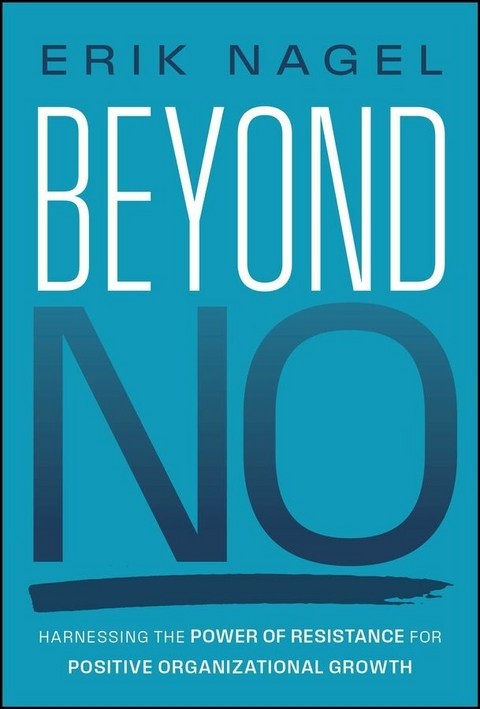
Beyond No (eBook)
Start viewing resistance as something beneficial instead of an inconvenience that must be eliminated
Beyond No: Harnessing the Power of Resistance for Organizational Growth is a thought-provoking exploration of the concept of resistance-something that is bound to arise within every organization in response to new projects, policies, or initiatives. Rather than seeing resistance as an inconvenience that needs to be eliminated, this book invites readers to take a new approach to different types of resistance, both hidden and obvious, and instead view resistance as a guiding light to discover objective differences, dissatisfaction, criticism of procedures, or different assessments or values.
This book contains a wealth of real stories from a wide variety of business leaders, detailing situations where resistance was encountered, solutions that were implemented, and their outcomes. Readers will also learn about:
- Shortcuts that lead to dead ends when managing resistance, including thinking 'man does not want to change' and 'one third is always against it anyways'
- Explanatory models behind resistance, including emotional events, attempts at domination, normative control, and expression of a damaged relationship
- Principles to productively manage resistance, including commitment, dignity, right to dissent, learning, and mindfulness
Beyond No earns a well-deserved spot on the bookshelves of all business leaders, executives, and managers seeking to achieve excellence in leadership through a thoughtful approach to resistance instead of relying on ineffective command-and-control tactics.
ERIK NAGEL, PhD, is a professor and Vice Director of the Lucerne School of Business and Co-Institute Director of the Institute for Management and Regional Economics IBR. He researches and teaches leadership, change management, resistance, cultural change, and organizational consulting.
CHAPTER 1
Resistance: An Everyday Exception
It happens in life, as in grammar, that the exceptions outnumber the rules.
—Rémy de Gourmont
I happen to be walking past Peter's office. I strike up a conversation with him about this and that. Peter works a lot from home or directly at the customer's premises. The only thing on his desk is his laptop. As is usual for him, there are no piles of documents and no personal belongings in the room. For some, the office probably exudes a pleasant sense of order, for others an almost clinical cleanliness. In the middle of the conversation, I notice the leaflet about the Gamma project, which is attached to the whiteboard right next to the doorway with two oversized white magnets. Gamma is a major project that has triggered resistance within the organization. I am a member of the strategic project committee and am therefore responsible for the project. I am aware that Peter is skeptical about it. I comment casually: “Was it you who put up the leaflet?” Peter looks at me with a smug smile and a steady gaze and replies: “Yes, I thought it was important for the management. So, of course, I just had to put it up.” I can't help but smile and say that the management will certainly appreciate that.
I found the situation strange and a little uncomfortable. In my opinion, I have a good, trusting relationship with Peter. Humor and irony are simply part of our conversations. This situation was different in that he was noticeably critical of a project for which I was also responsible. It was no coincidence that he commented on the project to me in this way.
When this happened, I had already decided to write a book about resistance. However, I hadn't really delved into the subject matter. Was this resistance? And if so, then it had to be a particularly subtle form of resistance. In any case, this experience intensified my curiosity and motivated me to dig deeper into the topic of resistance and find out what is considered resistance and what forms it can take. While dealing with the topic, I gained an insight into the many ways resistance can manifest itself and why it arises in the first place. In the experience I described, resistance manifests in Peter's ironic comment. Even if the comment is formulated in a friendly and humorous way, Peter is expressing his criticism of the Gamma project. Is he challenging me, or does he just want to express his dissatisfaction? This and much more is unclear: Does he reject the project completely, is he ambivalent, or is his objection mainly directed against individual aspects of the project? Does he want to contribute critically or is he distancing himself? How can I deal with this type of resistance? Looking back on the experience, I realize I should have dug deeper because I never clarified what Peter's actual attitude or concerns were regarding the Gamma project.
In coaching sessions and when advising organizations, I have repeatedly found that dealing with resistance is a real challenge for managers. Likewise, as the episode above shows, I encounter resistance time and again in my own management and leadership practice. Sometimes it is a burden or irritating and remains a little mysterious because it cannot be immediately penetrated and understood. In my opinion, my observation and assessment of the diversity and relevance of the topic are not reflected in the standard textbooks. In most cases, resistance is seen as a negative side effect of change, or there is a call to take resistance seriously. However, these considerations do not usually go much deeper. I concluded that it is worth exploring resistance in more detail, as it plays such an important role in day‐to‐day management.
1.1 Managers Tell Their Stories
In this book, as already illustrated in the experience with Peter, managers themselves will have their say. They will tell stories about the specific situations in which they experienced, felt, or evoked resistance themselves. They report on what happened in detail, how they and the others involved in the situation behaved and how they categorize the experiences for themselves. Over 50 managers from Switzerland agreed to tell me their personal management stories about resistance. They were not asked to use an overthought definition of resistance, but rather how they use the term for themselves and what events they have experienced. The book therefore provides information on how the term “resistance” is dealt with in practice, in everyday work and management.
The managers entrusted me with their stories in the knowledge that I would use them for publications. I will initially recount the stories to illustrate a point, but then I won't automatically adopt the narrator's point of view. Instead, I will try to work out and reflect on the underlying assumptions. I take the narrators at their word and only refer to what they say when thinking about the situations described. In doing so, I will focus on the stage of everyday management life, but also dare to look behind the scenes of everyday experiences. On the one hand, I will try to shed light on the situation, but on the other I always ask myself how the actors and, above all, the managers could have grasped and handled the situation differently. I am aware that it is always easier to look at challenging resistance situations in hindsight. But I do this to do justice to all the people involved in the situation, to gain helpful insights and to present them in a way that the reader can understand. I hope that those managers who have described their cases to me will be able to understand my approach to their stories and take something away from them.
This is therefore not a book in which, as is often the case, events from high‐profile major companies are reproduced. Rather, it is about the experiences of practitioners from normal larger and smaller organizations.
In addition to my own management experience and the research I have conducted myself and outlined above, many other researchers' work is included, supported by illustrative case studies. This should enable managers to reflect on their own practice and gain insights for their own management and leadership practice.
1.2 The Word “Resistance”
If the world of managers and their understanding of resistance are the primary focus of this book, then it cannot be a question of formulating a conclusive definition of resistance. Rather, it can be assumed that the word resistance is used or interpreted very differently depending on the context: Is a certain observed behavior identified as resistance at all? How is the observed behavior then evaluated?
Nevertheless, it makes sense to take a closer look at the origins of the word to understand its common uses and meanings today. The word resistance is a verbal noun meaning the act or instance of resisting. The verb resist means to oppose, withstand, refuse to accept, or refuse to comply with. Someone takes a stand against something or someone and may resist in a stubborn, tenacious, or even heroic way. From the opponent's point of view, the opposing person becomes an obstacle or hindrance.
Although the word resistance has found its way into organizational and management contexts as well as other disciplines such as psychology, in our everyday understanding we usually associate the word with mechanics, electrical engineering, and politics. In mechanics, resistance refers to a force that counteracts the movement of a body, and in electrical engineering it characterizes the property of certain substances that inhibits the flow of electric current. Or it refers to an electrical component that is used, for example, to limit electrical current to a certain value or to convert electrical energy into thermal energy. Resistance here is a normal, natural phenomenon, neither positive nor negative, which must be reduced or increased for certain purposes, and which fulfills a specific function.
However, the primary meaning of the word resistance is a political one. Here, resistance can be equated with a social state of emergency in which insurgents turn against those in power, especially if they use their influence against society or parts of it unscrupulously. The insurgents try to uncover the machinations or remove those in power. The Arab Spring comes to mind today as an example of resistance. Or we think of the several hundred students who blocked three main traffic arteries in the city center of Hong Kong for several weeks. But art and culture are also used in the fight against oppressive regimes: in 2012, for example, the punk rock group Pussy Riot staged a 41‐second action in a Moscow cathedral. In doing so, they protested the alliance between church and state. Another example is the Chinese artist Ai Weiwei, who has been using art to fight against the Chinese regime for years.
The insurgents are fighting back against the unpredictable, powerful regimes and are doing so with great courage and sacrifice. They stand up for freedom, social justice, and a life of dignity and democracy. However, they also know that they cannot control the course of events. In the worst‐case scenario, violence escalates, or authoritarian regimes take on a new guise. The insurgents and their supporters face greater dangers. They are harassed for years, and may be imprisoned, thus risking life and limb.
People are probably not always fully aware of the risks associated with acts of resistance, as the protests are carried out with tremendous conviction, euphoria,...
| Erscheint lt. Verlag | 4.2.2025 |
|---|---|
| Sprache | englisch |
| Themenwelt | Wirtschaft ► Betriebswirtschaft / Management ► Unternehmensführung / Management |
| Schlagworte | change initiatives • employee criticism • Employee dissatisfaction • Employee Motivation • Executive Leadership • leadership principles • Leadership Training • Management Leadership • Management strategies • Organizational change |
| ISBN-13 | 9781394303786 / 9781394303786 |
| Informationen gemäß Produktsicherheitsverordnung (GPSR) | |
| Haben Sie eine Frage zum Produkt? |
 EPUB (Adobe DRM)
Kopierschutz: Adobe-DRM
Adobe-DRM ist ein Kopierschutz, der das eBook vor Mißbrauch schützen soll. Dabei wird das eBook bereits beim Download auf Ihre persönliche Adobe-ID autorisiert. Lesen können Sie das eBook dann nur auf den Geräten, welche ebenfalls auf Ihre Adobe-ID registriert sind.
Details zum Adobe-DRM
Dateiformat: EPUB (Electronic Publication)
EPUB ist ein offener Standard für eBooks und eignet sich besonders zur Darstellung von Belletristik und Sachbüchern. Der Fließtext wird dynamisch an die Display- und Schriftgröße angepasst. Auch für mobile Lesegeräte ist EPUB daher gut geeignet.
Systemvoraussetzungen:
PC/Mac: Mit einem PC oder Mac können Sie dieses eBook lesen. Sie benötigen eine
eReader: Dieses eBook kann mit (fast) allen eBook-Readern gelesen werden. Mit dem amazon-Kindle ist es aber nicht kompatibel.
Smartphone/Tablet: Egal ob Apple oder Android, dieses eBook können Sie lesen. Sie benötigen eine
Geräteliste und zusätzliche Hinweise
Buying eBooks from abroad
For tax law reasons we can sell eBooks just within Germany and Switzerland. Regrettably we cannot fulfill eBook-orders from other countries.
aus dem Bereich