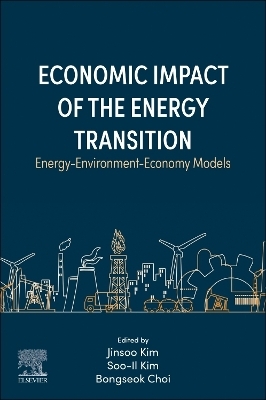
Economic Impact of the Energy Transition
Elsevier - Health Sciences Division (Verlag)
978-0-443-33461-0 (ISBN)
- Noch nicht erschienen (ca. März 2026)
- Versandkostenfrei
- Auch auf Rechnung
- Artikel merken
The last section of the book provides case studies demonstrating the utilization of different 3E models in various parts of the world. A final chapter carefully examines the advantages and limitations of each model, its policy implications, and considerations for empirical analysis, discusses how these can be applied, addresses the remaining challenges in the field of energy transition and economic impact analysis, and suggests directions for future research. This is a valuable resource for researchers, advanced students, faculty, scientists, engineers, analysts, policy makers, consultants, and other industry professionals with an interest in energy transition, modeling, policy, and the interconnection between energy, environment, and economy.
Dr. Jinsoo Kim is a Full Professor of Resource Economics and Policy at Hanyang University, South Korea. He has published over 70 peer-reviewed papers, covering socio-technical analysis of industrial decarbonization, criticality assessment of raw materials, multi-criteria decision making for renewable energy, and social cost-benefit analysis. Prof. Kim also conducted research at the University of Sussex (United Kingdom) with Prof. Benjamin K. Sovacool, publishing several papers on energy externalities and industrial decarbonization. He serves as associate editor or board member of several journals. Prof. Kim has also served as a member of the Policy Committee of Korea NGO's Energy Network and the Korean Society for New and Renewable Energy, and as Director of General Affairs of the Korean Resource Economics Association. He also contributed to the 3rd Basic Energy Plan as a member of the working group for the Ministry of Trade, Industry and Energy. Dr. Soo-Il Kim is a Senior Research Fellow at the Korea Energy Economics Institute, Republic of Korea. He has worked at KEEI since 2005 in the field of energy modelling and policy analysis. Dr. Kim also worked at the International Energy Agency as a Research Fellow for World Energy Outlook 2013 and 2014. With over 19 years of experience in energy modelling and policy analysis, Dr. Kim has worked on developing the new energy balance of Korea and the energy modelling system: Energy and Greenhouse-gas Modelling System and the System of Three E-Models. He served as Head of the Center for Energy Information and Statistics and has lead the long-term energy outlook team. Dr. Kim also contributed to series of National Basic Plan for Energy and Basic Plan of Electricity Demand and Supply as a working group member. Dr. Bongseok Choi is Associate Professor of Economics at the Department of Commerce and Finance of Kookmin University, South Korea. He received his Ph.D. from the State University of New York at Buffalo (USA). He was previously a Research Fellow at the Korea Energy Economics Institute. He explores the macroeconomics of environmental and energy transition, and the impact of international trade on business cycles. His current work focuses on environmental macroeconomics, especially optimal dynamic taxation, macroeconomic dynamics with transition risks. His work has been published in academic journals such as Energy Economics, Resource and Energy Economics, Global Economic Review, and Applied Economics.
Section 1: Energy Transition and Economic Impacts
1. Introduction to the Impact of Energy Transition
2. Macro Time Series Modelling
3. Input-Output and CGE Models
4. Macroeconomic Models: Growth and Business Cycles
Section 2: Energy Transition and Energy-Environment-Economy Models
5. Energy-Environment-Economy Models: Fundamentals
6. Energy-Environment-Economy Models: Case studies
7. System of Three E-Models (STEM)
Section 3: Assessing the Economic Impact of Energy Transition: Empirical Studies and Policy Issues
8. Macroeconomic Impact of Carbon Neutrality through Carbon Market Linkage between Korea, China and Japan
9. Dynamic Stochastic General Equilibrium: Comparing Renewable Energy Policies in EU, the United States, China and Korea
10. Economic Impacts and Employment Effects of Energy Transition Policies: Power Mix Case Studies
11. Economic Impacts of Carbon Capture, Utilization, and Storage: An Input-Output Model Case Study
12. Evaluating the economic impact of clean energy transition options in industry: a Lithuanian case study
13. Comparison of Net Zero Scenarios and its Economic Impact: Energy Efficiency Improvement and Electrification of End-Use
14. Conclusion
| Erscheint lt. Verlag | 1.3.2026 |
|---|---|
| Verlagsort | Philadelphia |
| Sprache | englisch |
| Maße | 152 x 229 mm |
| Gewicht | 450 g |
| Themenwelt | Technik ► Elektrotechnik / Energietechnik |
| Wirtschaft ► Volkswirtschaftslehre ► Ökonometrie | |
| ISBN-10 | 0-443-33461-7 / 0443334617 |
| ISBN-13 | 978-0-443-33461-0 / 9780443334610 |
| Zustand | Neuware |
| Informationen gemäß Produktsicherheitsverordnung (GPSR) | |
| Haben Sie eine Frage zum Produkt? |
aus dem Bereich