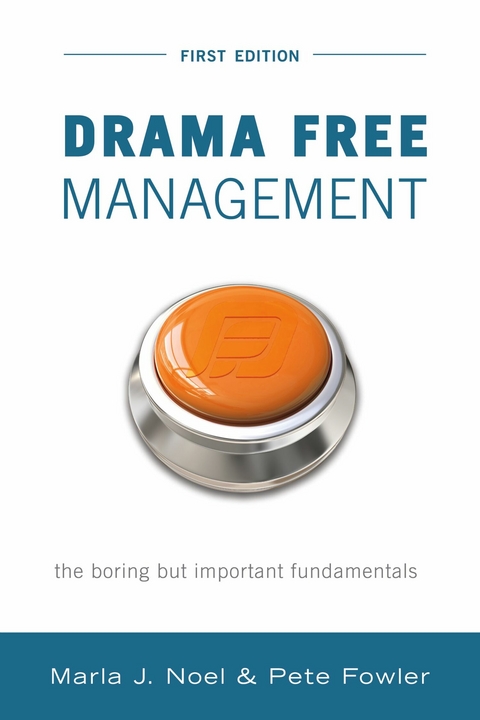
Drama Free Management (eBook)
224 Seiten
Bookbaby (Verlag)
979-8-3509-8850-5 (ISBN)
Pete Fowler is a product-focused CEO and Chief Quality Officer. He is a construction consultant, professional cost estimator, and a general building contractor in several states. Pete received a B.S. in Construction Management from California State University, Chico, and a minor in Management Information Systems. He has held certifications from AAMA, ASPE, ICBO, and others. Mr. Fowler has published articles in national magazines, has been invited to speak by the most important groups in the building industry (AAMA, APRA, ASPE, ASQ, ASTM, BETEC, CAI,CLM, DBIA, ICC, NIBS, PLRB, RCI, etc.), and has composed and delivered hundreds of educational programs on building inspection and testing, estimating, quality and construction management, project management, and claims and litigation. Pete has experience with successful expert witness testimony, including federal court. Pete Fowler Construction is a team of building experts and project management professionals who help clients make smart, informed decisions about buildings and property. Clients include property owners and managers, governmental organizations, developers and contractors, product manufacturers and suppliers, insurers, and lawyers. Services include building inspection and testing, estimating, quality and construction management, and building claims and litigation consulting, including expert witness testimony. Every year we work on hundreds of projects as widely varying as single-family residences, multi-family projects, mixed-use developments, and commercial, institutional, industrial, low-rise, mid-rise, and high-rise construction. We operate both in the private and public sectors and with for-profit as well as nonprofit organizations. We have been hired by the lawyer or insurance company for every major party in the building industry, including every major sub-trade.
Drama Free Management is a collection of practices that lead from high drama and low performance to low drama and exciting results. Running a business is hard. As the great management thinker Peter Drucker said, "e;Only three things happen naturally in organizations: friction, confusion, and underperformance. Everything else requires leadership."e; Pete is naturally a high drama leader, which caused much past suffering. Marla is naturally a low drama leader, and a mentor to Pete and many others. This collection of practices is guaranteed to reduce drama, like a physical fitness regimen will increase strength, if applied consistently over time.
1.
Introduction
From Marla and Pete
Drama Is Waste
We believe there are a collection of practices that lead from high drama and low performance to low drama and exciting results.
There are more than thirty million businesses in the United States. The majority of them have zero employees. Ninety-eight percent are “small businesses” with fewer than fifty employees. Only four thousand (0.01 percent) are public companies. Why? Is it because most business owners don’t want to have a thriving, growing business that is thrilling clients with amazing products and services while creating growth opportunities for their employees? Or maybe it is because the idea of increasing financial security for themself, their families, their partners, and employees seems terrible? We don’t think so.
We think it’s because running a business is hard. It’s hard enough to master the skills required to do or make something so valuable that customers are willing to buy. It’s hard to hire, train, lead, and manage people in a way that inspires them to work hard and fast enough. It’s hard to grow past the size where the owners can personally supervise and quality check all the work. It’s harder in the US because of the regulatory burden and litigation, and in some states the thicket of regulation makes it seem like the government is assertively discouraging commerce by making it too difficult and expensive to comply. It’s hard (some would argue impossible) to compete with businesses from a low-cost country for low margin work. And for all these reasons and more, it’s hard to make a profit.
The great management thinker Peter Drucker said, “Only three things happen naturally in organizations: friction, confusion, and underperformance. Everything else requires leadership.” That’s our definition of “drama” here. Our collection of practices are guaranteed to reduce drama, like a physical fitness regimen will increase strength, if applied consistently over time.
“Wellness” practices include a lot of boring stuff like spending time cultivating a network of loving and trusting relationships, sleeping enough, eating a healthy diet, regular exercise, finding meaningful work, financial health, and meaning-seeking through emotional, psychological, spiritual, or intellectual pursuits. Businesses need a similar collection of “boring” practices.
Everyone knows someone who is addicted to drama in their personal lives. Those lives are often messy because drama causes friction that keeps people from having the time to do the things that keep them healthy. The same happens in organizations of any kind, especially businesses.
Sound Familiar?
Marla is naturally a low-drama leader. Pete, on the other hand, is the descendant of a long line of drunken, bar fightin’ Irishmen, and was the first one on either side of the family to even visit a university campus, let alone graduate from one; so low drama was not even on the radar until after some painful learning.
Do any of these struggles Pete faced, or that Marla regularly coaches her clients through, sound familiar?
A key employee quit with a lot of important information saved only in their head:
- I am the only one who can solve problems.
- I can’t vacation without working much of the time.
- I hired the wrong person.
- I managed in a way that made employees feel sad or mad rather than inspired.
- I failed to fire someone everyone knew was wrong for the team.
- I want to grow, but I can’t personally manage any more of the operations, and I don’t want to.
- Meetings are a waste of time.
- Some employees are great and others not so much.
- We delivered defective work to the client.
- We have a culture of distrust and backbiting.
- We failed to create job descriptions for key roles.
- We failed to create documentation for key processes.
- We were losing money but did not know it until much too late.
- We made money but ran short of cash.
- We made plans but failed to follow up and follow through to conclusion.
- We relied on hope as the strategy, rather than written planning and disciplined execution.
- We spent absurd sums on ineffective consultants.
- We suffered a mutiny of employees who stole equipment, clients, and set up a competing business.
- We wish we had more work.
If any or all these issues are yours, keep reading. Even if you have a great company and feel you can always learn more, keep reading.
High Drama Leadership: Pete’s Story
I turned sixteen in 1984 and left the prestigious world of shoe shining in my mother’s barbershop to begin my career in construction as a ditch digger. By 1996, after a failed attempt at rock ‘n’ roll stardom (seriously), I received my BS in construction management. I got straight to working like a psychopath from 1996–1999 so I could jump straight into the upper-middle class with two kids, a stay-at-home wife, nice new cars, and a house on the hill. I had developed all the technical skills required to succeed in my industry by working seventy- to one-hundred-hour weeks. (I don’t recommend this strategy).
I didn’t want to, but in early 2000 I started what became a “successful” small business. My technical skills were not enough to overcome my limited experience and a lack of emotional maturity, so I got to learn most of the lessons listed above the hard and expensive way. By early 2015 I was five years divorced, had ended up with my children living with me full time (this is not good for business), and the “successful” business was 40 percent down from its peak and losing money.
My daughter was off to college, and I was paying for that out of pocket since there was no savings left. Since the divorce, my sweet, sensitive, now sixteen-year-old son had not been thriving, so much so that I had to hire two 300-pound guys to snatch him in the night and take him to an intensive therapeutic wilderness program where he spent seventy days. That was $40,000 I didn’t have. Then he went to a therapeutic boarding school deep in the desert that was another $9,000 a month I didn’t have either.
On the bright side, since the kids left the house I was refocused on the business and things were turning around, so much so that on an accrual basis we were already profitable. Unfortunately, in my business, getting paid takes around sixty days, so cash was uncomfortably tight.
On a Thursday afternoon I drove far into the desert for the boarding school’s quarterly “family weekend.” This would be our first weekend together in many months, and while I had no idea what to expect, I knew that I needed to be fully present for my cherished boy who was suffering. I was suffering too. I stayed in the closest cheap motel, but that still required a long drive to the school for the early Friday morning start. There was no mobile phone service in the little town until I reached the school.
I parked right in front of the meeting hall and was about to join the other parents, including my ex-wife and her second husband. I was about to toss my phone into the back seat with some other belongings when I realized a voicemail had been left while I was driving without service. I heard a pleasant voice say, “Hello, Mr. Fowler. This is your business bank. Payroll hit today, and you have insufficient funds. Can you please call us right away and let us know where you’ll be transferring the money from to cover it?”
Deep breath. Look at phone. Look into the meeting hall with parents gathering. Look back at phone. There was no money. There was no longer a line of credit. I was stuck. I said to myself, “Damn it. I was hoping the universe didn’t need to teach me what bankruptcy was like. I need to be fully present for this boy. And for me. Well . . . I guess I’m going bankrupt on Monday.” I turned off the phone, tossed it into the car, and closed and locked the door. I was fully present. “Peaceful” is not one of my native virtues, but I was unusually peaceful all weekend.
Since 2015 I did a bunch of things that we will discuss in the following pages. These activities have led to the point that I had more than enough time away from the day-to-day of the business to work on this book. I live a life that is far beyond the dreams I had as a young man. I hope the team I have gathered into my business would tell you that I still add a lot of value as the visionary president and chief quality officer, but they are not shy about saying that day-to-day, the place runs better when I leave them alone. It’s fantastic for everyone.
When I was driving back across the desert on Monday morning after the family weekend, I called the office to start figuring out what bankruptcy was going to be like. They had no idea what I was talking about. The office manager said, “We had a great collections day on Friday, so I went to the bank myself to make the deposit!” I guess the universe decided I didn’t need to know what bankruptcy was like after all.
Low Drama Leadership: Marla’s Case Studies
Case Study 1: Implementing Systems
On a cool summer morning in August at the Moulin Café in Costa Mesa, CA, I met with a young couple, Ken and Shelly, a husband-and-wife team who ran a construction company in Orange County. The patio furniture in front of the café was uncomfortable but satisfied our needs. We chatted...
| Erscheint lt. Verlag | 3.2.2025 |
|---|---|
| Sprache | englisch |
| Themenwelt | Wirtschaft |
| ISBN-13 | 979-8-3509-8850-5 / 9798350988505 |
| Informationen gemäß Produktsicherheitsverordnung (GPSR) | |
| Haben Sie eine Frage zum Produkt? |
 EPUB (Ohne DRM)
Größe: 3,3 MB
Digital Rights Management: ohne DRM
Dieses eBook enthält kein DRM oder Kopierschutz. Eine Weitergabe an Dritte ist jedoch rechtlich nicht zulässig, weil Sie beim Kauf nur die Rechte an der persönlichen Nutzung erwerben.
Dateiformat: EPUB (Electronic Publication)
EPUB ist ein offener Standard für eBooks und eignet sich besonders zur Darstellung von Belletristik und Sachbüchern. Der Fließtext wird dynamisch an die Display- und Schriftgröße angepasst. Auch für mobile Lesegeräte ist EPUB daher gut geeignet.
Systemvoraussetzungen:
PC/Mac: Mit einem PC oder Mac können Sie dieses eBook lesen. Sie benötigen dafür die kostenlose Software Adobe Digital Editions.
eReader: Dieses eBook kann mit (fast) allen eBook-Readern gelesen werden. Mit dem amazon-Kindle ist es aber nicht kompatibel.
Smartphone/Tablet: Egal ob Apple oder Android, dieses eBook können Sie lesen. Sie benötigen dafür eine kostenlose App.
Geräteliste und zusätzliche Hinweise
Buying eBooks from abroad
For tax law reasons we can sell eBooks just within Germany and Switzerland. Regrettably we cannot fulfill eBook-orders from other countries.
aus dem Bereich