


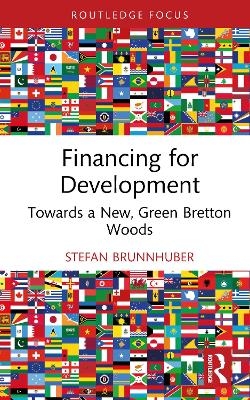
Financing for Development
Towards a New, Green Bretton Woods
Seiten
2025
Routledge (Verlag)
978-1-032-81461-2 (ISBN)
Routledge (Verlag)
978-1-032-81461-2 (ISBN)
This book provides a robust argument for an upgrade of the financial system to enable a more sustainable approach. The author argues that a new green Bretton Woods 2.0 will provide the agenda to transform our economy and our society, and a Green Transition plan is included in the book.
This book provides a robust argument for an upgrade of the financial system to enable a more sustainable approach. It explores the upcoming debate on a newly modified international financial architecture, facing serial ecological crisis and the advent of new technologies, and which operates in a multipolar world.
Instead of business as usual (BAU) scenarios, it explores new, innovative, out of the box approaches in the following arenas: taxonomy and regulation, including capital flow management measures and taxations schemas; financial engineering such as hedging instruments private public partnerships; and polity frameworks e.g. IMF, World Bank, Multilateral development banks, voting quota. It addresses the new role of Central Bank Digital Currencies (CBDCs), the current and upcoming campaign on debt restructuring, as well as the role of new technologies - AI and Blockchain - to tackle illicit financial transactions and fraud, including predictive coding and big DATA correlations. The book focuses on the new role of monetary regulators and central bankers in providing conditioned, additional liquidity to finance, hedge and manage our global commons and to mobilize private capital at the same time, meaning that monetary policy will oversteer fiscal and credit policy in a Bretton Woods II process. The author argues that a new green Bretton Woods 2.0 will provide the agenda to transform our economy and our society, and a Green Transition plan is included in the book.
This will serve as a comprehensive reader for students, scholars and activists in the fields of macroeconomics, international development policy, finance and sustainability. It will also appeal to policy makers and executives in the financial sector as well as informed monetary experts.
This book provides a robust argument for an upgrade of the financial system to enable a more sustainable approach. It explores the upcoming debate on a newly modified international financial architecture, facing serial ecological crisis and the advent of new technologies, and which operates in a multipolar world.
Instead of business as usual (BAU) scenarios, it explores new, innovative, out of the box approaches in the following arenas: taxonomy and regulation, including capital flow management measures and taxations schemas; financial engineering such as hedging instruments private public partnerships; and polity frameworks e.g. IMF, World Bank, Multilateral development banks, voting quota. It addresses the new role of Central Bank Digital Currencies (CBDCs), the current and upcoming campaign on debt restructuring, as well as the role of new technologies - AI and Blockchain - to tackle illicit financial transactions and fraud, including predictive coding and big DATA correlations. The book focuses on the new role of monetary regulators and central bankers in providing conditioned, additional liquidity to finance, hedge and manage our global commons and to mobilize private capital at the same time, meaning that monetary policy will oversteer fiscal and credit policy in a Bretton Woods II process. The author argues that a new green Bretton Woods 2.0 will provide the agenda to transform our economy and our society, and a Green Transition plan is included in the book.
This will serve as a comprehensive reader for students, scholars and activists in the fields of macroeconomics, international development policy, finance and sustainability. It will also appeal to policy makers and executives in the financial sector as well as informed monetary experts.
Stefan Brunnhuber, MD, PhD, is Trustee at the World Academy of Art and Science, Member of the Club of Rome and endowed chair in sustainability.
1. Introduction: Tomorrow Is Now 2. Finding the Right Narrative: The Many Relevant Stories We Could Tell 3. The Traditional Way: End of Pipe 4. Helping to Set the Course: Taxonomies, Transparency and Transition Plans 5. Resetting the Framework: The New Game in Town 6. Upgrading the System: Towards a Green Bretton Woods 7. Conclusion: The Full Picture
| Erscheinungsdatum | 11.05.2025 |
|---|---|
| Reihe/Serie | Routledge Focus on Economics and Finance |
| Zusatzinfo | 8 Tables, black and white; 12 Line drawings, black and white; 12 Illustrations, black and white |
| Verlagsort | London |
| Sprache | englisch |
| Maße | 138 x 216 mm |
| Gewicht | 380 g |
| Themenwelt | Sozialwissenschaften ► Politik / Verwaltung |
| Wirtschaft ► Betriebswirtschaft / Management ► Finanzierung | |
| Betriebswirtschaft / Management ► Spezielle Betriebswirtschaftslehre ► Bankbetriebslehre | |
| Wirtschaft ► Volkswirtschaftslehre ► Finanzwissenschaft | |
| Wirtschaft ► Volkswirtschaftslehre ► Makroökonomie | |
| ISBN-10 | 1-032-81461-6 / 1032814616 |
| ISBN-13 | 978-1-032-81461-2 / 9781032814612 |
| Zustand | Neuware |
| Informationen gemäß Produktsicherheitsverordnung (GPSR) | |
| Haben Sie eine Frage zum Produkt? |
Mehr entdecken
aus dem Bereich

aus dem Bereich
Warum unser Geld stirbt und wie Sie davon profitieren
Buch | Hardcover (2024)
FinanzBuch Verlag
CHF 41,95
Praxisnahe Einführung mit zahlreichen Fallbeispielen börsennotierter …
Buch | Softcover (2020)
Vahlen (Verlag)
CHF 34,85
denken und handeln wie ein professioneller Trader
Buch | Softcover (2023)
Vahlen, Franz (Verlag)
CHF 51,65


