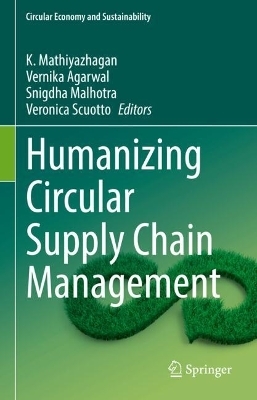
Humanizing Circular Supply Chain Management
Springer International Publishing (Verlag)
978-3-031-86561-9 (ISBN)
This book the improvements in the circular economy are discussed, and a multidisciplinary approach is taken to examine developments in the recovery of value in CSCM. This book's main goal is to give readers a platform on which to discuss the role of human resources in effective supply chain management in a circular economy and how it may be used. CSCM is a new way of conducting business that offers a waste-free and sustainable substitute to the economy. The concept of CSCM is often incomplete if the human capital aspect of it is not covered. Human resources" or "human capital" represents a person's skills, talents, qualifications, and experiences. Thus, it is inconceivable that the shift to a circular economy would be successful without a new strategy for managing human resources. The COVID-19 epidemic has heightened and realigned the value of human capital inside organizations, whether it is through remote work policies, greater attention to employee health benefits, staff morale, or well-being concerns. It has provided HR professionals with the ability to reevaluate their interactions with employees and has made room for innovative working methods. To end the loop of the linear economic model, sustainability and sustainable improvements are prioritized internationally in all facets of organizations. The book offers the latest deveopments of Circular Supply Chain Management and its applications. It describes the role of human resources in regulating supply chains in the circular economy. The "take-make-waste" economic model in CSCM is encouraging us to rebuild better HR and entrepreneurial policies, which will be vital in building a stronger and more resilient company culture that maintains the value of all resources and is required to get through these trying times. To achieve this goal currently there exists a gap between the present skill sets and the skills required in future to generate new innovation and/or set a new business. In turn, this would request Continuous investment in employees development and training. Alongside, it involves a great attention on how humans are generating new innovations throughout the whole supply chain. At the moment, there is a focus on technologies and less consideration on humans in the field of supply chain management. Again, sustainability seems to be the new core of a company and its circulatory calls for a variety of human skills. In this scenario , the book's ultimate proposal is to give a research viewpoint that included views from policymakers, regulators, and practitioners. The book aims to address the significance of humanizing CSCM and also invites case studies on the topic.
This book will meet the demands of research researchers, graduate students, and undergraduate students. Also, it will serve as reference information for academics, researchers, and industry professionals.
Dr. K. Mathiyazhagan is a Professor and Chairperson Research Centre Thiagarajar School of Management, Madurai. His impressive academic contributions are underscored by his editorial roles (associate & assistant editor) in high-impact journals such as Technological Forecasting and Social Change (Elsevier), Business Strategy and the Environment (Wiley), Journal of Knowledge Management (Emerald), Management Decision (Emerald), and Environment, Development and Sustainability (Springer). He has also served as a guest editor for several special issues in top-tier journals like IJLM, JBL, IJPDLM, SPC, Socio Economy & Decision Science. Dr. K. Mathiyazhagan s research has earned him a place among the Top 2% of scientists globally, as recognized by Stanford University. He has published extensively, with over 7000 research citations and accolades such as the Excellence Citation Award from Emerald Publisher Ltd. His research interests span Green and Sustainable Supply Chain Management, Multi-Criteria Decision Making, Sustainable Lean Manufacturing, Lean Six Sigma, and more. He has received invitations to speak at international conferences and workshops across the UK, Poland, Italy, and China. Dr. K. Mathiyazhagan has organized multiple international conferences and workshops, edited conference proceedings, and been a reviewer for over 30 prestigious international journals. He has supervised numerous undergraduate, postgraduate, and Ph.D. scholars, and his recent AICTE grants support workshops on Six Sigma in Quality Management and Circular Economy. Also, he has received funded projects from ICSSR & WBPCB. In addition to his academic accomplishments, he is a visiting faculty member at the University of Rome Tor Vergata, Italy.
Dr. Vernika Agarwal is an Associate Professor in operations in Apeejay School of Management, Dwarka, New Delhi, India with 10+ years of rich work experience across the teaching and research fields. She works in the fields of green supply chains, circular economy and sustainability, cross-disciplinary research in supply and operations management, optimization, reverse logistics, and empirical research. She earned her doctorate specializing in operations and supply chain management from the Department of Operational Research, University of Delhi, India in the year 2019. She has published 20+ research papers published in journals of national and international repute and presented at 20+ conferences. One of her most recent articles was published in Business Strategy and the Environment (Impact factor- 10.302). Majority of her papers are in ABDC listed journals. She is currently the Guest editor for Special issue on "MSME s resilience and performance: COVID-19 perspective", Benchmarking (Emerald) - ABDC- B. She has recently published a book titled "Lean and Green Manufacturing - Towards Eco-Efficiency and Business Performance" book series of Management and Industrial Engineering, Springer.
Snigdha Malhotra is an academician and researcher, currently spearheading initiatives at the Center for Responsible Management at the Fortune Institute of International Business (FIIB), New Del
1. Investigating the barriers for Humanizing Circular Supply Chain Management.- 2. Issues and Challenges in Humanizing Circular Supply Chain Management.- 3. Examining the intersection of Circular Economy and Human Resources.- 4. Synergies in CSCM and Human resources.- 5. Employee Skills required for efficient CSCM.- 6. Reinventing employee skills for building circular economies.- 7. Human entrepreneurship and sustainable supply chain management.
| Erscheinungsdatum | 10.07.2025 |
|---|---|
| Reihe/Serie | Circular Economy and Sustainability |
| Zusatzinfo | IX, 379 p. 55 illus., 48 illus. in color. |
| Verlagsort | Cham |
| Sprache | englisch |
| Maße | 155 x 235 mm |
| Themenwelt | Wirtschaft ► Betriebswirtschaft / Management ► Logistik / Produktion |
| Schlagworte | circular economy • Circular supply chain mangement • Entrepreneurship • Human resource and human capital • Humans in the field of supply chain management • new ways of working • Sills and reskilling • training and development • Waste-free and sustainable development |
| ISBN-10 | 3-031-86561-8 / 3031865618 |
| ISBN-13 | 978-3-031-86561-9 / 9783031865619 |
| Zustand | Neuware |
| Informationen gemäß Produktsicherheitsverordnung (GPSR) | |
| Haben Sie eine Frage zum Produkt? |
aus dem Bereich