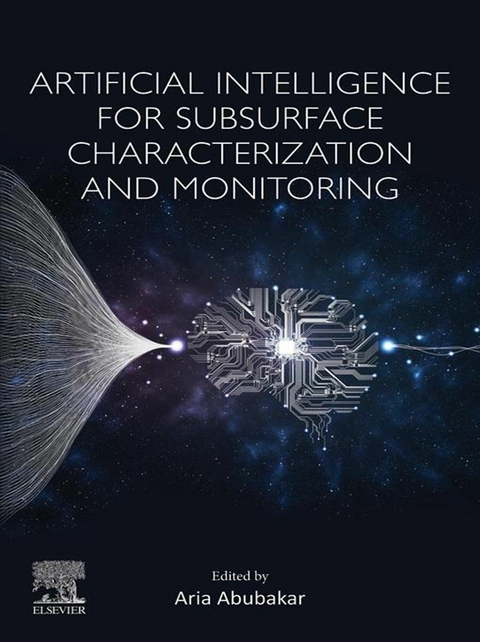
Artificial Intelligence for Subsurface Characterization and Monitoring (eBook)
300 Seiten
Elsevier Science (Verlag)
978-0-443-22422-5 (ISBN)
Artificial Intelligence for Subsurface Characterization and Monitoring provides an in-depth examination of how deep learning accelerates the process of subsurface characterization and monitoring and provides an end-to-end solution. In recent years, deep learning has been introduced to the geoscience community to overcome some longstanding technical challenges. This book explores some of the most important topics in this discipline to explain the unique capability of deep learning in subsurface characterization for hydrocarbon exploration and production and for energy transition. Readers will discover deep learning methods that can improve the quality and efficiency of many of the key steps in subsurface characterization and monitoring.The text is organized into five parts. The first two parts explore deep learning for data enrichment and well log data, including information extraction from unstructured well reports as well as log data QC and processing. Next is a review of deep learning applied to seismic data and data integration, which also covers intelligent processing for clearer seismic images and rock property inversion and validation. The closing section looks at deep learning in time lapse scenarios, including sparse data reconstruction for reducing the cost of 4D seismic data, time-lapse seismic data repeatability enforcement, and direct property prediction from pre-migration seismic data. - Focus on deep learning applications for geoscience provides a one-stop reference for deep learning applications for geoscience. - Comprehensive examples of the state-of-art techniques throughout the subsurface characterization workflow provide readers with a chance to familiarize themselves with deep learning applications not only in their own field of expertise but also in other relevant fields. - All applications come with realistic field dataset examples so that readers can learn what to expect in real life.
| Erscheint lt. Verlag | 31.1.2025 |
|---|---|
| Sprache | englisch |
| Themenwelt | Technik ► Elektrotechnik / Energietechnik |
| Wirtschaft | |
| ISBN-10 | 0-443-22422-6 / 0443224226 |
| ISBN-13 | 978-0-443-22422-5 / 9780443224225 |
| Informationen gemäß Produktsicherheitsverordnung (GPSR) | |
| Haben Sie eine Frage zum Produkt? |
 PDF (Adobe DRM)
Kopierschutz: Adobe-DRM
Adobe-DRM ist ein Kopierschutz, der das eBook vor Mißbrauch schützen soll. Dabei wird das eBook bereits beim Download auf Ihre persönliche Adobe-ID autorisiert. Lesen können Sie das eBook dann nur auf den Geräten, welche ebenfalls auf Ihre Adobe-ID registriert sind.
Details zum Adobe-DRM
Dateiformat: PDF (Portable Document Format)
Mit einem festen Seitenlayout eignet sich die PDF besonders für Fachbücher mit Spalten, Tabellen und Abbildungen. Eine PDF kann auf fast allen Geräten angezeigt werden, ist aber für kleine Displays (Smartphone, eReader) nur eingeschränkt geeignet.
Systemvoraussetzungen:
PC/Mac: Mit einem PC oder Mac können Sie dieses eBook lesen. Sie benötigen eine
eReader: Dieses eBook kann mit (fast) allen eBook-Readern gelesen werden. Mit dem amazon-Kindle ist es aber nicht kompatibel.
Smartphone/Tablet: Egal ob Apple oder Android, dieses eBook können Sie lesen. Sie benötigen eine
Geräteliste und zusätzliche Hinweise
Buying eBooks from abroad
For tax law reasons we can sell eBooks just within Germany and Switzerland. Regrettably we cannot fulfill eBook-orders from other countries.
aus dem Bereich