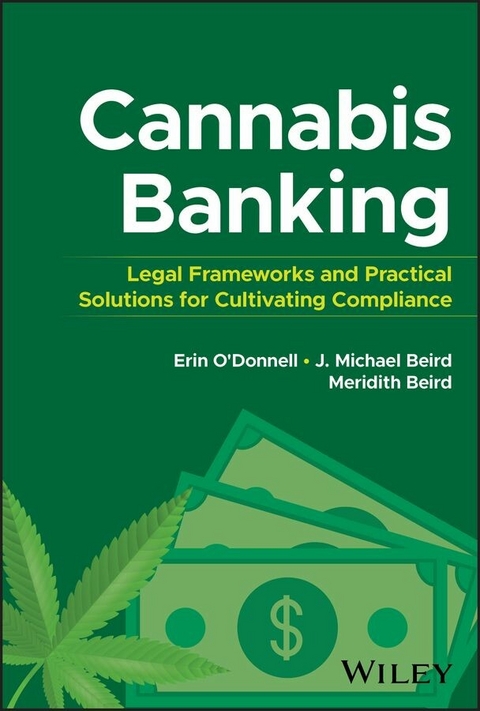
Cannabis Banking (eBook)
360 Seiten
Wiley (Verlag)
978-1-394-27628-8 (ISBN)
Unlock the financial potential of the cannabis industry
Cannabis Banking: Legal Frameworks and Practical Solutions for Cultivating Compliance offers a deep dive into a critical issue facing cannabis businesses worldwide: the challenge of accessing essential financial and banking services. Written by a team of experienced finance professionals and entrepreneurs, this guide is tailored to demystify the complex world of banking regulations and present practical solutions for cannabis enterprises.
As the cannabis sector continues to expand at an unprecedented rate, many businesses find themselves hindered by regulatory uncertainties, preventing them from accessing the financial services necessary for growth. Cannabis Banking not only addresses these challenges but also opens the door for finance professionals, entrepreneurs, and investors to explore substantial business opportunities within the industry.
You'll also find:
- Detailed discussions on the pending SAFER legislation that grants safe harbor to banks who do business with cannabis enterprises
- Strategies for maintaining compliance and optimizing fiscal opportunities when banking cannabis firms
- Up-to-date guidance, practical tips, and real-world case studies of cannabis finance and banking
Whether you are a bank and credit union personnel, compliance officer, risk analyst, or fintech professional involved with the cannabis sector, Cannabis Banking is your go-to resource for navigating the complexities of cannabis finance. Equip yourself with the knowledge to foster efficient, compliant financial operations and propel your cannabis business or financial career forward.
ERIN O'DONNELL is the Founding Partner of the Association for Cannabis Banking and a Co-founder of BankersHub. She has over thirty years' experience in the events, education and financial services industry.
J. MICHAEL BEIRD is the Founding Partner of the Association for Cannabis Banking and has over 45 years' experience in financial services working as a branch manager, auditor, M&A analyst, workforce optimization manager, procedural reengineer, and bank advisor on four different continents. He is a Co-founder of BankersHub.
MERIDITH BEIRD is a Partner of the Association for Cannabis Banking. She has over ten years' experience in online education for financial services.
Unlock the financial potential of the cannabis industry Cannabis Banking: Legal Frameworks and Practical Solutions for Cultivating Compliance offers a deep dive into a critical issue facing cannabis businesses worldwide: the challenge of accessing essential financial and banking services. Written by a team of experienced finance professionals and entrepreneurs, this guide is tailored to demystify the complex world of banking regulations and present practical solutions for cannabis enterprises. As the cannabis sector continues to expand at an unprecedented rate, many businesses find themselves hindered by regulatory uncertainties, preventing them from accessing the financial services necessary for growth. Cannabis Banking not only addresses these challenges but also opens the door for finance professionals, entrepreneurs, and investors to explore substantial business opportunities within the industry. You'll also find: Detailed discussions on the pending SAFER legislation that grants safe harbor to banks who do business with cannabis enterprises Strategies for maintaining compliance and optimizing fiscal opportunities when banking cannabis firms Up-to-date guidance, practical tips, and real-world case studies of cannabis finance and banking Whether you are a bank and credit union personnel, compliance officer, risk analyst, or fintech professional involved with the cannabis sector, Cannabis Banking is your go-to resource for navigating the complexities of cannabis finance. Equip yourself with the knowledge to foster efficient, compliant financial operations and propel your cannabis business or financial career forward.
CHAPTER 1
Understanding the Cannabis Industry
A BRIEF HISTORY OF CANNABIS
Before we jump into the rules and regulations surrounding cannabis banking, it is important to look at the basics. What is cannabis exactly, how have the political and social relationships with cannabis changed over the years, and where does cannabis currently stand in the eyes of the government? Let us get started!
The cultivation and use of the cannabis plant is not a new phenomenon. In fact, evidence of cannabis use dates back to around 2700 bce in China by Emperor Shen Nung, whose teachings and medical practices with the plant were passed down for generations by word of mouth before being recorded in a book on herbal remedies, written around the second century CE.1 Over time, the plant spread throughout Asia, into Europe, and by the sixteenth century, Spanish and English settlers were bringing it across to the Americas.
Within the United States, the cannabis plant has a long and complex history, with the first hemp law enacted in 1619. However, instead of a law banning the plant, which is more in line with what we see in the country today, this law actually required every farm in the colonies to plant hemp. At the time, hemp was a critical crop for the colonists, used for things like clothing, rope, paper, and even as a legal currency for some time in the colonies of Virginia, Pennsylvania, and Maryland.2 Hemp production eventually lost out in popularity to cotton, which provided a softer clothing option; but by that time, marijuana, as an extract of the hemp plant, was already commonly used in medicines and tinctures. It wasn’t until around the 1920s that a more recreational use for marijuana began to develop, the practice of which was primarily introduced by Mexican immigrants. With the initial rise in price of alcohol, followed shortly thereafter by prohibition, marijuana became a cheaper and more readily available alternative to drinking. Throughout the next decade or so, marijuana use became increasingly associated with Mexican immigrants – who the public resented due to the lack of jobs available during the depression – and the lower class, who were often seen as perpetrators of crime and violence. With the social stigma of marijuana now tainted, it wasn’t long until the government stepped in.3
History of the Regulation of Hemp and Marijuana
Hemp, and by extension marijuana, was largely regulated as any other plant for many years in the US. And while the social stigma had taken a hit, it wasn’t until the end of prohibition that it came back into the legal and political spotlight. With alcohol no longer being banned, the focus shifted to marijuana. By the early 1930s, the drug was being outlawed in cities all over the country, and states quickly started following suit – by 1931 it had been banned in 29 states. Federally, the US was hesitant to outlaw marijuana partly due to the medicinal uses of the drug being used and researched, and also partly due to the lucrative business coming from the hemp plant at large. However, there was no denying the shifting political focus and so the Marihuana Tax Act was passed in 1937. This act criminalized marijuana and created a tax on hemp, requiring official Marihuana Tax Act stamps for the importation and exportation of the plant. The aim of this act was to lessen or stop the use of marijuana for recreational purposes, but it resulted in some unintended consequences for the rest of the industry: the growth and exportation of hemp became much more difficult and expensive, leading to a decrease in production. Additionally, this all but stopped scientific studies on both the plant and the drug.4
Much like with prohibition, this did not stop the spread and use of marijuana, it simply got pushed underground and into fringe cultural groups. In the 1950s, marijuana became popular with the Beat generation, who favored a more Bohemian lifestyle; it also became connected with jazz enthusiasts following the song “Reefer Man” by Cab Calloway. In the 1960s and 1970s, marijuana was a common drug of choice for the hippy subculture as they saw it as a way to push back against the mainstream lifestyles.
Introducing the Controlled Substance Act (CSA)
In 1969, the Marihuana Tax Act was deemed unconstitutional after the court case of Leary v. United States.5 Leary argued that his registration to purchase tax stamps would be self-incriminating (and therefore a violation of the fifth amendment) due to the fact that the sale and transfer of the drug was illegal, so having to register for intent to possess or use the drug would be an immediate red flag for authorities. For a short time, that meant there was technically no federal regulation for marijuana. However, the US shortly thereafter passed the Controlled Substance Act of 1970, which once again made marijuana illegal nation wide, and it classified marijuana as a drug that is considered as hazardous and addictive as others such as heroin, peyote, and LSD (Lysergic Acid Diethylamide).6 Alongside promotions such as Nancy Reagan’s “Just Say No” campaign, marijuana was deemed a dangerous drug and one we needed to keep away from the public at all costs. However, in the 1990s, that ideology began to shift.
In 1996, California became the first state to adopt a medical marijuana program. Set up under the Compassionate Use Act, this new legislation allowed people with certain medical ailments to obtain and use marijuana as a treatment with medical supervision.7 Colorado followed suit just a couple of years later in 2000, and since then there has been a snowball effect of states opening their doors to the cannabis market. In 2013, marijuana again found itself in the headlines when the Deputy Attorney General at the time, James Cole, issued a memorandum (hereafter known as the Cole Memo) that essentially allowed for states to make their own decisions about the sale and distribution of marijuana and cannabis. The essence of the Cole Memo was this: the federal government has an interest in the bigger picture of marijuana, and as long as their main focus and goals are not impeded, states were henceforth allowed to implement programs for legal marijuana sales and distribution, if they so choose to.8 (We will be talking about the Cole Memo in depth in Chapter 3.)
Since 2013, individual states have regularly been voting to adopt cannabis programs, whether for medical or recreational use. 2013 was also the first year that public support for cannabis legalization surpassed 50%, according to Gallup poll findings. And their research has shown that support has only continued to grow – as of October 2023, the nationwide support for cannabis legalization was up to a whopping 70%. More importantly, these numbers are reflected in the population regardless of demographics or current state legality. While self-identified conservatives and Republicans are the groups with the lowest percentages in favor, even these groups now show majority support for the cause (with 52% and 55%, respectively).9
Health Benefits of Marijuana
Additionally, more health studies are being conducted and are educating on how marijuana can be used for certain health ailments, such as epilepsy, Alzheimer’s, Amyotrophic Lateral Sclerosis (ALS), chronic pain, and more. These are critical for marijuana’s path to legislation for one simple reason: marijuana is still classified as a Schedule I drug by the Drug Enforcement Agency (DEA). This means that under federal law, marijuana is found to be a substance with a high probability of addiction and containing no medicinal benefits. While we know that the hemp plant has been used for medical treatments for centuries, it is crucial for the drug to be studied and measured against today’s health standards and best practices. In early 2024, the Department of Health and Human Services sent a letter to the DEA recommending that they consider rescheduling marijuana to Schedule III. By definition, this category of drugs has a much lower potential for dependence and abuse, with examples such as Tylenol with Codeine, Anabolic Steroids, and Testosterone.10 While this would be a critical step for the eventual legalization of marijuana on a federal level, it is just that – a step. This is not meant to magically open doors for dispensaries around the country but is instead a way to change the way that marijuana as a drug is viewed in the eyes of the law.
CANNABIS BASICS
What do we mean when we talk about “cannabis”? The term is colloquially used as a more acceptable substitution for the word “marijuana,” which still has a slightly negative connotation in today’s society. However, there is a scientific difference between these terms, and it is vital to understand how they differ. Dissecting the cannabis plant into its individual components may seem like a tedious task, but it is crucial when discussing federal and state legalities.
Components of Cannabis
Cannabis, while often used as a catchall term, is also the name of a plant genus under the Cannabaceae family. The species of Hemp and Marijuana are found within the Cannabis genus. Cannabis plants are made up of around 80–100 cannabinoids, or chemical compounds, with the two main ones being cannabidiols (CBD) and delta-9 tetrahydrocannabinols (THC). While both CBD and THC have calming effects on the body, THC is the cannabinoid strain that produces a...
| Erscheint lt. Verlag | 28.1.2025 |
|---|---|
| Sprache | englisch |
| Themenwelt | Wirtschaft ► Betriebswirtschaft / Management |
| Schlagworte | accessing banking services for cannabis businesses • bank compliance • Banking Compliance • banking the cannabis industry • cannabis banking compliance • cannabis bank regulation • Cannabis finance • high-risk banking • high-risk banking sectors |
| ISBN-10 | 1-394-27628-1 / 1394276281 |
| ISBN-13 | 978-1-394-27628-8 / 9781394276288 |
| Informationen gemäß Produktsicherheitsverordnung (GPSR) | |
| Haben Sie eine Frage zum Produkt? |
 EPUB (Adobe DRM)
Kopierschutz: Adobe-DRM
Adobe-DRM ist ein Kopierschutz, der das eBook vor Mißbrauch schützen soll. Dabei wird das eBook bereits beim Download auf Ihre persönliche Adobe-ID autorisiert. Lesen können Sie das eBook dann nur auf den Geräten, welche ebenfalls auf Ihre Adobe-ID registriert sind.
Details zum Adobe-DRM
Dateiformat: EPUB (Electronic Publication)
EPUB ist ein offener Standard für eBooks und eignet sich besonders zur Darstellung von Belletristik und Sachbüchern. Der Fließtext wird dynamisch an die Display- und Schriftgröße angepasst. Auch für mobile Lesegeräte ist EPUB daher gut geeignet.
Systemvoraussetzungen:
PC/Mac: Mit einem PC oder Mac können Sie dieses eBook lesen. Sie benötigen eine
eReader: Dieses eBook kann mit (fast) allen eBook-Readern gelesen werden. Mit dem amazon-Kindle ist es aber nicht kompatibel.
Smartphone/Tablet: Egal ob Apple oder Android, dieses eBook können Sie lesen. Sie benötigen eine
Geräteliste und zusätzliche Hinweise
Buying eBooks from abroad
For tax law reasons we can sell eBooks just within Germany and Switzerland. Regrettably we cannot fulfill eBook-orders from other countries.
aus dem Bereich