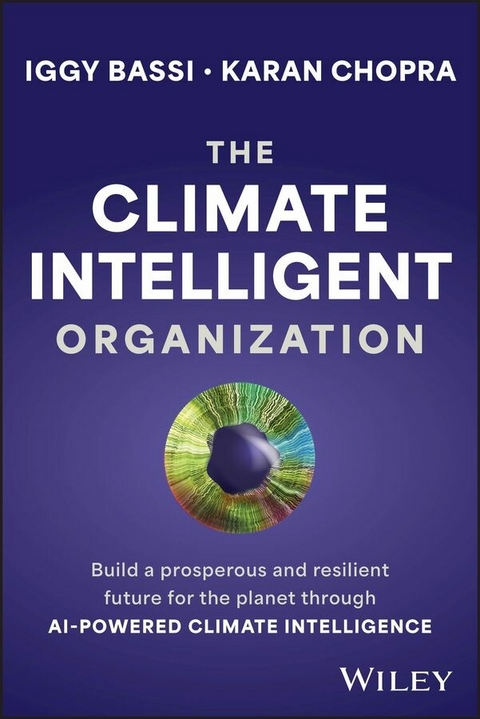
The Climate Intelligent Organization (eBook)
278 Seiten
Wiley (Verlag)
978-1-394-22853-9 (ISBN)
Learn to make sound business decisions on a rapidly changing planet
In The Climate Intelligent Organization, renowned entrepreneurs and climate intelligence pioneers Iggy Bassi and Karan Chopra, deliver an intuitive and practical guide to the transformative power of AI-driven Unified Climate Intelligence (UCI). Written with the business practitioner in mind, the book showcases how holistic climate analysis can be integrated into decisions, growth plans, and investments as organizations navigate the challenges and opportunities of climate change.
You'll discover:
- How UCI can redefine competitive advantage and reshape leadership.
- Strategies to improve climate-related financial performance.
- A roadmap for driving resilient value creation in the new climate economy.
Perfect for managers, executives, directors, policy makers, entrepreneurs, founders, and other business leaders, The Climate Intelligent Organization will also prove invaluable to finance and sustainability professionals seeking new insights into how to adapt to a changing planet.
IGGY BASSI is a renowned expert in climate intelligence, currently serving as CEO of Earthena AI. With his combined expertise in business, AI, and sustainability, he is at the forefront of the drive toward a climate-aligned economy and has been featured in BBC News, Sky News, the Financial Times, Wall Street Journal and New York Times.
KARAN CHOPRA is a climate tech entrepreneur, operator and co-founder of Earthena AI. He has advised and built tech and impact ventures featured in the New York Times, Wall Street Journal, and Aspen Ideas Festival. He is a Harvard Business School Baker Scholar and lives in the San Francisco Bay Area.
Learn to make sound business decisions on a rapidly changing planet In The Climate Intelligent Organization, renowned entrepreneurs and climate intelligence pioneers Iggy Bassi and Karan Chopra, deliver an intuitive and practical guide to the transformative power of AI-driven Unified Climate Intelligence (UCI). Written with the business practitioner in mind, the book showcases how holistic climate analysis can be integrated into decisions, growth plans, and investments as organizations navigate the challenges and opportunities of climate change. You'll discover: How UCI can redefine competitive advantage and reshape leadership. Strategies to improve climate-related financial performance. A roadmap for driving resilient value creation in the new climate economy. Perfect for managers, executives, directors, policy makers, entrepreneurs, founders, and other business leaders, The Climate Intelligent Organization will also prove invaluable to finance and sustainability professionals seeking new insights into how to adapt to a changing planet.
PREFACE AND INTRODUCTION
A PERSONAL JOURNEY THROUGH THE CLIMATE DIALOGUE
Welcome to The Climate Intelligent Organization. This book reflects our collective experience over the past quarter century, offering a deep dive into the evolving narrative of climate change. Enriched with our insights, we aim to transform how organizations perceive and engage with the climate challenge by introducing Unified Climate Intelligence (UCI). UCI represents the next frontier in climate strategy and technology, shifting the focus from risk to creating opportunities and accelerating climate‐aligned growth with tangible value creation.
Our journey began in 2008, while advising a sovereign wealth fund manager on emerging economies. Dismissed then as irrelevant, climate change is now at the forefront of economic strategy for that same entity. This dramatic shift underpins the global awakening to the urgency of climate action – a transformation we have been a part of, advising companies and governments on competitiveness, growth and resource security. Our professional paths have taken us from observing sustainability and climate change as mere afterthoughts to driving the narrative toward urgent, actionable change, where opportunities for innovation, value, and risk management coexist. This personal journey, filled with both frustrations and triumphs, is the wellspring from which The Climate Intelligent Organization originates.
Our experiences have revealed a stark disconnection between environmental sustainability and economic decision making. This realization spurred a profound shift in our careers. We ventured into sustainable agribusiness in West Africa, confronting first‐hand the harsh realities of climatic volatility on food security. This venture was not just about business; it was about deeply understanding and mitigating the impacts of climate change at a community level. The resilience and adaptation strategies we developed there were early iterations of what we now define as UCI.
However, our pivotal moment came with the founding of Cervest, a data analytics platform designed to predict and quantify physical climate hazards. Launched as nations around the world committed to the Paris Agreement, Cervest and its flagship product EarthScan was our response to the critical need for tools that could translate complex climate data into actionable business insights. We quickly recognized that complex data, when transformed into decision‐useful insights, could help companies not only understand but also communicate climatic impacts to regulators demanding new answers. Our frustration grew as climate discussions remained peripheral, with no binding agreement until the Paris breakthrough, yet climate risks and CO2 levels continued to rise. Our first‐hand experience on the farm, especially when a “50‐year wind event” damaged half our grain milling factory, taught us the urgent need for predictive climate intelligence. If we had possessed better insights earlier, we would have altered the engineering decisions for our food processing factory and farming infrastructure to better withstand such events.
From Risk to Opportunity: A Quantum Leap with Unified Climate Intelligence
For too long, climate change has been viewed predominantly as a paralyzing risk, overshadowing its potential as a catalyst for innovation and value creation. Our professional journeys, characterized by both challenges and insights, have illuminated the limitations of viewing climate solely through a lens of risk. This perspective not only stifles the urgency for proactive measures but also blinds us to the vast opportunities that proactive climate action can present.
However, the narrative is changing. A technological revolution is well underway, reshaping our approach to climate challenges. Advancements in AI, machine learning, big data and the declining costs of clean technologies are ushering in a new era. These developments allow us strategic foresight to understand and react to climate dynamics much earlier and more accurately than ever before, unlocking tremendous value for businesses and society alike.
The emergence of radical transparency in climate reporting fundamentally changes the business landscape. With increased visibility into climate risks and opportunities, there is no longer “anywhere to hide.” This transparency compels businesses to be proactive in managing their climate impact, not just for compliance, but as a strategic imperative to maintain a competitive advantage. Previously, a company's climate strategy might have been a private matter. Now, these strategies are openly quantified and scrutinized by B2B partners, banks, regulators and insurance companies. This introduces a game theory dimension to climate action. Furthermore, advancements in Generative AI (Gen‐AI) hold immense potential to revolutionize and democratize climate intelligence. Gen‐AI can be harnessed to analyze vast datasets, identify complex patterns, generate more nuanced climate insights and make this all contextually relevant in natural language. This, in turn, can inform the development of even more sophisticated UCI frameworks, enabling businesses to permanently transform their relationship with climate by making data‐driven decisions that not only mitigate risks but also capitalize on emerging opportunities in the low‐carbon economy.
Companies with robust climate strategies that demonstrably mitigate risk and capitalize on opportunities will be seen as more attractive partners, more creditworthy borrowers, and more insurable entities. Conversely, those lagging behind will face disadvantages in all these areas.
UCI is at the forefront of this revolution, transforming how we analyze climate data. Traditional methods, often fragmented and isolated, fail to provide a holistic view of climate impacts. UCI transcends these limitations by integrating diverse data sources – ranging from climate science and financial metrics to AI analysis – into a cohesive framework. This comprehensive approach provides a 360° view of climate risks and opportunities, empowering businesses to:
- Identify and Prioritize Climate Action: Gain granular, quantified insights into how climate change and related policies could impact operations, supply chains and market dynamics.
- Discover Hidden Opportunities: Explore new markets catalyzed by the low‐carbon transition, including innovative clean technologies.
- Make Data‐Driven Decisions: Embed climate considerations into core business strategies to enhance decision making and future‐proof operations.
- Enhance Resilience: Develop robust strategies to adapt to the changing climate and minimize potential disruptions.
- Reduce Costs: Achieve greater resource efficiency and energy savings, enhancing operational efficiency and profitability.
By embracing UCI, businesses can shift from a risk‐averse posture to one where climate action is a strategic driver of innovation, value creation and long‐term resilience. This shift is not just theoretical but practical, as we have moved from focusing solely on risk to leveraging climate action as an opportunity for profound economic and social transformation. We see immense potential for climate intelligence to accelerate the transition toward climate‐aligned enterprises and cities, enhancing their viability, livability and economic prosperity.
This holistic understanding of UCI, which incorporates physical hazards, transition pathways, CO2 removal, nature conservation, resource optimization and fiscal incentives, is crucial. It allows for a deeper comprehension and management of climate‐related financial performance, propelling businesses and cities toward actions that are not only environmentally sustainable but also economically beneficial and socially necessary.
Beyond CO2: A Multifaceted Approach for a Polycrisis
The world has gone all‐in on net zero since the Paris Agreement, aiming to achieve a future where human activity no longer adds greenhouse gases to the atmosphere. This ambitious goal is undeniably necessary – it's the cornerstone of mitigating climate change and preventing catastrophic warming. However, a singular focus on net zero is myopic. We are living in a time of multiple, interconnected crises – a polycrisis. Climate change, biodiversity loss and ecological degradation are intricately linked, forming a complex web of environmental challenges.
The current approach, where many companies set far‐off net zero targets and often rely on carbon offsets to achieve them, is a dangerous oversimplification. While carbon offsets play a role, their limitations are becoming increasingly apparent. For instance, recent controversies surrounding the sourcing of carbon credits, such as those linked to forest fires in BP and Microsoft's case, highlight the need for permanence and robust verification systems. Focusing solely on decarbonization goals neglects the interconnected nature of these crises. As Iggy conveyed to the former US vice president Al Gore at COP 26, “we simply can't decarbonize our way to a climate‐aligned economy.” Reaching net zero emissions is crucial, but it's not the only piece of the puzzle. We need a multifaceted approach that factors in physical hazards, the depletion of natural capital and strategies for carbon removal.
The consequences of this short‐sighted approach are already unfolding. Climate hazards are exceeding the engineering design and resource...
| Erscheint lt. Verlag | 24.1.2025 |
|---|---|
| Sprache | englisch |
| Themenwelt | Wirtschaft ► Betriebswirtschaft / Management |
| Schlagworte | climate change • climate change asset risk • climate change business • climate change business decisions • climate change business risk • climate change risk • Climate Risk • Climate Risk Management • climate risk mitigation • Risk Management |
| ISBN-10 | 1-394-22853-8 / 1394228538 |
| ISBN-13 | 978-1-394-22853-9 / 9781394228539 |
| Informationen gemäß Produktsicherheitsverordnung (GPSR) | |
| Haben Sie eine Frage zum Produkt? |
 EPUB (Adobe DRM)
Kopierschutz: Adobe-DRM
Adobe-DRM ist ein Kopierschutz, der das eBook vor Mißbrauch schützen soll. Dabei wird das eBook bereits beim Download auf Ihre persönliche Adobe-ID autorisiert. Lesen können Sie das eBook dann nur auf den Geräten, welche ebenfalls auf Ihre Adobe-ID registriert sind.
Details zum Adobe-DRM
Dateiformat: EPUB (Electronic Publication)
EPUB ist ein offener Standard für eBooks und eignet sich besonders zur Darstellung von Belletristik und Sachbüchern. Der Fließtext wird dynamisch an die Display- und Schriftgröße angepasst. Auch für mobile Lesegeräte ist EPUB daher gut geeignet.
Systemvoraussetzungen:
PC/Mac: Mit einem PC oder Mac können Sie dieses eBook lesen. Sie benötigen eine
eReader: Dieses eBook kann mit (fast) allen eBook-Readern gelesen werden. Mit dem amazon-Kindle ist es aber nicht kompatibel.
Smartphone/Tablet: Egal ob Apple oder Android, dieses eBook können Sie lesen. Sie benötigen eine
Geräteliste und zusätzliche Hinweise
Buying eBooks from abroad
For tax law reasons we can sell eBooks just within Germany and Switzerland. Regrettably we cannot fulfill eBook-orders from other countries.
aus dem Bereich