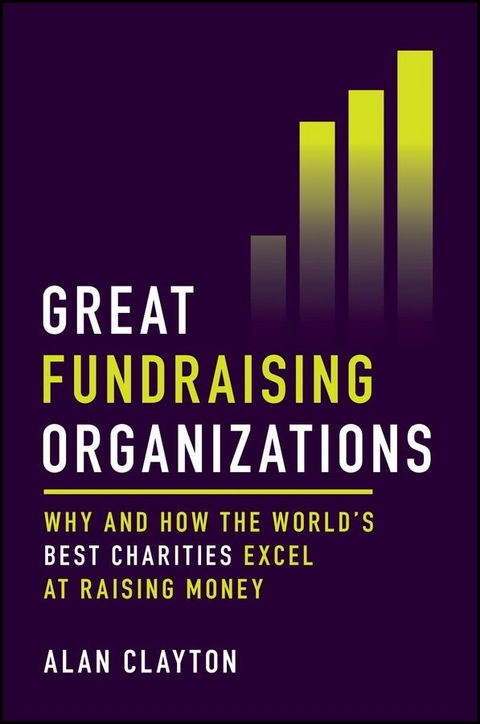
Great Fundraising Organizations (eBook)
317 Seiten
Wiley (Verlag)
978-1-394-27826-8 (ISBN)
Unlock new growth opportunities by transforming your organization's approach to fundraising
In Great Fundraising Organizations, renowned nonprofit consultant Alan Clayton delivers a proven blueprint for charities and non-profits worldwide to scale their fundraising efforts and their effectiveness. Based on data gathered over twenty years of work with more than 500 organizations including Unicef and WWF, this book explains exactly what works and why, revealing to readers the rigorously researched mindsets, strategies, and practices in use by Great Fundraising Organizations (GFOs)-rare organizations that have the ability to unlock the fundraising revenue they need to meet or exceed performance and mission goals.
Accessible, confident, and infused with Clayton's signature style of observational humor, this book delivers everything readers need to fundraise more effectively with certainty, clarity, and confidence. Some of the ideas explored by Clayton include:
- Evidence to explain why some non-profits dramatically grow their revenues whilst others don't.
- What makes leadership for a Great Fundraising Organization different.
- That a precise set of internal behaviours are more important in driving growth than external factors.
- Why some fundraising communications drive growth and why some don't.
Great Fundraising Organizations earns a well-deserved spot on the bookshelves of nonprofit CEOs, directors of fundraising, board chairs and members, and all fundraising professionals seeking to apply tried-and-tested methods for fundraising success and growth to their organizations.
ALAN CLAYTON is the founder and CEO of Revolutionise International, a fourteen-year-old consultancy that works with name-brand NGOs worldwide to 'accelerate people with purpose.' His firm has helped more than 500 organizations, including UNICEF, WWF, Oxfam, and many smaller and medium sized nonprofits solve their problems through a signature blend of research, teaching, and execution.
Unlock new growth opportunities by transforming your organization's approach to fundraising In Great Fundraising Organizations, renowned nonprofit consultant Alan Clayton delivers a proven blueprint for charities and non-profits worldwide to scale their fundraising efforts and their effectiveness. Based on data gathered over twenty years of work with more than 500 organizations including Unicef and WWF, this book explains exactly what works and why, revealing to readers the rigorously researched mindsets, strategies, and practices in use by Great Fundraising Organizations (GFOs) rare organizations that have the ability to unlock the fundraising revenue they need to meet or exceed performance and mission goals. Accessible, confident, and infused with Clayton's signature style of observational humor, this book delivers everything readers need to fundraise more effectively with certainty, clarity, and confidence. Some of the ideas explored by Clayton include: Evidence to explain why some non-profits dramatically grow their revenues whilst others don't. What makes leadership for a Great Fundraising Organization different. That a precise set of internal behaviours are more important in driving growth than external factors. Why some fundraising communications drive growth and why some don't. Great Fundraising Organizations earns a well-deserved spot on the bookshelves of nonprofit CEOs, directors of fundraising, board chairs and members, and all fundraising professionals seeking to apply tried-and-tested methods for fundraising success and growth to their organizations.
Introduction
“How Can It Be So Hard to Save a Child?”
This book is about growth.
The charities mentioned in these pages are part of a set that has raised billions. They have done so by implementing big-picture insights based on our research of the Great Fundraising Organizations to create transformational growth across the long term. These numbers are no exaggeration. The data exists and is in the public domain. More importantly, each organization has used its share of the billions to advance its mission and increase its services.
It is my earnest hope that by the end of this book, you will be on the path to raising billions too. Or millions, or thousands – whatever growth your organization’s purpose demands of your fundraising.
But this story starts in another place entirely – it begins with a person I failed. Years ago, I knew a man who was an excellent aid worker in the Global South. He’d given up a very prestigious job in the United Kingdom to deliver aid at the front lines in some of the most devastated parts of the world. His work was phenomenal. But there came a point where he wanted a more settled life while still working and helping children, and so he decided fundraising might be the career for him.
At the time, I was the manager of a small but very effective fundraising team. We were looking to expand, and we got an application from this man. I was thrilled. This person was a pure-born fundraiser. He was a storyteller extraordinaire: he could meet people and tell them exactly what problem the nonprofit was addressing and what their donations could achieve. Plus, he was lovely to spend time with; he was one of the most present and caring but determined individuals you could come across. Soft-spoken but steely.
When he joined our organization, his work was great. Donors loved to spend time with him, and he generated significant gifts because his relationships with the donors were so powerful. But over time, I watched his morale drop.
As his line manager, I did what I could to support him. But each week, when we began our routine meeting, I could tell his faith and enthusiasm in fundraising was fading. He was finding it difficult to survive on the salary he was on. He couldn’t get what he needed from the other departments in the organization to tell the donors the right stories to make them feel connected to the nonprofit. He was consistently being told off for his personal approach to fundraising and for how he communicated the organization’s stories. He was being criticized by his peers despite his achievements. He was spending more time dealing with the internal politics of the organization than raising money.
Even now, after 25 years, it is gutting for me to tell this story. It was my responsibility as a fundraising leader to help him, and I was entirely unable to do so. I took him out to coffee one day to try to talk some faith into him, and he was depressed. I remember him sitting across from me, shoulders slumped, drinking his coffee slowly. He said, “Alan, all I want to do is a good thing. How can it be so hard to save a child?”
I was young and inexperienced in leadership at the time; I didn’t have answers. Two weeks later, he left fundraising and moved back into aid work, where he’s had a brilliant career. But here’s the thing: he should have been the greatest fundraiser the world had ever seen. He had all the makings of one. Except I failed him. I didn’t know how to give him what he needed to change the world.
It was the first time I had been directly in charge of someone with immense talent, and it was horrifying to me that he quit. He was lost and confused, struggling in a broken system, desperate to raise more money to do good and unable to do so, and I couldn’t give him any answers.
But it became the catalyst I needed to go look for them.
Learning from the Best
For the next 25 years, I went on a quest to understand why it can be so hard to save a child and what we as fundraising leaders can do about it. Following my failure, I left the organization and decided to learn from the best. So I reached out to whom I considered to be the very best, Ken Burnett.
I was fortunate enough to be mentored by Ken for a decade, which probably makes me one of the luckiest fundraisers alive. He helped me grow from an angry young man to a somewhat immature but more stable middle-aged man. More importantly, he taught me that fundraising at its heart was about donors and not the organization. As he wrote in his 2002 book Relationship Fundraising, fundraising was where everyone could win, which meant it wasn’t a necessary evil but a good thing in its own right. These were revolutionary insights that changed the way I approached my profession.
During that decade, I established my own agency. We had clients that were spectacularly successful, and we had some that struggled. Both successes and failures were important because I learned by comparing the two and finding patterns. I discovered that the differentiating factor between my clients that succeeded and those that struggled was the internal culture of the organization and their relationship with my agency. Clients that didn’t do so well were often mired in internal conflict and kept us at a distance as a vendor. The ones that succeeded had a different approach. We were very much a part of their team, rather than just a supplier of communications and data.
This observation was confirmed by the very first bit of research I did. At the end of the decade, I was moving out of the agency and wasn’t sure what to do next. So I sat down with each of our clients that we had worked with for a significant period of time and interviewed them about what they considered to be the critical success factors in their relationship with our agency. None of them said it was the creative communications or the analyses or the strategy work. Instead, they said it was mood, energy, focus, and chemistry: the symbiosis of our agency team and their people that created an effect on their internal culture, confidence, and the pace they could work at.
It was an incredible insight. I realized that people were not necessarily looking for another supplier of high-quality communications and data. They were looking for someone who could help them build the capacity, energy, and focus of their fundraising teams. I decided to not set up another agency and instead began to research acceleration. Since then, I have spent the last decade building Revolutionise International so we can accelerate people with purpose.
There are not a lot of books in the fundraising sector about acceleration, but there are plenty in the private sector. The more I learned, the more I could distinguish both parallels and differences between the private sector versus the nonprofit sector. We began to apply some of these insights to organizations with immediate effect and saw quite a few successes. More importantly, at this stage, we uncovered the primacy of emotion, both as a driver of growth and a blocker of it. I was still working with Ken Burnett at the time, and we ran a highly successful seminar series called “Emotional Fundraising.”
I didn’t know it then, but I was circling closer and closer to a unified approach and methodology. I couldn’t see it as yet – the answers were fragmented, disjointed, the thesis unformed. That would change once I met Professor Adrian Sargeant.
Research on the Great Fundraising Organizations
Professor Sargeant was the foremost academic on fundraising in both the United Kingdom and the United States. He had been a professor of fundraising since 2001, and I’ve long regarded him as the go-to academic on the subject. We had never managed to have an in-depth chat until now, but I had extraordinary respect for his work.
I met Adrian for a single gin and tonic – one of the last drinks I would have, actually. We talked about his research for a bit, and then he asked what we were up to.
“Well,” I said, “I think we’ve identified that the biggest driver of fundraising growth is behavioral.”
Adrian put his glass down on the table and looked at me through the top half of his eyes. “Really?” he said.
“Well, we have no official research,” I said, “so I cannot say we’ve identified it. But let’s put it this way: it is more than a hunch.”
“Any interest in getting that research?”
We had looked for existing data, of course, but there were no studies on the behaviors of the Great Fundraising Organizations. If we wanted scientific research and data, we would need to go out and conduct the studies ourselves.
Turns out Adrian was very keen to research the behaviors of the Great Fundraising Organizations compared to organizations that struggled or flatlined. The problem, he told me wryly, was getting funding for that kind of research.
So I went home and thought about it on my commute. By the end of that train ride, I had decided to fund the research. I had to pay the first installment of it personally because I didn’t have a company vehicle at the time, but I knew it was important. This could change how we understood fundraising. It could be the catalyst that finally answered the question I had been asking these many years: How can it be so hard to save a child, and what can we do about it?
This first research study that we commissioned from Professor Sargeant, his partner...
| Erscheint lt. Verlag | 23.1.2025 |
|---|---|
| Sprache | englisch |
| Themenwelt | Wirtschaft ► Betriebswirtschaft / Management |
| Schlagworte | charity fundraising • charity investment • charity programs • donor fundraising • nonprofit culture • nonprofit fundraising • nonprofit investment • nonprofit performance • nonprofit programs • nonprofit revenue • Nonprofit strategy |
| ISBN-10 | 1-394-27826-8 / 1394278268 |
| ISBN-13 | 978-1-394-27826-8 / 9781394278268 |
| Informationen gemäß Produktsicherheitsverordnung (GPSR) | |
| Haben Sie eine Frage zum Produkt? |
 EPUB (Adobe DRM)
Kopierschutz: Adobe-DRM
Adobe-DRM ist ein Kopierschutz, der das eBook vor Mißbrauch schützen soll. Dabei wird das eBook bereits beim Download auf Ihre persönliche Adobe-ID autorisiert. Lesen können Sie das eBook dann nur auf den Geräten, welche ebenfalls auf Ihre Adobe-ID registriert sind.
Details zum Adobe-DRM
Dateiformat: EPUB (Electronic Publication)
EPUB ist ein offener Standard für eBooks und eignet sich besonders zur Darstellung von Belletristik und Sachbüchern. Der Fließtext wird dynamisch an die Display- und Schriftgröße angepasst. Auch für mobile Lesegeräte ist EPUB daher gut geeignet.
Systemvoraussetzungen:
PC/Mac: Mit einem PC oder Mac können Sie dieses eBook lesen. Sie benötigen eine
eReader: Dieses eBook kann mit (fast) allen eBook-Readern gelesen werden. Mit dem amazon-Kindle ist es aber nicht kompatibel.
Smartphone/Tablet: Egal ob Apple oder Android, dieses eBook können Sie lesen. Sie benötigen eine
Geräteliste und zusätzliche Hinweise
Buying eBooks from abroad
For tax law reasons we can sell eBooks just within Germany and Switzerland. Regrettably we cannot fulfill eBook-orders from other countries.
aus dem Bereich