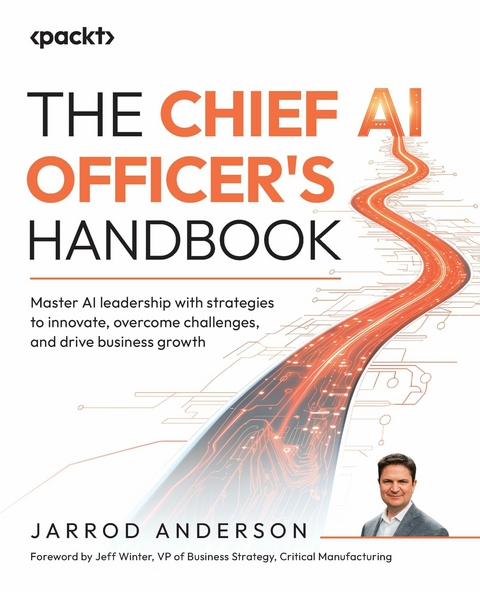
The Chief AI Officer's Handbook (eBook)
352 Seiten
Packt Publishing (Verlag)
978-1-83620-084-0 (ISBN)
Chief Artificial Intelligence Officers (CAIOs) are now imperative for businesses, enabling organizations to achieve strategic goals and unlock transformative opportunities through the power of AI. By building intelligent systems, training models to drive impactful decisions, and creating innovative applications, they empower organizations to thrive in an AI-driven world. Written by Jarrod Anderson, Chief AI Officer at SYRV.AI, this book bridges the gap between visionary leadership and practical execution.
This handbook reimagines AI leadership for today's fast-paced environment, leveraging predictive, deterministic, generative, and agentic AI to address complex challenges and foster innovation. It provides CAIOs with the strategies to develop transformative AI initiatives, build and lead elite teams, and adopt AI responsibly while maintaining compliance. From shaping impactful solutions to achieving measurable business outcomes, this guide offers a roadmap for making AI your organization's competitive edge.
By the end of this book, you'll have the knowledge and tools to excel as a Chief AI Officer, driving innovation, strategic growth, and lasting success for your organization.
Empower your leadership with this detailed guide for CAIOs and business leaders to drive innovation, address complex challenges, and implement ethical AI strategiesKey FeaturesExplore practical frameworks for effective AI team building and team managementImplement and Optimize AI Agents and Agentic Systems through design and implementation of AI agents.Gain actionable advice for leveraging AI to drive innovation and strategic growthPurchase of the print or Kindle book includes a free PDF eBookBook DescriptionChief Artificial Intelligence Officers (CAIOs) are now imperative for businesses, enabling organizations to achieve strategic goals and unlock transformative opportunities through the power of AI. By building intelligent systems, training models to drive impactful decisions, and creating innovative applications, they empower organizations to thrive in an AI-driven world. Written by Jarrod Anderson, Chief AI Officer at SYRV.AI, this book bridges the gap between visionary leadership and practical execution. This handbook reimagines AI leadership for today s fast-paced environment, leveraging predictive, deterministic, generative, and agentic AI to address complex challenges and foster innovation. It provides CAIOs with the strategies to develop transformative AI initiatives, build and lead elite teams, and adopt AI responsibly while maintaining compliance. From shaping impactful solutions to achieving measurable business outcomes, this guide offers a roadmap for making AI your organization s competitive edge. By the end of this book, you ll have the knowledge and tools to excel as a Chief AI Officer, driving innovation, strategic growth, and lasting success for your organization.What you will learnDevelop and execute AI strategy as a CAIO, ensuring ethical complianceMaster agile AI project management from ideation to deploymentApply deterministic and probabilistic AI concepts through case studiesDesign and implement AI agents for autonomous system optimizationCreate human-centered AI systems using proven design principlesEnhance AI security through data privacy and model protection measuresWho this book is forThis book is for chief AI officers, business leaders, AI and data science professionals, IT managers, entrepreneurs, consultants, academic leaders, policymakers, and general business professionals. This diverse audience seeks to understand not only the technical intricacies of AI, but also how to leverage AI to solve real-world business problems, drive innovation, and achieve strategic goals.]]>
Table of Contents
Preface
Free Benefits with Your Book
Part 1: The Role and Responsibilities of the Chief AI Officer
1
Why Every Company Needs a Chief AI Officer
The strategic necessity for a CAIO
Bridging the gap – from vision to execution
Driving innovation
Cohesive and impactful AI efforts
Ensuring compliance and ethical AI use
The changing landscape of data and AI
The competitive advantage
Building a data-driven culture
Navigating the AI ecosystem
The evolving role of the CAIO
Embracing the CAIO era
The strategic importance of AI leadership
Integrating AI into business strategy
Navigating AI implementation challenges
Driving cross-functional collaboration
Ensuring continuous improvement and adaptability
Enhancing decision-making with AI
The transformative power of AI leadership
AI leadership and the future of business
Alignment of AI initiatives with business goals
Strategic vision and AI integration
Establishing clear objectives and metrics
Cross-functional collaboration and alignment
Continuous evaluation and adjustment
Leveraging data and insights
Building a culture of alignment
The role of leadership in alignment
The strategic impact of alignment
Reflection and practical next steps
Key questions for reflection
Practical next steps
Summary
Questions
Get This Book's PDF Version and Exclusive Extras
References
2
Key Responsibilities of a Chief AI Officer
The problem – pain points and challenges
The complexity of AI technologies
Rapid technological advancements
Ethical and regulatory concerns
Cultural and organizational resistance
Resource allocation and skill gaps
The need for a clear AI vision
The solution – step-by-step implementation
Step 1 – Developing a clear AI vision and strategy
Step 2 – Navigating technological complexity
Step 3 – Addressing ethical and regulatory challenges
Step 4 – Cultivating a culture of AI adoption
Step 5 – Strategic resource allocation and skill development
Step 6 – Establishing robust infrastructure and processes
Case study – transforming operations at APEX Manufacturing and Distribution
Initial situation
Steps taken
Results achieved
Reflection and practical next steps
Reflecting on core insights
Critical assessment
Practical next steps
Moving forward
Summary
Questions
References
Subscribe for a free eBook
3
Crafting a Winning AI Strategy
The problem – pain points and challenges
Misaligned objectives
Lack of clear KPIs
Measuring ROI
Integration with existing processes
Talent gap
Data quality and governance
The significance of the problem
The solution – a step-by-step implementation
Step 1 – developing a clear AI vision and strategy
Step 2 – creating a detailed roadmap
Step 3 – identifying KPIs
Step 4 – measuring ROI
Step 5 – ensuring seamless integration
Step 6 – building and sustaining AI talent
Hypothetical case study – transforming operations at APEX Manufacturing and Distribution
Initial situation
Steps taken
Results achieved
Reflection and practical next steps
Reflect on core insights
Critical assessment
Practical next steps
Moving forward
Summary
Questions
Get This Book's PDF Version and Exclusive Extras
References
4
Building High-Performing AI Teams
The problem – pain points and challenges
Talent scarcity
Structuring the AI team
Fostering a culture of innovation
Integration with existing business processes
Measuring success
The significance of the problem
Solution and process for building exceptional AI teams
Identifying the right talent – curiosity, creativity, and imagination
Providing the right environment – impact and control
Step-by-step implementation for building a high-performing AI team
Step 1 – recruiting top AI talent
Step 2 – structuring your AI team for success
Step 3 – fostering a culture of innovation and collaboration
Step 4 – integrating AI initiatives with business processes
Step 5 – measuring success and iterating
Hypothetical case study – transforming APEX’s manufacturing and distribution with AI
Steps taken
Results achieved
Reflection and practical next steps
Summary
Questions
References
Subscribe for a free eBook
Part 2: Building and Implementing AI Systems
5
Data – the Lifeblood of AI
The problem – pain points and challenges
Data collection – the first hurdle
Data management – an ongoing battle
Ensuring data quality – the devil is in the details
Maintaining data integrity – the trust factor
Leveraging big data – turning volume into value
The solution and process – implementation
Data collection and management
Ensuring data quality
Maintaining data integrity
Leveraging big data and data analytics
Case study – APEX Manufacturing and Distribution
Data collection and management
Ensuring data quality and integrity
Leveraging big data and advanced analytics
Results achieved
Memorable insights
Reflection and practical next steps
Reflecting on core insights
Critical assessment questions
Actionable next steps
Summary
Questions
References
Get This Book's PDF Version and Exclusive Extras
6
AI Project Management
The problem – pain points and challenges
Scope creep – the silent project killer
Resource allocation – balancing expertise and time
Technology integration – the jigsaw puzzle of systems
Data quality and availability – the fuel for AI
Change management – navigating organizational resistance
Analytical insight with a relatable touch
The solution and its implementation
Managing AI projects from concept to deployment
Agile methodologies for AI
Overcoming common AI project challenges
A checklist for identifying and mitigating challenges
Hypothetical case study – APEX Manufacturing and Distribution
Initial situation
Step-by-step implementation
Results achieved
Relatable anecdotes and motivational insights
Reflection and practical next steps
Summary
Questions
References
Subscribe for a free eBook
7
Understanding Deterministic, Probabilistic, and Generative AI
The problem – pain points and challenges
Navigating the deterministic AI landscape
The complexity of probabilistic AI
Unleashing the potential of generative AI
Integrating AI into existing business processes
Personal anecdote – the AI learning curve
Overcoming challenges
The solution and implementation
Deterministic AI
Probabilistic AI
Generative AI
Hypothetical case study – APEX Manufacturing...
| Erscheint lt. Verlag | 28.1.2025 |
|---|---|
| Vorwort | Jeff Winter |
| Sprache | englisch |
| Themenwelt | Informatik ► Theorie / Studium ► Künstliche Intelligenz / Robotik |
| Wirtschaft ► Betriebswirtschaft / Management ► Unternehmensführung / Management | |
| ISBN-10 | 1-83620-084-6 / 1836200846 |
| ISBN-13 | 978-1-83620-084-0 / 9781836200840 |
| Informationen gemäß Produktsicherheitsverordnung (GPSR) | |
| Haben Sie eine Frage zum Produkt? |
 EPUB (Ohne DRM)
Digital Rights Management: ohne DRM
Dieses eBook enthält kein DRM oder Kopierschutz. Eine Weitergabe an Dritte ist jedoch rechtlich nicht zulässig, weil Sie beim Kauf nur die Rechte an der persönlichen Nutzung erwerben.
Dateiformat: EPUB (Electronic Publication)
EPUB ist ein offener Standard für eBooks und eignet sich besonders zur Darstellung von Belletristik und Sachbüchern. Der Fließtext wird dynamisch an die Display- und Schriftgröße angepasst. Auch für mobile Lesegeräte ist EPUB daher gut geeignet.
Systemvoraussetzungen:
PC/Mac: Mit einem PC oder Mac können Sie dieses eBook lesen. Sie benötigen dafür die kostenlose Software Adobe Digital Editions.
eReader: Dieses eBook kann mit (fast) allen eBook-Readern gelesen werden. Mit dem amazon-Kindle ist es aber nicht kompatibel.
Smartphone/Tablet: Egal ob Apple oder Android, dieses eBook können Sie lesen. Sie benötigen dafür eine kostenlose App.
Geräteliste und zusätzliche Hinweise
Buying eBooks from abroad
For tax law reasons we can sell eBooks just within Germany and Switzerland. Regrettably we cannot fulfill eBook-orders from other countries.
aus dem Bereich