


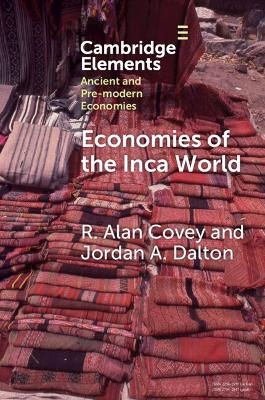
Economies of the Inca World
Seiten
2025
Cambridge University Press (Verlag)
978-1-009-55209-7 (ISBN)
Cambridge University Press (Verlag)
978-1-009-55209-7 (ISBN)
This Element explores the Inca Empire, focusing on local economic self-sufficiency and reciprocity. It reviews archaeological research in the Inca capital region and provinces, shows variation in political economy development and practices tailored to Andean environments. Evidence suggests specialized trading practices in Inca peripheral regions.
The Inca Empire (c. 1400–1532) was the largest Indigenous state to develop in the Americas, spanning the extraordinarily rich landscapes of the central Andes. Scholarly approaches to Inca-era economies initially drew on Spanish colonial documents that emphasized royal resource monopolies, labor tribute, and kin-based land tenure. Anthropologists in recent decades have emphasized local economic self-sufficiency and the role of reciprocity in Inca economics. This Element adds to the existing literature by reviewing recent archaeological research in the Inca capital region and different provinces. The material evidence and documents indicate considerable variation in the development and implementation of Inca political economy, reflecting an array of local economic practices that were tailored to different Andean environments. Although Inca economic development downplayed interregional trade, emerging evidence indicates the existence of more specialized trading practices in Inca peripheral regions, some of which persisted under imperial rule.
The Inca Empire (c. 1400–1532) was the largest Indigenous state to develop in the Americas, spanning the extraordinarily rich landscapes of the central Andes. Scholarly approaches to Inca-era economies initially drew on Spanish colonial documents that emphasized royal resource monopolies, labor tribute, and kin-based land tenure. Anthropologists in recent decades have emphasized local economic self-sufficiency and the role of reciprocity in Inca economics. This Element adds to the existing literature by reviewing recent archaeological research in the Inca capital region and different provinces. The material evidence and documents indicate considerable variation in the development and implementation of Inca political economy, reflecting an array of local economic practices that were tailored to different Andean environments. Although Inca economic development downplayed interregional trade, emerging evidence indicates the existence of more specialized trading practices in Inca peripheral regions, some of which persisted under imperial rule.
1. The Inca empire and Andean economics; 2. Inca political economy in historical context; 3. The 'Noble Economy' of Cuzco; 4. Inca political economy in the highland provinces; 5. Specialization and trade on the pacific coast; 6. Imperial economics in marginal and frontier zones; 7. Conclusion; Glossary; References.
| Erscheinungsdatum | 22.01.2025 |
|---|---|
| Reihe/Serie | Elements in Ancient and Pre-modern Economies |
| Zusatzinfo | Worked examples or Exercises |
| Verlagsort | Cambridge |
| Sprache | englisch |
| Maße | 152 x 229 mm |
| Gewicht | 177 g |
| Themenwelt | Geisteswissenschaften ► Archäologie |
| Wirtschaft ► Volkswirtschaftslehre ► Wirtschaftspolitik | |
| ISBN-10 | 1-009-55209-0 / 1009552090 |
| ISBN-13 | 978-1-009-55209-7 / 9781009552097 |
| Zustand | Neuware |
| Informationen gemäß Produktsicherheitsverordnung (GPSR) | |
| Haben Sie eine Frage zum Produkt? |
Mehr entdecken
aus dem Bereich

aus dem Bereich
Wohlstand, Wachstum, Wettbewerb
Buch | Softcover (2025)
Kohlhammer (Verlag)
CHF 68,90
mit Marx, Menger und Marshall durch die Grundlagen der Ökonomie
Buch | Hardcover (2025)
De Gruyter Oldenbourg (Verlag)
CHF 62,90
Buch | Softcover (2025)
Europa-Lehrmittel (Verlag)
CHF 44,90


