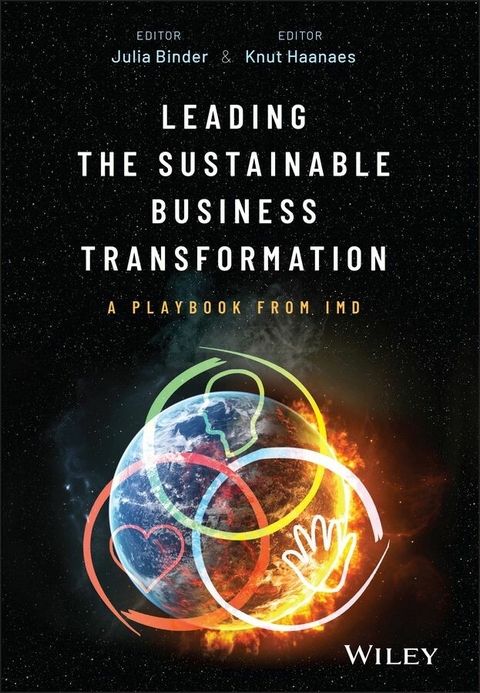
Leading the Sustainable Business Transformation (eBook)
391 Seiten
Wiley (Verlag)
978-1-394-31409-6 (ISBN)
Complete playbook to plan, execute, and showcase corporate sustainability initiatives
Based on extensive research conducted in the past several years at the International Institute for Management Development in Switzerland (IMD), Leading the Sustainable Business Transformation: A Playbook from IMD helps readers understand why sustainability matters, what it involves, how it fits with corporate strategy and how to implement it according to the specifics of their companies. This playbook emphasises both strategic and organisational work, delivering a framework to generate solid financial returns without depleting the world's natural and social wealth.
With detailed case studies and quotations from executives to provide context, this book explores topics including:
- How social and environmental sustainability initiatives sharply differ from the much-criticised Environmental, Social, and Governance (ESG) framework
- Barriers to change based on gaps in organisational capacity and how to overcome them
- Minimising risks, accelerating change and fostering innovation through AI powered by Big Data
- Managing performance and measuring impact through new KPIs that utilise relevant metrics
- Marketing strategies to showcase sustainability efforts in a way that resonates with consumers
Filled with actionable strategies to navigate the intersection of global impact and financial success with precision and purpose, Leading the Sustainable Business Transformation is an essential read for executives and business leaders seeking to transform their organisations for the better.
Julia Binder is IMD Professor of Sustainable Innovation and Business Transformation. She is also a director at IMD's Center for Sustainable and Inclusive Business. Her work has been published in the Journal of Business Venturing and the Academy of Management Review.
Knut Haanaes is IMD Professor of Strategy and the Lundin Chair Professor of Sustainability. He is involved with IMD's partnership with the World Business Council for Sustainable Development. His work has been published in the Harvard Business Review.
Complete playbook to plan, execute, and showcase corporate sustainability initiatives Based on extensive research conducted in the past several years at the International Institute for Management Development in Switzerland (IMD), Leading the Sustainable Business Transformation: A Playbook from IMD helps readers understand why sustainability matters, what it involves, how it fits with corporate strategy and how to implement it according to the specifics of their companies. This playbook emphasises both strategic and organisational work, delivering a framework to generate solid financial returns without depleting the world s natural and social wealth. With detailed case studies and quotations from executives to provide context, this book explores topics including: How social and environmental sustainability initiatives sharply differ from the much-criticised Environmental, Social, and Governance (ESG) framework Barriers to change based on gaps in organisational capacity and how to overcome them Minimising risks, accelerating change and fostering innovation through AI powered by Big Data Managing performance and measuring impact through new KPIs that utilise relevant metrics Marketing strategies to showcase sustainability efforts in a way that resonates with consumers Filled with actionable strategies to navigate the intersection of global impact and financial success with precision and purpose, Leading the Sustainable Business Transformation is an essential read for executives and business leaders seeking to transform their organisations for the better.
PART I
Framing the Conversation
Julia Binder and Knut Haanaes
In late 2020, as the world began to emerge from the worst of the COVID-19 pandemic, Wärtsilä, a Finnish corporation specializing in power systems, made a bold decision. Despite being a well-established company with a strong track record in manufacturing and servicing on-land and marine power systems, the company faced a significant challenge. Since peaking in 2017, both its operating margin and stock price had fallen by half, largely due to its reliance on fossil-fuel technologies at a time when the world was shifting toward carbon neutrality. Sales were likely to stagnate or even decline as global warming pushed industries to move away from carbon-intensive sources.
In response, the board made a strategic move by hiring a new CEO, Håkan Agnevall, from outside the company. Agnevall had successfully led Volvo’s bus division through a sustainability transformation, making it a world leader in electric-powered transportation. He proposed a similar approach at Wärtsilä, aiming to turn the threat of decarbonization into an opportunity.
Agnevall knew that the transformation would be a long-term endeavor. Customers in Wärtsilä’s sectors, on-land generation and marine propulsion, were conservative and cautious – after all, their investments were meant to last for decades. And with ocean-going freighters still lacking a reliable carbon-neutral fuel, the path forward was uncertain. But rather than waiting for technology and customer preferences to catch up, Wärtsilä took proactive steps.
The company developed decarbonization as a service, aligning with its existing strategic shift towards services, already nearly half of its business. Furthermore, despite the financial constraints imposed by the pandemic, Wärtsilä invested €250 million in establishing the Sustainable Technology Hub, a research institute dedicated to advancing sustainability through collaboration with industry partners.
In November 2021, just ten months after taking the helm, Agnevall unveiled Wärtsilä’s new strategy, positioning sustainability as the company’s primary purpose. The strategy set out clear values, principles, and actionable targets, with the aim of making Wärtsilä a global leader in decarbonizing the marine and energy markets. While the company’s stock price remained volatile and its operating margins were slow to recover, Agnevall and his team were convinced they were on the right path for the long term.
A TWOFOLD APPROACH: STRATEGY AND LEADERSHIP
The journey toward sustainability is neither simple nor straightforward. It requires a twofold approach that balances strategic vision with effective leadership – a combination of the head, which represents the logic and rationale of transformation, and the heart and hands, which embody the leadership and action needed to implement change. In many ways, this balance is the core theme of this book. To achieve true sustainability, organizations must integrate strategy with leadership, ensuring that plans are not just formulated but executed with conviction and agility.
Sustainability, at its essence, is about creating business models that are resilient, adaptable, and capable of enduring over the long haul. It’s not merely about compliance or risk management – it’s about fundamentally rethinking how businesses operate in a world facing profound environmental, social, and economic challenges. This shift from viewing sustainability as a risk to embracing it as an opportunity is crucial. Companies like Wärtsilä are showing that sustainability can drive innovation, open up new markets, and create long-term value.
The urgency of this shift cannot be overstated. The signals for change are all around us; climate change, resource scarcity, and social inequalities are reshaping the global landscape. Businesses can no longer afford to ignore these trends. They must act now not just to protect their bottom lines but to ensure their future viability. This is why sustainability is a global imperative, transcending borders and industries. No company, regardless of its size or location, can afford to stand still.
THE INFINITY LOOP: THE DYNAMIC INTERACTION OF STRATEGY AND LEADERSHIP
Sustainability isn’t a one-time project where you develop a strategy, implement it, and move on. It’s an ongoing process that requires a continuous interaction between strategic planning and leadership – a dynamic relationship that can be visualized as an infinity loop. This loop represents the constant flow between strategy and leadership, where each element reinforces and enhances the other.
On one side of the loop is strategy. Have you ever wondered how to craft a sustainability strategy that truly aligns with your company’s long-term vision? It’s more than just setting goals; it’s about envisioning a future where your business not only survives but thrives in a rapidly changing world. This requires breaking away from the limitations of the present and imagining new possibilities. Tools like future-back thinking and scenario planning aren’t just theoretical exercises; they’re essential for building a strategy that’s resilient and forward-looking.
Consider how this strategic approach could come to life in your organization. For example, companies like Siemens have embedded sustainability into their core strategy, not simply to mitigate risks but to lead in the global transition toward a sustainable economy. By investing in energy-efficient technologies and smart infrastructure, Siemens is positioning itself at the forefront of the energy revolution, shaping the future rather than just reacting to it.
But even the best strategy can falter without effective leadership. This is where the other side of the infinity loop comes into play. Leadership isn’t just about implementing a strategy – it’s about inspiring and mobilizing your organization to make that strategy a reality. Have you ever seen a great plan fall short because it didn’t get the buy-in it needed? Leadership is the key to ensuring that your strategy isn’t just a document but a driving force that energizes your entire organization.
Effective leadership involves creating a culture where sustainability is more than a buzzword – it becomes a shared value that influences every decision and action. Imagine an organization where every employee, from the boardroom to the front lines, understands their role in achieving sustainability goals. This level of engagement doesn’t happen by accident; it’s the result of leaders who are committed to fostering a sense of ownership and accountability at every level.
The infinity loop illustrates that sustainability is not a static goal but a dynamic journey. As you implement your strategy, you’ll encounter new challenges and opportunities that require you to adapt and refine your approach. Are you prepared to pivot when necessary? This is where agile leadership becomes crucial, enabling you to make quick strategic adjustments while keeping your long-term objectives in focus.
The continuous interaction between strategy and leadership creates a powerful feedback loop. As your organization moves forward, you’ll gather insights and data that allow you to assess what’s working and what isn’t. This feedback helps you tweak your strategy, ensuring it remains effective in a constantly evolving environment. Leadership, in turn, adapts to these changes, guiding the organization through the complexities of sustainability with clarity and purpose.
So, as you think about sustainability in your organization, consider how well your strategy and leadership are working together. Are they in sync, each reinforcing the other? By embracing this infinity loop of strategy and leadership, you create a dynamic process that drives real, lasting change, making sustainability not just a goal but the very essence of your business.
The Wärtsilä example, as presented earlier, illustrates an important reality: the transformation toward sustainability is not a linear process with clear-cut phases. Instead, it’s an ongoing, iterative journey – an infinity loop where strategy and leadership continuously reinforce one another. Focusing on strategy can lead to missed opportunities for engagement, while concentrating on leadership may lack the strategic foundation needed for lasting change.
This infinity loop reflects the dynamic nature of sustainability, where adjustments in strategy prompt shifts in leadership and vice versa. It’s not just about setting goals; it’s about creating an environment where strategy and leadership are in constant dialogue, driving continuous improvement.
To succeed in this journey, leaders must develop a strategy that is not only aligned with the company’s purpose but also adaptable to changing circumstances. This strategy must be communicated effectively, supported by robust reporting and a commitment to long-term goals. However, strategy alone isn’t enough. Leaders must also ensure that sustainability is embedded in the company’s culture, making it a shared responsibility across all levels.
Moreover, leaders need to engage with external stakeholders – regulators, NGOs, and the broader community – integrating their insights and needs into the strategy. This holistic approach ensures...
| Erscheint lt. Verlag | 16.12.2024 |
|---|---|
| Sprache | englisch |
| Themenwelt | Wirtschaft ► Betriebswirtschaft / Management ► Unternehmensführung / Management |
| Schlagworte | Corporate Sustainability • Environmental sustainability • Organisational Change • Social Sustainability • sustainability ai • sustainability business • sustainability finances • sustainability leadership • Sustainability Marketing |
| ISBN-10 | 1-394-31409-4 / 1394314094 |
| ISBN-13 | 978-1-394-31409-6 / 9781394314096 |
| Informationen gemäß Produktsicherheitsverordnung (GPSR) | |
| Haben Sie eine Frage zum Produkt? |
 EPUB (Adobe DRM)
Kopierschutz: Adobe-DRM
Adobe-DRM ist ein Kopierschutz, der das eBook vor Mißbrauch schützen soll. Dabei wird das eBook bereits beim Download auf Ihre persönliche Adobe-ID autorisiert. Lesen können Sie das eBook dann nur auf den Geräten, welche ebenfalls auf Ihre Adobe-ID registriert sind.
Details zum Adobe-DRM
Dateiformat: EPUB (Electronic Publication)
EPUB ist ein offener Standard für eBooks und eignet sich besonders zur Darstellung von Belletristik und Sachbüchern. Der Fließtext wird dynamisch an die Display- und Schriftgröße angepasst. Auch für mobile Lesegeräte ist EPUB daher gut geeignet.
Systemvoraussetzungen:
PC/Mac: Mit einem PC oder Mac können Sie dieses eBook lesen. Sie benötigen eine
eReader: Dieses eBook kann mit (fast) allen eBook-Readern gelesen werden. Mit dem amazon-Kindle ist es aber nicht kompatibel.
Smartphone/Tablet: Egal ob Apple oder Android, dieses eBook können Sie lesen. Sie benötigen eine
Geräteliste und zusätzliche Hinweise
Buying eBooks from abroad
For tax law reasons we can sell eBooks just within Germany and Switzerland. Regrettably we cannot fulfill eBook-orders from other countries.
aus dem Bereich